Site Map | Search Warsailors.com | Merchant Fleet Main Page | Warsailors.com Home Merchant Fleet Main Page | Warsailors.com Home |
|
M/S Brand To Brand on the "Ships starting with B" page.
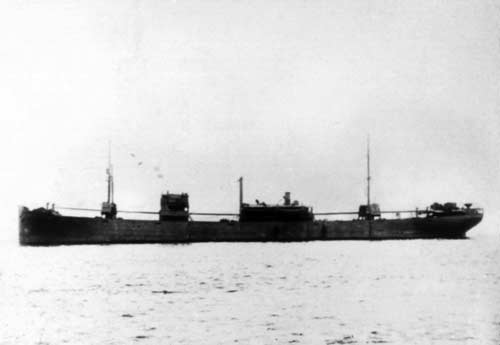
Owner: A/S Borgestad Delivered from Götaverken A/B, Gothenburg, Sweden (402) in May-1927 as Brand to A/S Borgestad, Porsgrunn. 380.5' x 54.7' x 25.7', 2 x 6 cyl. 4 TEV DM (builders), 2120 bhp. Captain: Reidar Helgesen Related item on this website: Her voyages are listed on these original images from the Norwegian National Archives: Please compare the above voyages with Arnold Hague's Voyage Record below.
(Received from Don Kindell - His source: The late Arnold Hague's database). Follow the convoy links provided for more information on each.
When war broke out in Norway on Apr. 9-1940, Brand was on her way from Geelong to Balboa - see Page 1. Her 1941 voyages also start on this document and continue on Page 2. It'll be noticed, that she spent a long time at Table Bay that year. She had arrived there from Mauritius on June 26 and departure is given as Oct. 28, when she proceeded to Trinidad. According to A. Hague, this long stay was due to her requiring major engine repairs. From Trinidad, where she had arrived on Nov. 25, she proceeded to Sydney, C.B. on Dec. 8, arriving Dec. 23, and with a cargo of sugar for Liverpool, she was scheduled for the slow Convoy SC 62 from there on Dec. 27, but did not sail (Montbretia and Rose are named among the escorts for this convoy). She was also cancelled from Convoy SC 63 a week later (Jan. 3-1942), but got away with the next convoy on Jan. 9, SC 64. Her destination is now given as Clyde, and she arrived there on Jan. 23, remaining in that area for quite a long time. At the external website that I've linked to below, she's listed among the ships in Convoy OS 21 in March-1942, on a voyage from Clyde to Capetown and Beira with general cargo in station 103 of the convoy, which left Liverpool on March 4 (several other Norwegian ships are also named - follow the link provided for more details). However, A. Hague has instead included her, with a general cargo for Beira, in station 51 of the westbound North Atlantic Convoy ON 75*, originating in Liverpool on March 10-1942, so she either did not join OS 21 at all, or joined and returned to port. She arrived Capetown independently on Apr. 16, Convoy ON 75 having been dispersed on March 19. Other Norwegian ships were Brasil, Evita, Norfjell and Vanja. Brand now made voyages to Port Elizabeth, East London and Durban, then on to Lourenco Marques, where she arrived May 6. As will be seen when going back to Page 2, she subsequently spent quite a long time there; she did not leave again until July 14, when she proceeded to Trinidad, with arrival Aug. 12. Again, A. Hague says this long stay was due to engine repairs. Convoy information for some of her subsequent voyages can be found in the Voyage Record above. (It'll be noticed that she also had a long stay in New York that year). Skipping now to Nov. 1-1942, when she according to A. Hague joined the slow Convoy SC 108* from New York, in order to sail to the U.K., but she returned to port (Sydney, C.B. - again, see Page 2), later travelling to Boston (via Halifax) for repair of defects. Having remained in Boston from Nov. 20-1942 to Febr. 2-1943, she proceeded to New York, where she joined Convoy SC 120* on Febr. 13. Both these convoys had other Norwegian ships as well, namely Bonneville, Granfoss, Snar, Torfinn Jarl and Vanja in SC 108, while Gausdal, Mathilda, Norhauk, Norsktank, Nyco and Vest are listed in SC 120. Brand had a cargo of sugar and general and sailed in station 85 of the convoy, which arrived Liverpool on March 5. She later joined Convoy ON 175*, which departed Liverpool on March 24 and also included the Norwegian Kaldfonn, Kong Sverre, Norelg, Petter and Washington Express. Brand (in station 41) lost touch with the convoy on March 29, but arrived Halifax safely on Apr. 10 - judging from the information found on the archive document, her original destination had been New York. This was to be her last westbound convoy voyage; she was sunk on her way back to the U.K. the following month.
Related external link:
As mentioned above, Brand had arrived Halifax on Apr. 10-1943. According to Page 2, she left Halifax again on Apr. 30 for Charlottetown, but arrival there is not given; the document shows that she returned to Halifax again. She had been scheduled for the Halifax portion of Convoy HX 236 on Apr. 26-1943, but instead joined the Halifax section of the next convoy on May 3, HX 237, which had originated in New York on May 1. She was on a voyage from Charlottetown via Halifax for Liverpool with a cargo of 1000 tons ammunition, sulphur, 2500 tons flour and 4500 tons of various machines. She had been separated from the convoy in dense fog on May 7, and at 10:35 ship's time (11:35 GMT) on May 12, in 47 19N 24 41W, she was torpedoed on the port side aft by U-603 (Baltz), sinking in a few minutes. 2 crew and 1 gunner drowned. 39 survivors got in the 3 lifeboats that had been successfully launched, 1 from the starboard side, 2 from port (an attempt to launch a 4th boat was unsuccessful due to the heavy list). They searched for possible survivors for 3 hours, but as none were found they set sail for Ireland at 14:00. At 18:45 that same day the Canadian corvette Morden (K-170) picked them up. A Swordfish aircraft had been sighted at 16:00 that afternoon and it was believed responsible for the corvette being directed to the boats. M/T Sandanger also became a straggler from this convoy and was torpedoed and sunk by U-221 the same day. Captain Reidar Helgesen wrote a book about his war experiences, entitled "Dra te' sjøss" (in Norwegian, ISBN 82-992998-1-0). Issues No. 3 and 4 for 1997 of the Norwegian magazine "Krigsseileren" have some excerpts, one of which describes the events surrounding the attack on Brand. He says the convoy had been scattered, and the Commodore had ordered all the ships to meet at a certain position, but when they got to the rendezvous on May 10 the Commodore Vessel and convoy never showed up. After having waited a while along with 4 other stragglers, one ship after another started out alone and Brand followed suit. In the morning of May 12, Boatswain Sørlie spotted the torpedo heading their way and seconds later it hit in No. 3 hold which was full of sacks of flour 50 lbs each. There was no explosion, but it must have caused a large hole in her side as she immediately started listing and sinking. Both lifeboats and a gig were lowered, but 4 men were found to be missing: 1st Mate Sørensen was thought to have been pulled under by the suction of the ship which sank by the stern in about 9 minutes. Steward Olsen had been by the starboard lifeboat but had been seen running back to his cabin. The deckboy(?) had not been seen at all and an English engine boy(?) had probably not been able to get out of the engine room in time (these titles appear to be wrong - ref. crew list below). Captain Helgesen mentions that they had 2 newly educated British radio operators on board in addition to the Norwegian one. They were both in the captain's boat, as was 2nd Engineer Thingstad. They had started to row away when the U-boat came up, but disappeared after having been told the captain had gone down with his ship. Shortly thereafter they spotted some smoke further away, and upon investigating they found a raft with the missing deck boy who had taken full advantage of some of the equipment on the raft to get their attention. Captain Helgesen says they had had 500 tons TNT in No. 1 and No. 5 holds, so the fact that the torpedo had hit in No. 3 hold saved their lives. Not only did the sacks of flour stop it from detonating, but they had also served as "lifebelts" for several of the men who had ended up in the water. Helgesen also mentions 3 large landing craft as being among the cargo. These were floating nearby and he briefly considered transferring to them for warmth and shelter, but quickly thought better of it as there wouldn't have been any way of navigating them, so he settled down to the task of organizing the survivors. Those in the gig were distributed among the lifeboats, before they set sail for Ireland. Captain Helgesen's account of their rescue corresponds with my text in the second paragraph. Morden arrived Londonderry very early in the morning (date not given) and after a couple of days, the shipwrecked men were sent to Liverpool. The maritime hearings were held in Liverpool on May 24-1943 with Captain Helgesen, the 3rd mate (on the bridge at the time of attack), Able Seaman Olsen (at the wheel), Radio Operator Rasmussen and (Engine Room) Assistant Nygaard appearing. According to the 3rd mate, the 1st mate had been on the chartroom roof when the torpedo hit. After the 3 lifeboats had been launched the 2 men jumped overboard together from the starboard side, both with lifevests on, but the 1st mate was not seen again after that. The radio operator had sent out SOS before he too jumped overboard from the starboard side, then held on to some debris until he was picked up by one of the boats. For info, U-603 had also been responsible for the loss of Stigstad, Glittre and Elin K earlier that year - follow the links for details (in fact, these were the only ships sunk by this boat). Crew List:
Related external links: Operations information for U-603 - This website now appears to have been taken down. Will leave the link up for now, in case an archive will be available later (see this page). Back to Brand on the "Ships starting with B" page. Other ships by this name: The company's 1st Brand had been delivered in 1890, built in Port Glasgow, 2003 gt. Sold to Japan in 1914 and renamed Heiwa Maru. Broken up in 1921. Norway had another Brand (steamship) in 1915-1926. This vessel had started out as Labor of 1496 gt when it was built in England in 1901 for Oscar Hytten & C. E. Semb, Tønsberg. Had several different owners in the years to follow, then became Brand in 1915 (Gran Kahrs, Bergen). Sold to Italy 1926, renamed Federazione, 1937-1943 Marco. Bombed and sunk by British aircraft in Oct.-1943, Yugoslavia. The text on this page was compiled with the help of: "Nortraships flåte", J. R. Hegland, issues No. 3 and 4 for 1997 of the Norwegian magazine "Krigsseileren", "Sjøforklaringer fra 2. verdenskrig", Volume I (Norwegian Maritime Museum), and misc. others for cross checking info. - ref My sources.
|
|||||||||||||||||||||||||||||||||||||||||||||||||||||||||||||||||||||||||||||||||||||||||||||||||||||||||||||||||||||||||||||||||||||||||||||||||||||||||||||||||||||||||||||||||||||||||||||||||||||||||||||||||||||||||||||||||||||||||||||||||||||||||||||||||||||||||||||||||||||||||||||||||||||||||||||||||||||||||||||||||||||||||||||||||||||||||||||||||||||||||||||||||||||||||||||||||||||||||||||||||||||||||||||||||||||||||||||||||||||||||||||||||||||||||||||||||||||||||||||||||||||||||||||||||||||||||||||||||||||||||||||||||||||||||||||||||||||||||||||||||||||||||||||