Site Map | Search Warsailors.com | Merchant Fleet Main Page | Warsailors.com Home Merchant Fleet Main Page | Warsailors.com Home |
|
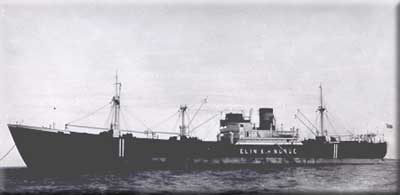
M/S Elin K To Elin K on the "Ships starting with E" page. Owner: A/S Inger Built by Bremer Vulkan, Vegesack, Germany in 1937. Captain: Robert Johannessen Related item on this website: Her voyages are listed on these original images from the Norwegian National Archives Please compare the above voyages with Arnold Hague's Voyage Record below.
(Received from Don Kindell - His source: The late Arnold Hague's database). Follow the convoy links provided for more information on each.
As can be seen when going to Page 1 of the archive documents, Elin K was in Lourenco Marques on Apr. 9-1940, the day the Germans invaded Norway. The same document shows that she was in New York for about 2 months at the beginning of 1941, from Febr. 15 to Apr. 19, possibly for repairs? According to A. Hague, she had grounded in Cape Cod Canal; I have no further details on this. She does not appear to have sailed in convoys very often, but she's listed in Convoy SL 101, which left Freetown on Febr. 21-1942 and arrived Liverpool on March 15. Her cargo is given as raw sugar, and she had station 112 of the convoy. Dagrun, Drammensfjord, Tabor and Tanafjord are also listed. The following month, we find her in Convoy OS 25, going in the other direction. She was again in the company of other Norwegian ships, namely Arthur W. Sewall, Marathon and Sandanger. This convoy left Liverpool on Apr. 12 and arrived Freetown on the 29th. Elin K's destination is given as Cape/Middle East, station 53, carrying stores; she arrived Cape Town on May 9, continuing to Mombasa a few days later. Both these convoys are available via the links provided in the Voyage Record above. Her voyages in this period are shown on Page 2. In Aug.-1942, Arnold Hague has included her, along with Tiradentes, in Convoy OC 18, which left Melbourne on Aug. 15 and arrived Newcastle, N.S.W. on the 18th; Elin K, however, was bound for Auckland, where she arrived on the 24th, having been detached from the convoy Aug. 18. At the end of that year, she's listed in Convoy OC 55, departing Melbourne on Dec. 21, arriving Sydney, N.S.W. on Christmas Eve. From there, she headed to Balboa in Jan-1943, then on to New York - see Page 3.
Elin K was en route from Sydney N.S.W. to Liverpool via Panama when Boatswain Kristian Kristiansen fell overboard and drowned on Febr. 3-1943. He had been working on a platform with Carpenter Johansen when the sea washed him overboard. 2 life buoys were immediately thrown into the water, the engine was stopped and the ship turned around to look for him. Upon reaching the spot where he was believed to have fallen in, the ship was stopped and the workboat launched, manned by the 3rd mate and 4 men, but he was nowhere to be seen. The ship circled around the area for 3 hours to no avail, then continued her voyage. She arrived New York on Febr. 24, leaving again on March 8 in Convoy HX 229 (having been cancelled from Convoy HX 228 on Febr. 28, in which Brant County was sunk). Please follow the link for much more information; crusing orders are also available, as well as an analysis of attacks on several convoys sailing around the same time. Commodore was in Abraham Lincoln. Her cargo consisted of 7000 tons wheat, manganese and 339 bags of mail, and she had station 101. On March 16 she was struck on the starboard side, Hold No. 4 by a torpedo from U-603 (Bertelsmann), 50 38N 34 46W* and immediately started to sink. The entire complement of 40, incl. 6 British gunners(?) went in the lifeboats and were picked up by the escorting British corvette Pennywort shortly afterwards. The ship had gone down in 8-10 minutes. The survivors were landed at Courock on March 22, then sent to Glasgow. In the Norwegian magazine "Krigsseileren", Issue No. 3 for 1974, 2nd Mate Hans-Henrik Smith Hansen's notes on the sinking are included, submitted by his widow (he died in 1969). Before the loss of Elin K he had survived 3 other sinkings; the first one being D/S Cubano, then M/S Teneriffa and Thode Fagelund. After Thode Fagelund had been sunk on Nov. 17-1941 (date given in this story is Dec. 1, but that must be an error) he joined Elin K in Cape Town on Jan. 28-1942. He mentions an incident which he says has never (at the time) been reported or recorded, involving the sighting of a periscope when en route to New York in March-1943 (again, I believe there's some date confusion here, it's more likely that this took place in Febr.-1943 rather than March, being as they arrived New York on Febr. 24 - see also Page 3). He says this "object" was about 2 n. miles off, 45° to the port side. He must have been on duty as he ordered full power to the engine and the 12(?) British gunners to their stations. When they got close they were ordered to fire and the "object" disappeared. Once in New York he says they were run into by a Dutch ship, S/S Suidenkart, in the process of maneuvering out, causing a gaping hole in Elin K's side, as well as damage to the Dutch vessel. Another source says the name of the ship was S/S Zaanland - in fact, Zaanland is also listed in Convoy HX 229, and was sunk. This collision might be the reason they had been cancelled from the previous convoy, HX 228? Clicking on the link, we find that Zaanland was also cancelled from HX 228, so the collision may have taken place while going out to form this convoy. The 2nd mate says that after repairs had been undertaken they joined another convoy (HX 229), and on March 16, (in position 50 15N 34 59W* according to him) the torpedo hit. He says that due to the heavy seas many ships had lost their rafts and other rescue equipment, so all of Elin K's lifeboats were swung in and tightly secured, but they were able to get them out and manned very quickly, not even needing to lower them because the ship sank so fast that the water was already reaching them. He says that Pennywort found them within the hour, picked them up, then sailed on and rejoined the convoy around midnight. At dawn he saw 11 sinking ships all at once, with "a Norwegian floating factory like a fire spitting vulcano in the horizon" (he probably means Southern Princess, which was British, not Norwegian - again, see my pages about HX 229). He describes the scene of lifeboats, debris, people in the water and the subsequent rescues by Pennywort, with tremendous respect and admiration for the British crew in the way they conducted themselves in this situation, adding on a lighter note that while the battle was at its fiercest a 15-16 year old messboy came up to the bridge with a pot of tea and some mugs dangling in one hand, asking 'do you want a cup of tea now Sir?' as if he was at home in his mother's kitchen. Smith Hansen ends his account by saying they were landed on March 22 near an American ferry converted to a Red Cross station.
22 merchant ships went down in this 5 day battle of the two convoys HX 229 and SC 122 which has been dubbed "the biggest convoy battle of the war", one U-boat was sunk by aircraft on March 19 (U-384). Gudvor, Askepot and Polarland had started out from New York in Convoy SC 122, but only Askepot was present when the attacks started, the other 2 having lost the convoy in a storm and returned to port. Again, please see my pages about these convoys for much more information; see also the external links provided below. For info, U-603 was also responsible for the loss of Stigstad, Glittre and Brand that year - follow the links for details (these were the only ships sunk by this U-boat). Crew List - No casualties:
Related external links: More on this battle - Scroll down on the page (from USMM in WW II). HX 229, 16-19 March | SC 122, 17 -19 March - the battle day by day, and ships sunk. Back to Elin K on the "Ships starting with E" page. The text on this page was compiled with the help of: "Nortraships flåte", J. R. Hegland, "Sjøforklaringer fra 2. verdenskrig", Volume I (Norwegian Maritime Museum) and misc. others for cross checking info as named within above text - ref. My sources.
|