Site Map | Search Warsailors.com | Merchant Fleet Main Page | Warsailors.com Home Merchant Fleet Main Page | Warsailors.com Home |
|
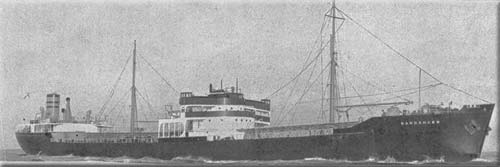
M/T Sandanger To Sandanger on the "Ships starting with S" page. Manager: Westfal-Larsen & Co. A/S, Bergen Delivered in Dec.-1938 from J. L. Thompson & Sons, Sunderland, 475' x 68' x 36', 7 cyl. 2T 4800 ihp, 13 knots. Captain: Sigurd Jamne Her voyages are listed on these original images from the Norwegian National Archives: Please compare the above voyages with Arnold Hague's Voyage Record below.
(Received from Don Kindell - His source: The late Arnold Hague's database). Follow the convoy links provided for more information on each. Errors may exist, and some voyages are missing.
As will be seen when going to Page 1 of the archive documents, Sandanger was at Suez when war broke out in Norway on Apr. 9-1940, having arrived there from Tandjong Oeban the day before. That summer, she's listed in Convoy SL 36, which left Freetown on June 15 and arrived Liverpool July 3 (having lost 3 ships, while 1 was damaged - ref. external link further down on this page); Sandanger arrived Bowling July 5. A little over a week later, we find her in Convoy OB 183, originating in Liverpool on July 13, dispersed July 17. Her destination is given as Jamaica; according to the archive document mentioned above, she arrived Trinidad on July 30, having started out from Greenock on the 14th. Both these convoys are available via the external links provided in the Voyage Record above; several Norwegian ships are listed. It'll be noticed, when going back to Page 1, that she appears to have had a long stay in Halifax, where she had arrived from Bermuda on Sept. 1. Departure is given as Oct. 8, when she joined Convoy HX 79 back to the U.K, cargo of kerosene. Benwood, Egda, Thyra, Høyanger, Triton and Ravnefjell are also listed in this convoy, which arrived Liverpool on Oct. 23 with the loss of 12 ships, 1 was damaged. Please follow the link to my page about this convoy for more details; see also the external link below. Sandanger stopped at Belfast Lough on Oct. 22, before proceeding to Liverpool on the 27th, then on to Stanlow and Eastham. At the beginning of Dec.-1940 she shows up, with destination Cape Town, in Convoy OB 255, leaving Liverpool on Dec. 7, however, it looks like she did not sail, or returned to port, because she's also included in the next convoy, OB 256, which left Liverpool on Dec. 8 and dispersed on the 12th. Again, please see the external link provided below and in the Voyage Record. According to Page 1, she arrived Curacao on Dec. 27 (arrival Cape Town is not mentioned for this time period, though the document does indicate this was her original destination). From Curacao, she proceeded to Bermuda a few days later, leaving again on Jan. 9-1941 in the Bermuda portion of Convoy HX 102; as will be seen when following the link, she's mentioned in the escorting HMS Ranpura's notes. Sandanger had cargo of benzine for Avonmouth, where she arrived (via Swansea) on Febr. 3. Later that month, we find her in station 63 of Convoy OB 290, in which Borgland and Solferino and others were sunk, and the Commodore Vessel Samuel Bakke damaged (follow the links for details), but Sandanger escaped unharmed, arriving Curacao on March 15, later proceeding to Aruba, then on to Halifax, with arrival March 30. From there, she joined Convoy HX 118 the following day, bound for Manchester with benzine in station 54. She arrived Liverpool on Apr. 19, Stanlow the next day, continuing to Eastham on the 25th. She subsequently joined Convoy OB 315, which departed Liverpool on Apr. 27 and dispersed May 4, Sandanger arriving Curacao on May 16, heading to Bermuda again 3 days later, then joined the Bermuda portion of Convoy HX 129 on May 25, cargo of benzine. Cruising order/Commodore's notes are also available for this convoy. Her destination is given as Manchester on the original A 1 form, as Avonmouth in the Advance Sailing Telegram; according to Page 2, she arrived Avonmouth June 14. A couple of weeks later, she's listed in Convoy OB 340, originating in Liverpool on June 27-1941, dispersed July 13, Sandanger arriving New York on July 17, remaining there for over a month, before proceeding to Halifax. With a cargo of petrol, she now headed back to the U.K. on Aug. 29 in Convoy HX 147 (station 103), together with the Norwegian Nueva Granada (104), Bello (114), Solør (54), Bralanta (102), Slemmestad (95), Strinda (63), G. C. Brøvig (44) and O. A. Knudsen (112). She later joined the westbound Convoy ON 20, which originated in Liverpool on Sept. 25 and dispersed Oct. 9, Sandanger arriving New York Oct. 13 (she had joined from Loch Ewe). On Oct. 22, we find her in Convoy HX 156 from Halifax to the U.K., for which Eglantine and Montbretia served as escorts for a while. With destination Curacao, she was scheduled for the westbound Convoy ON 36 on Nov. 13, but put in at Loch Ewe, and from there, she later joined Convoy ON 38*, which originated in Liverpool on Nov. 19 and dispersed Nov. 30, Sandanger arriving Curacao on Dec. 11. Having made another stop at Aruba, she returned to the U.K. again in Convoy HX 167, leaving Halifax on Dec. 27-1941. She arrived Belfast Lough on Jan. 10-1942, continuing to Avonmouth the next day (Page 2). At the beginning of Febr.-1942, she appears in the westbound North Atlantic Convoy ON 63*, which originated in Liverpool on Febr. 2 and dispersed on the 13th. Her destination is given as Aruba; according to Page 3, she arrived Port Arthur on Febr. 24, proceeding to Corpus Christi that same day. From there, she later continued to Halifax in order to join Convoy HX 180 on March 15, and arrived Avonmouth, via Belfast Lough, on March 29/30 (cargo of aviation gas). She now did make a voyage to Aruba, having joined Convoy OS 25, voyaging from Milford to Aruba in ballast in station 65 of the convoy, which originated in Liverpool on Apr. 12. Sandanger arrived Aruba on Apr. 30, having sailed from Milford Haven on Apr. 11 - A. Hague says he had been detached on Apr. 20. She's also listed in station 42 of Convoy SL 111/SLF 111, which left Freetown on May 24. Sandanger, cargo of gasolene, was in the fast section (SLF) which detached on June 8 and arrived Liverpool on the 13th (Sandanger stopped at Belfast Lough), while the slow section arrived on June 16. Other Norwegian ships taking part were Havkong, Petter II, Skandinavia and Solsten. Follow the external links provided in the Voyage Record for more convoy information. From Belfast Lough, she subsequently made another Trans-Atlantic voyage, having joined the westbound Convoy ON 105*, which originated in Liverpool on June 19 and arrived Halifax June 30; Sandanger, however, arrived New York July 3 (her destination is given as Boston, but this is not mentioned for this period on Page 3). As can be seen, she later proceeded to Aruba and Curacao again; convoy information for some of her subsequent voyages can be found in the Voyage Record. At the end of Aug.-1942 she can be found among the ships in Convoy HX 205 from Halifax to the U.K. Acanthus, Eglantine, Montbretia and Potentilla are named among the escorts. Sandanger returned with Convoy ON 133* (from Liverpool Sept. 25-1942, to New York Oct. 11). Via this message in my Gustbook Rick Pitz, a visitor to my website, has informed me that in Oct.-1942, she was in Convoy GAT 16, which left Guantanamo Bay, Cuba for Trinidad on Oct. 22 with 24 ships, among them several Norwegian (named in the Guestbook message - this convoy is also available via the external link in the table above). Sandanger's destination is given as Curacao and from Page 3, we learn that she arrived there on Oct. 25. Having returned to New York (see Voyage Record) she was scheduled for Convoy HX 215 from there on Nov. 11, but instead joined the next convoy on Nov. 19, HX 216. She was bound for Avonmouth with gasoline and had station 93 of the convoy, arriving her destination on Dec. 6 (via Belfast Lough). Just a few days later, she headed back to New York with Convoy ON 153 (Bello and others were sunk - follow the links for details). From the U.S., she made a voyage to Casablanca at the beginning of 1943, remaining there for a month before returning to New York - see Page 4. Again, convoy information for these voyages is shown in the Voyage Record.
Related external links: OB convoys - OB 255 is included, but as indicated in the narrative above, it looks like she did not sail. See also this chronological HX 79, 19 Oct, 1940 - 20 Oct, 1940 - (Here again is my own page about this convoy).
As mentioned above, Sandanger had been to Casablanca in Febr./March-1943. She had arrived New York again on Apr. 14 (Page 4), and was scheduled for Convoy HX 235 to the U.K. on Apr. 18, but did not sail. She was also cancelled from the next convoy, HX 236, but eventually departed New York on May 1, bound for Belfast Lough and Swansea in Convoy HX 237, which encountered heavy fog. When visibility improved off St. John's, Sandanger found herself alone on the ocean. That afternoon they met a Dutch tug escorted by an armed trawler, and Sandanger joined them, following directions from the trawler, as the tug was headed for the convoy. At dawn the trawler was gone, and Sandanger and the tug continued through that day and the following night, with a somewhat altered course. The next morning, May 8 the tug signalled that an attempt would be made to find the convoy as an "incomplete radio message" had been received. That same day Sandanger received the position the convoy would be in the following day and consequently headed for that position, but reaching the meeting place at noon on May 9, no convoy could be seen. In the morning of the 10th they met a ship belonging to the same convoy, and later that morning another 2 ships. At noon that day they were at the meeting place again, but still no convoy could be found, so the ships proceeded at full speed. 2 days later, on May 12, Sandanger was hit on the port side by 3 torpedoes from U-221 (Trojer), 1 striking amidships, 1 in the pumproom and 1 in No. 6 tank, position 46N 21W. She was immediately engulfed in flames, as she had a cargo of 7000 tons paraffin and 7000 tons gasoline. Only the starboard aft motor lifeboat remained intact, and had to be lowered straight down into the burning sea. The engine had been stopped by the 2nd engineer, but Sandanger still had some speed so that the boat had drifted a few meters away from the side of the ship. One of the mechanics was seen hanging in the net, before jumping into the flaming water. He tried to swim to the boat, but gave up before he reached it. The boatswain was also half way down the ship's side when he called to the others to keep rowing. He then reboarded the ship. The starboard raft was seen to be thrown down into the flames and several jumped overboard after it, never to be seen again. The after part of Sandanger sank while the forepart stayed afloat like a giant bonfire. Those in the lifeboat were wet with benzine and the boat itself had also been sprayed, so they were in great danger from the flames and intense heat, until a phenomenon occurred which saved them. Because of the fast combustion, an area of low pressure was created, which caused a very strong wind to blow in along the water from the high pressure area outside of the flames, and this wind lifted and split the flames on the starboard side in two. The lifeboat was maneuvered into this area, and for about 40 minutes the men rowed for life underneath a "bridge" of flames just a few feet above their heads, gasoline and flames floating in their wake. The fire went out about 5 hours after Sandanger had been torpedoed, and those in the lifeboat rowed the whole time to keep away from the flames. According to a report presented at the maritime hearings the attack had occurred at 19:00* on May 12, and at 01:00 on May 13 they could finally set sail, heading in the direction Sandanger had originally been going. However, the wind changed and in the morning they had to go straight west, keeping this course for 2 days. In the morning of the 3rd day they managed to get the motor started and set an easterly course, but after 43 hours they ran out of petrol so the rest of the time they sailed.
On May 14, a four engined bomber aircraft had sighted the boat and dropped water and food. The following day 3 aircraft had circled them and 1, believed to be a Sunderland, dropped a first aid kit as well as a portable American Bendix radio. Although there was no radio operator in the boat, it was used frequently, and it was later learned that these signals had been heard, and were largely responsible for their rescue. The next day (May 16) a merchant ship was sighted but they were not seen. Finally, on the 22nd, they were picked up by the Canadian destroyer HCMS Kootenay (H-75) which landed them in Londonderry on May 23. Out of a crew of 39, 20 had died, including the captain, the British Radio Operator Ronald Boardman (age 18), and all the deck officers. The inquiry was held in Glasgow on June 3-1943 with the 1st and 2nd engineers, and Able Seamen Marthinsen and Ulriksen appearing. M/S Brand also became a straggler from this convoy (sunk), and several other Norwegian ships took part, as will be seen when going to my page about Convoy HX 237. For info, U-221 had also been responsible for the attacks on Fagersten, Senta and Jamaica - follow the links for dates and more details.
Related external links: River Class - Canadian Destroyers - On the WW II Canadian ships website. Picture of Kootenay - On the Naval Museum of Manitoba website. Back to Sandanger on the "Ships starting with S" page. In June-1951 another Sandanger was delivered to Westfal-Larsen, built at Akers Mek. Verksted, Oslo, 5628 gt. Lost 450 miles south of Long Beach on May 18-1964 following a fire, voyage Vancouver-Le Havre. 3 crew and 7 passengers died. Wreck broken up in Taiwan. The text on this page was compiled with the help of: "Nortraships flåte", J. R. Hegland, "The allied Convoy System", Arnold Hague, "Sjøforklaringer fra 2. verdenskrig", Norwegian Maritime Museum, Volume II, and misc. (ref. My sources).
|
|||||||||||||||||||||||||||||||||||||||||||||||||||||||||||||||||||||||||||||||||||||||||||||||||||||||||||||||||||||||||||||||||||||||||||||||||||||||||||||||||||||||||||||||||||||||||||||||||||||||||||||||||||||||||||||||||||||||||||||||||||||||||||||||||||||||||||||||||||||||||||||||||||||||||||||||||||||||||||||||||||||||||||||||||||||||||||||||||||||||||||||||||||||||||||||||||||||||||||||||||||||||||||||||||||||||||||||||||||||||||||||||||||||||||||||||||||||||||||||||||||||||||||||||||||||||||||||||||||||||||||||||||||||||||||||||||||||||||||||||||||||||||||||||||||||||||||||||||||||||||||||||||||||||||||||||||||||||||||||||||||||||||||||||||||||||||||||||||||||||||||||||||||||||||||||||||||||||||||||||||||||||||||||||||||||