Site Map | Search Warsailors.com | Merchant Fleet Main Page | Warsailors.com Home Merchant Fleet Main Page | Warsailors.com Home |
|
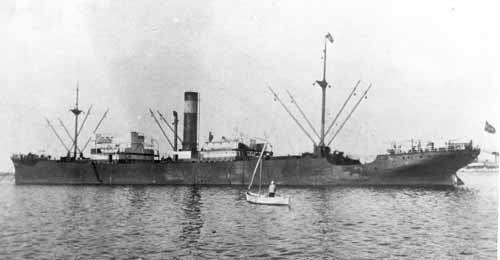
D/S Ingerfem To Ingerfem on the "Ships starting with I" page. Owner: A/S Inger Built by William Doxford & Sons Ltd., Sunderland in 1912. Previous names: Athamas until 1916, Øvre until 1931. Captain: Johan H. Johnsen On charter to British Empire Steel Products Co. Ltd.
Her voyages are listed on these original images from the Norwegian National Archives: Please compare the above voyages with the information found in her movement card (see narrative below), as well as with A. Hague's Voyage Record.
(Received from Don Kindell - His source: The late Arnold Hague's database). Follow the convoy links provided for more information on each (please be aware that some of the external convoys are incomplete). Errors may exist, and some voyages are missing.
For information on voyages made in between those mentioned here, please see the documents received from the Norwegian archives and A. Hauge's Voyage Record above (the differences in dates in some cases could simply be due to different time zones used). Follow the convoy links provided for more details; the Commodore's notes are also available for some of them, and several Norwegian ships took part.
In March-1939, we find Ingerfem in New Orleans, leaving for Hull on the 10th, arriving Hull Apr. 3, departing again in ballast on the 15th for Sydney, C.B., arriving May 5. A little over a week later, she proceeded to Newport, cargo of steel billets, with arrival May 24, then made a voyage in ballast to Murmansk at the end of that month, from there to Antwerp, cargo of Apatite ore, and back to Murmansk in July, then to Rotterdam, Amsterdam, Pernis (arrived the latter on July 23) and Leningrad, then back to Antwerp (with pit props), bringing us to Aug.-1939. Towards the end of that month, she made a voyage to Archangel (arrived Sept. 5), on to Velsen, then to Quebec, where she arrived Nov. 23. A few days later, she proceeded to Sydney, C.B., then to Aarhus(? this seems odd).
In Apr.-1940, she was in Baltimore, continuing to Halifax with arrival Apr. 26 (this agrees with Page 1 of the archive documents, where we also learn she had arrived Baltimore from Bergen, Norway on Apr. 11, in other words, 2 days after the German invasion of Norway). There's a note here saying she was time chartered by Ministry of Shipping, to be delivered on May 10 at Halifax. She left Halifax with 2000 standards of timber for Garston on May 28, joining Convoy HX 46, arriving Garston June 11. She was also degaussed before heading back to Sydney, C.B. at the beginning of July. For this voyage, she's listed, together with Austvard, Benjamin Franklin, Hellen, Margrethe Bakke, Senta and Skrim, in Convoy OB 178, which left Liverpool on July 3 and dispersed on the 7th, Ingerfem arriving Sydney July 16, according to the archive document. With a cargo of pitprops, she returned to the U.K. at the end of that month with Convoy HX 62 from Halifax, and arrived Grangemouth, via Methil Roads, on Aug. 19. Some repairs are said to have been made at Leith in this period, completed Sept. 5, before she again started on a voyage in ballast to Sydney, C.B. on Sept. 8, arriving Sept. 26. She's listed in Convoy OA 211 at the external site below, however, Arnold Hague instead has her in Convoy OA 212, which left Methil on Sept. 9. From Sydney, C.B., she proceeded to St. John, N.B. on the 29th, with arrival Sept. 30. Again, there's a note in the document saying she went in for repairs on Oct. 4, completed Oct. 25, but I'm not sure where these were undertaken and why, though she did not leave St. John until Nov. 8, so they were probably done there. She arrived Sydney, C.B. on Nov. 11 in order to join Convoy SC 12, which left on Nov. 13 and arrived Liverpool on Nov. 29; Ingerfem, cargo of steel and lumber, anchored at Greenock on Dec. 1 (Page 1 gives arrival as Nov. 30). Christmas that year was celebrated in Immingham, where some repairs were completed on Jan. 16-1941. Related external link: She left Imminham again in ballast on Jan. 28-1941, anchored at Methil Roads Febr. 2, sailed the next day, arrived Loch Ewe on Febr. 5, left on Febr. 10 for Halifax, where she arrived Febr. 24 (listed in Convoy OB 283, which had originated in Liverpool on Febr. 8 and dispersed on the 12th - see the external links provided within the Voyage Record for more on the OB convoys mentioned here). Her final destination was Tampa, where she was due around March 3, but she was involved in a collison (with Uranienborg? - note that this ship is listed in the Bermuda portion of Convoy HX 109. See also HX 109 at ships in all HX convoys). Collision date looks like Febr. 25; Ingerfem sustained damage to plates. A survey done in Halifax showed that she was extensively damaged and was sent to New York on March 2 for repairs, arrived March 5, expected to be completed around March 24. This date was later changed to Apr. 6, and she finally arrived Tampa on Apr. 13. On Apr. 19, she left for Halifax (arrived Apr. 30) then joined Convoy HX 125A for Liverpool on May 6, cargo of phosphates for Garston, station 55 - see also the Cruising order/Commodore's notes. (Ingerfem had been cancelled from the previous convoy, HX 124 which left Halifax on Apr. 30 - she may have missed it). She's said to have arrived her destination on May 24 (Page 1 gives arrival as May 26), leaving again on June 1 for Botwood in order to load 6100 tons of zinc concentrates, joining Convoy OB 330, which departed Liverpool on June 2 and dispersed on the 7th and also included Heina and Noreg. Ingerfem arrived St. John's, N.F. on June 13, proceeding to Botwood on the 21st, arriving June 23, according to the archive document. She left Botwood again on June 26 for Halifax, arriving June 30, later continuing to Sydney, C.B. with arrival July 4, then left on July 12 with Convoy SC 37* which arrived Clyde on July 28. Ingerfem stopped at Belfast Lough that day, before continuing to her destination Avonmouth, where she arrived on July 31 (as already indicated above, she had a cargo of zinc concentrates from Botwood) - her voyages in this period are shown on Page 2. She was ready to leave Avonmouth again on Aug. 8, and sailed for Wabana to load 6100 tons of iron ore, arriving there on Aug. 28, having sailed in the westbound North Atlantic Convoy ON 7, which had been dispersed on Aug. 25. Minor repairs undertaken there were expected to be completed on Sept. 3. On the 7th, she left Wabana to head back to the U.K. with Convoy SC 43*, which had started out at Sydney, C.B. on Sept. 5. She arrived Cardiff, via Belfast Lough, on Sept. 22, continuing to Port Talbot the next day. On Oct. 7, she departed Port Talbot for Montreal, where she arrived on Oct. 31, having sailed in Convoy ON 25* (originated in Liverpool on Oct. 10, dispersed on Oct. 24). She left again on Nov. 16 for Sydney, C.B., in order to join Convoy SC 56 on Nov. 22 (cargo of grain, rolled oats and coal), arriving Loch Ewe on Dec. 8, later continuing to her destination Hull, where she arrived Dec. 16. Ingerfem left Hull on Jan. 6-1942, and later joined the westbound North Atlantic Convoy ON 57* (originated in Liverpool Jan. 13, dispersed Febr. 7 - according to Page 2 of the archive documents, she sailed from Loch Ewe on Jan. 18). Heavy weather had been encountered, several ships returned to port, while others were wrecked. The convoy was waiting off the Hebrides for the weather to improve. See also Astrell and Ingrid. Eglantine is named among the escorts (see ON convoy escorts). Ingerfem arrived her destination Freeport on March 22. Intermediate voyages here are given as follows in her movement card, all dates agreeing with the archive document: Arrived Methil Roads Jan. 10, sailed Jan. 11, arrived Loch Ewe Jan. 13, sailed Jan. 18, arrived Hampton Roads Febr. 12 (repairs expected to be completed Febr. 16), sailed Febr. 19, arrived Galveston Febr. 28, collision damage, repairing at Galveston, sailed March 21, arriving Freeport March 22, as already mentioned. (Re-allocated Gulf Febr., 5727 tons sulphur). She left Freeport on March 25 for Hampton Roads, arriving Apr. 4. There's a note in the movement card saying she was detained w/engine trouble, but I'm not sure whether this happened while at Hampton Roads? She left again on Apr. 16, arrived New York Apr. 17, continuing to Halifax Apr. 18 with arrival Apr. 20, subsequently joining Convoy SC 81 on Apr. 23, arriving Garston on May 11 (cargo of sulphur). Another note says that voyage repairs (in Garston) started May 13, completed May 17. The following day, she left Garston for Wabana, joining the westbound Convoy ON 96*, which left Liverpool on May 19 and arrived Halifax on June 7; Ingerfem, however, had arrived Wabana on June 2. She loaded 6200 tons of iron ore, before leaving Wabana on June 7 for St. John's, N.F., then returned to Loch Ewe, with arrival there June 20 (? Page 3 gives arrival as June 18), having sailed in the Newfoundland portion of Convoy SC 86, for which Ramø served as Vice Commodore Ship. There's now mention of some boiler defects, which were repaired at Aultbea, as well as in Middlesbrough, completed July 2, whereupon she departed Middlesbrough on July 9 (via Loch Ewe July 12-13) in order to return to Wabana, with arrival there on July 25, having sailed in Convoy ON 112*, which had originated in Liverpool on July 13. On the 31st of that month, she proceeded to St. John's, N.F., departing again on Aug. 2 with 6200 tons iron ore, arriving Loch Ewe on the 14th with Convoy SC 94. As will be seen when following the link, this convoy lost several ships; see also the external link provided below. Ingerfem later continued to Middlesbrough, where she arrived on Aug. 18. Having proceeded to Loch Ewe, she joined the westbound North Atlantic Convoy ON 126 from there at the end of that month, station 53. The Norwegian Rena served as Commodore Vessel for this convoy. Ingerfem arrived Halifax on Sept. 16, where it looks like some repairs were undertaken again, before she continued to St. John, N.B. on Sept. 27, arriving Sept. 29. On Oct. 2, she left St. John for Halifax where she arrived on the 4th, departing on Oct. 6 with the Halifax portion of Convoy SC 104*, which had originated in New York on Oct. 3. This convoy was attacked and several ships were sunk, including Fagersten and Senta (follow the links for further details. See also the external links below; my page about Potentilla has an eye witness account of the battle. Acanthus, Eglantine and Montbretia are also named among the escorts - see SC convoy escorts). Ingerfem (bound for London) made it safely to Clyde on Oct. 21; later arriving Gravesend on Oct. 28 - again, see Page 3. She left Gravesend on Oct. 31, arrived Leith Nov. 3/4 for repairs which were completed on Dec. 7. There's now a gap in the dates on the movement card (but Page 3 has more) - she arrived Loch Ewe on Dec. 23/24 and according to her movement card, as well as the archive document, she left again in ballast for Halifax on the 25th, while Norwegian sources say she left on Christmas Eve. Further developments have been noted in the next paragraphs.
Related external links: Group Wotan and the Battle for Convoy SC 104 - Article with a very detailed description of the convoy battle (a section of Rob Fisher's Home Page).
Ingerfem left Loch Ewe in ballast for Halifax with Convoy ON 156 on Christmas Eve-1942 (see also * below and Page 3), but had engine problems and lost touch with the convoy after three days. In the afternoon of Dec. 29, two British aircraft signalled that it would return that evening with instructions as to whether she should continue to Canada or return to Scotland (due to the engine problems), but the aircraft did not return. Instead, Ingerfem was spotted by U-631 (Krüger) which sent a torpedo into her at 10:30 that evening. This is stated by the sole survivor, Gunner Ole Næss, at the Maritime hearings, so it's probably ship's time(?). The archive documents gives sinking date as Dec. 30 at 22:35. Most of the crew went in two lifeboats, while the captain, the 3rd mate and a Norwegian gunner were seen struggling with a 3rd lifeboat from the bridge, but before they succeeded in lowering it the ship broke in two and sank, 59N 21W, 5 minutes after the torpedo had detonated. One of the lifeboats with 33 men in it was later lost. The other also had problems in the bad weather. It kept taking in water and the 8 men in it struggled to keep it going for 3 days, until it capsized on Jan. 1-1943. All 8 managed to get into it again, but 7 of them had simply lost their desire to go on, and 1st Mate Otto Andreas Jacobsen and 2 crew died that same day, standing upright in the boat. 7 more days went by, with the boat continuously taking in water and it turned over yet again. The 5 remaining men again managed to straighten it out, but that night 4 of them died, leaving Ole Næss alone in the boat. He managed to "bury" the dead in the sea, but it had all been too much for him and he jumped overboard. A wave immediately washed him back into the boat. He drank large amounts of seawater in an attempt to end his life, but that didn't succeed either. On Jan. 11-1943, he was spotted about 500 n. miles west of Scotland by the American fruit carrier Steemac**. He was unconscious in the boat, and couldn't be straightened out so he was lifted in a sitting position onto Steemac, where the doctor on board gave him the best care possible, until he could be taken to the hospital in Ards District, County Down on Jan. 13, suffering from severe shock and salt water sores. There, he was nursed back to health again, though his legs were for a long time threatened by gangrene, but he was spared from amputation. He was 20 years old. 40 of his shipmates had died.
Crew List:
Related external links: Back to Ingerfem on the "Ships starting with I" page. The text on this page was compiled with the help of: "Nortraships flåte", J. R. Hegland, "Sjøforklaringer fra 2. verdenskrig", Volume I (Norwegian Maritime Museum) and misc. as named within above text (ref. My sources).
|
||||||||||||||||||||||||||||||||||||||||||||||||||||||||||||||||||||||||||||||||||||||||||||||||||||||||||||||||||||||||||||||||||||||||||||||||||||||||||||||||||||||||||||||||||||||||||||||||||||||||||||||||||||||||||||||||||||||||||||||||||||||||||||||||||||||||||||||||||||||||||||||||||||||||||||||||||||||||||||||||||||||||||||||||||||||||||||||||||||||||||||||||||||||||||||||||||||||||||||||||||||||||||||||||||||||||||||||||||||||||||||||||||||||||||||||||||||||||||||||||||||||||||||||||||||||||||||||||||||||||||||||||||||||||||||||||||||||||||||||||||||||||||||||||||||||||||||||||||||||||||||||||||||||||||||||||||||||||||||