Site Map | Search Warsailors.com | Merchant Fleet Main Page | Warsailors.com Home Merchant Fleet Main Page | Warsailors.com Home |
|
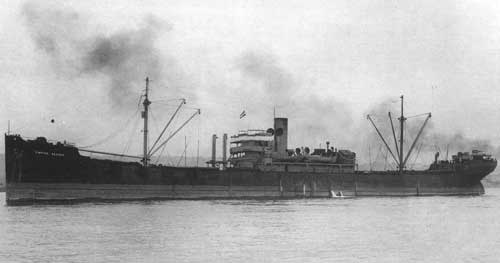
D/S Norhauk To Norhauk on the "Ships starting with N" page. Manager: Nortraship Built under United States Shipping Board contracts (WW I) by G. M. Standifer Construction Corp., Vancouver, Wash., completed as Waban (USSB) in 1919. Design 1015; 9400 tdw, 402 ft x 53 ft. Owned by Lykes Bros-Ripley SS Co. in 1933. Purchased from USA by British Ministry of Shipping in 1940, renamed Empire Sambar. On March 6-1941 she had an explosion in the engine room while at sea; towed in, repaired, and renamed Empire Beaver (M.O.W.T.) in 1942. (Info from Mitchell & Sawyer's "Empire Ships", received from Barbara Mumford). This was one of 19 ships transferred to Nortraship in 1942, see my page "Ship Statistics & Misc." under Empire Ships for names of the other 18. Taken over at Mersey on April 5-1942 and given the name Norhauk (she had previously arrived U.K. as Empire Beaver in Convoy SC 70). Most of the ‘Empire’-named ships that were transferred from the British to the Norwegian flag during the war years were given the prefix ‘Nor’, others were named for members of the (exiled) Norwegian Royal Family. A slight disagreement over tonnage here, "Empire Ships" says she was 6038 gt, while "Lloyd's War Losses WW II" gives her 6086 gt, as does Charles Hocking's "Dictionary of Disasters at Sea during the Age of Steam 1824-1962". "Nortraships flåte" says she was 9193 tdwt, while "Sjøforklaringer fra 2. verdenskrig" gives her 6086 gt, 3749 net. All these books (except "Empire Ships") are listed in My sources. Captain: Thorvald Birger Lihaug Her voyages are listed on these original images from the Norwegian National Archives: Please compare the above voyages with Arnold Hague's Voyage Record below.
(Received from Don Kindell - His source: The late Arnold Hague's database). Follow the convoy links provided for more information on each.
As mentioned, Norhauk was taken over by Nortraship on Apr. 5-1942, having previously arrived U.K. as Empire Beaver in Convoy SC 70. Already on the 14th, we find her in the westbound North Atlantic Convoy ON 86* from Liverpool, together with Bonde, Bur, Drammensfjord, Harpefjell, Maud, Sneland I and Trolla. The Norwegian corvettes Acanthus, Eglantine, Potentilla and Rose are named among the escorts for this convoy (see ON convoy escorts). Norhauk was bound for Philadelphia, where she arrived on May 3. With a general cargo for Liverpool, she returned across the Atlantic in June in Convoy SC 86 from Sydney, C.B., for which the Norwegian Ramø served as the Vice Commodore ship. Having remained in Liverpool for a month (see Page 1), Norhauk joined the westbound Convoy ON 114*, which left on July 19 and dispersed Aug. 4, Norhauk arriving New York the next day. Astrid, Berto, Bonneville (Commodore Vessel), Ingertre, Marga, Marie Bakke, Titanian and Torfinn Jarl are also named in this convoy. When on her return voyage to the U.K. in Convoy SC 100 the following month, she rescued some of the survivors from Empire Hartebeeste, which was sunk in this convoy (see external link provided further down on this page). Rio Verde rescued the other survivors. Going back to Page 1, we see that she later had a long stay at Gravesend, before proceeding to Methil Roads, then on to Loch Ewe, and together with Fana, James Hawson, Norse King (sunk - follow link for details), Ramø, Ravnefjell, Veni and Vest, we now find her in the westbound Convoy ON 154*, originating in Liverpool on Dec. 18-1942, arriving New York Jan. 12-1943, having lost many ships (ref. external links provided on my page about Norse King for more on this battle). According to the archive document, Norhauk's destination was New York and Baltimore, but she lost touch with the convoy and put in at Halifax on Jan. 9-1943. From there, she later joined the westbound Convoy ON 156, according to A. Hague. ON 156 had started out from Liverpool on Christmas Eve and arrived New York Jan. 17-1943 (Ingerfem was sunk - follow link for more info); Norhauk sailed from Halifax on Jan. 11 and arrived Hampton Roads on the 18th, leaving again for Baltimore that same day; later arrived New York on Febr. 8. Arnold Hague now has her returning to the U.K. in Convoy SC 120*, departing New York on Febr. 13-1943, arriving Liverpool March 5. Norhauk had a general cargo as well as bombs, and had again been in the company of several other Norwegian ships, namely Brand, Gausdal, Mathilda, Norsktank, Nyco (to St. John's) and Vest. Later that month she's listed, along with Askepot, Astrid, Harpefjell, Ingerfire (sunk - follow link for details), Ravnefjell and Suderøy, in the westbound North Atlantic Convoy ONS 2*, which left Liverpool on March 28 and arrived Halifax on Apr. 19; Norhauk, however, was bound for New York, where she arrived on the 22nd. In June-1943 we find her, again with a general cargo and explosives, in station 32 of the slow Convoy SC 133, which left Halifax on June 5 and arrived Liverpool on the 19th - Norhauk stopped at Loch Ewe on the 18th. Together with Acasta, Bestik, Boreas, Karmt, Marie Bakke, Snar, Solstad and Tercero, she later joined the westbound Convoy ONS 14* (departure Liverpool July 26, arrival Halifax Aug. 9). Norhauk was bound for Philadelphia; she had sailed from Oban on July 27 and arrived New York on Aug. 12, Philadelphia the next day, heading back to the U.K. on Sept. 15 with Convoy SC 142 from Halifax. She had a general cargo for Hull, arriving there Oct. 3, subsequently joining the westbound Convoy ONS 21*, which originated in Liverpool on Oct. 22 and arrived Halifax Nov. 5; this time her destination was St. John, N.B., where she arrived Nov. 6, having started out from Oban again - see Page 2. Ferncliff, Gausdal, Henrik Ibsen, Maud, Para, Petter II, Sommerstad and Suderøy also took part in this convoy. Shortly thereafter she was to embark on her last voyage across the Atlantic.
Related external links:
Norhauk departed Halifax on Dec. 2-1943 in Convoy SC 148, her captain serving as the Vice Commodore (Tropic Star served as Rear Commodore ship). Eglantine, Potentilla and Rose are named among the escorts (see SC convoy escorts). Norhauk was on a voyage from St. John, N. B. (had left Nov. 24) with 6800 tons general cargo for London, incl. about 500 tons ferro chrome in hold No. 3, but she didn't make it into London. In the morning of Dec. 15, the convoy split into 2 groups, with Norhauk taking over as Commodore Vessel for the northbound group. She arrived Loch Ewe in the morning of Dec. 16, then joined a coastal convoy that evening (see Convoy WN 519 - external link), arriving Methil Roads in the afternoon of the 18th, and left again the next day in a southbound coastal convoy (Convoy FS 1305 - external link). Again, see also Page 2. On Dec. 21 a pilot embarked at the inlet to the Thames. Around 14:38 that day, when in 51 50 03N 01 33 01E (Thames Estuary) a horrendous explosion occurred beneath the after part of hatch 3, practically severing the ship in 2 to the 'tween deck, and in a matter of seconds she sank in the middle down to the upper bridge, and was under water from hatch 1 to hatch 5. On the bridge at the time were the 2nd mate and the pilot, the captain having left a little earlier, as he had been up for more than 48 hours. There was no time to get to the lifeboats on the boat deck before they went under. The 2nd mate was injured, but tried to release the No. 1 boat with the captain's help, however, the captain was taken by the suction. Stoker Stenhovden and Donkeyman Johannessen were killed in the engine room. The 1st radio operator was also on watch, while the 2nd radio operator was off duty, as were the other casualties listed below, except for the cook. The pilot was killed on the upper bridge. Some of the men who had been amidships were either killed in the explosion, or injured so badly they were unable to jump overboard to save themselves, while others drowned. Several vessels nearby came to assist and picked up 15 from the water (incl. a British gunner), 12 from the stern and 3 from the prow, total count: 11 died, 30 survived. According to a report presented at the subsequent inquiry, held in London on Jan. 6-1944, Norhauk did have degaussing installed, and this had been on the whole time. The captain, the 2nd mate, the boatswain, the carpenter and the 3rd engineer appeared at the hearings. The boatswain and the carpenter had been forward when the ship struck the mine and they both remained there with another crew member until rescued by lifeboats from other ships in the convoy. The engineer had been in the engine room. He ended up in the water and swam around for about half an hour before getting onto the after part of the ship which was still above water, and was picked up from there by a tug which had come to in order to tow the ship away(?), along with the 11 others who had remained in that area. While in the water he had seen Stoker Steen on the propeller and swam towards him, but as he came closer he was gone. He had also seen another 2 men swimming around whom he believed to have been the 2nd radio operator and the cook. A visitor to my website has told me that "Shipwreck Index of the British Isles" lists her cargo as 111 tons of flour, 1,000 tons of zinc, 863 tons of cheese, 727 tons of aluminium, 627 tons of military vehicles, 60 tons of tank parts, 95 tons of wireless sets and 236 tons of guns and aircraft (totalling 3719 tons). This source adds that the wreck was dispersed by explosives.
Related external links: Stavern Memorial commemorations - Norwegians only are commemorated at this memorial for seamen in Stavern, Norway. Olav Kristoffer Indrevær is probably identical to Olav K. Olsen above (Norwegians often added the place names to their name, in other words, Olav K. may have been the son of someone called Ole or Ola [Ole's son=Olsen] living at Indrevær). Back to Norhauk on the "Ships starting with N" page. The text on this page was compiled with the help of: "Nortraships flåte", J. R. Hegland, "Sjøforklaringer fra 2. verdenskrig", Norwegian Maritime Museum, Volume II, and misc. as named within text above - (ref. My sources).
|
|||||||||||||||||||||||||||||||||||||||||||||||||||||||||||||||||||||||||||||||||||||||||||||||||||||||||||||||||||||||||||||||||||||||||||||||||||||||||||||||||||||||||||||||||||||||||||||||||||||||||||||||||||||||||||||||||||||||||||||||||||||||||||||||||||||||||||||||||||||||||||||||||||||||||||||||||||||||||||||||||||||||||||||||||||||||||||||||||||||||||||||||||||||||||||||||||||||||||||||||||||||||||||||||||||||||||||||||||||||||||||||||||||||||||||||||||||||||||||||||||||