Site Map | Search Warsailors.com | Merchant Fleet Main Page | Warsailors.com Home Merchant Fleet Main Page | Warsailors.com Home |
|
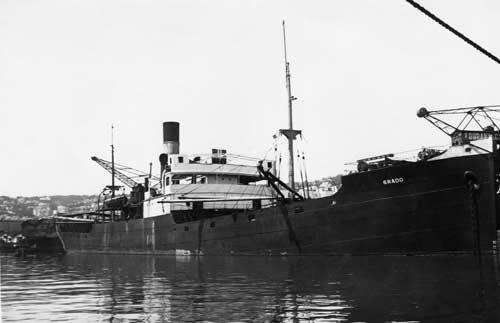
D/S Grado To Grado on the "Ships starting with G" page.
Owner: D/S A/S Iris Built by E. Finch & Co. Ltd., Chepstow, Monmouthshire, delivered as War Forest in Dec.-1918 to The Shipping Controller (Morel Ltd.). Renamed Abergallus for Soc. Maritime et Commerciale du Pacifique, Bordeaux in 1920, Thermidor for Cie Nationale de Nav., Bordeaux in 1925, Andreas Gerakis for N. Gerakis, Cephalonia in 1926, Louis Mercier for Union Miniere et Maritime, Rouen in 1927. Owned in 1930 by Union Industrielle et Maritime, Bordeaux. Sold in 1937 to D/S A/S Iris (Hans Fr. Grann), Oslo and renamed Grado. One of several Norwegian ships affected by the Spanish civil war when she was forced to go to Ceuta in June-1938 and was kept there for 3 weeks. Captain WW II: Theodor Jensen. In the book "Englandsfarten" there's mention of a captain by this name, and I'm wondering if it might be the same person. It gives the story of a sail boat that departed Arendal on July 14-1940 with 4 people on board, all of whom were officers in the Merchant Marine, namely Captain Theodor Jensen, Captain Jens Lassen Ugland, Engineer Olav Andersen, and Captain Reidar Ytterlid. They had been given permission by German authorities to sail as far as Farsund for "a little vacation", which they also did, but after a few days they took off one night and headed for England. They encountered terrible weather and ended up drifting, but were spotted by a British submarine which picked them up. Being as the sub was on a mission on the Norwegian coast the 4 went back towards Norway on board (the sub torpedoed a ship near Egersund). At the end of July the 4 officers were landed in Newcastle. They had been aided by a resistance group in Arendal and had with them the code books for a radio station. 5 members of the resistance group were arrested after this, initially sentenced to death, but this was later changed to 10 years in the penitentiary. Several others involved also had to serve time in the penitentiary. (Jens Lassen Ugland later became captain of Mosfruit and Christian Michelsen - see also Mosdale). Related item on this website: Her voyages are listed on these original images from the Norwegian National Archives: Please compare the above voyages with Arnold Hague's Voyage Record below.
(Received from Don Kindell - His source: The late Arnold Hague's database). Follow the convoy links provided for more information on each (where the "Convoy" column is left blank, it means that convoy is not known). Errors may exist, and some voyages are missing.
Grado is mentioned among the ships in Convoy HN 9A from Norway to the U.K. in Jan.-1940, but there's some disagreement as to whether she actually sailed in this convoy. As will be seen when clicking on the link, several Norwegian ships took part. Grado is said to have started this voyage from Malmö, arriving Shields on Febr. 2. When war broke out in Norway on Apr. 9-1940, she was in Hartlepool, having arrived there from Antwerp the day before, according to Page 1 of the archive documents. That summre, we find her in station 13 of Convoy OA 184, which departed Methil on July 14 and dispersed on the 18th, Grado arriving Sydney, C.B. on July 26, proceeding to Newcastle, N.B. the next day. A. Hague has also included the Norwegian Brisk and Eva - see the external link provided within the table above. Grado returned to the U.K. the following month in Convoy HX 66, in which the Norwegian Norne was sunk. Grado, bound for Hull with a cargo of pit props, joined this convoy from Sydney, C.B., taking station 14, while Norne had joined from Bermuda. HX 66 originated in Halifax on Aug. 16. In Oct.-1940, she's listed, together with Marita and Ruth I, in Convoy OA 226, which departed Methil on Oct. 8 and rendezvoused with OB 226 on Oct. 11 (in which Brant County, Laurits Swenson, Petter and Samuel Bakke are listed - ref. links in Voyage Record), then dispersed the next day. Her destination is given as New York, but according to Page 1, as well as Hague's Voyage Record, she arrived Yarmouth, N.S. on Oct. 27, later proceeding to Halifax on Nov. 5; New York is not mentioned. She now appears to have spent quite a long time in Halifax, from arriving there from Yarmouth, N.S. on Nov. 6-1940, to departing for the U.K. in the slow Convoy SC 22 on Febr. 8-1941. The original Advance Sailing Telegram for this convoy gives her destination as Hull, cargo of pit props; she arrived her destination, via Loch Ewe and Methil, on March 10, remaining there for over a month. She's now listed, with Ferncastle, Vanja, Velox and Ørnefjell, in Convoy OB 314, which originated in Liverpool on Apr. 23 and dispersed Apr. 30, Grado arriving Fernandina on May 12, proceeding to Bermuda about a week later. With a cargo of phosphates for Aberdeen, she was scheduled for the Bermuda portion of Convoy HX 129 on May 24, but instead sailed independently from Bermuda to Sydney, C.B. that day, joining Convoy SC 33 from there on June 1. She arrived Aberdeen, via Loch Ewe, on June 23 - see also Page 2. Together with Arosa, Evviva, Fanefjeld, Ferncourt (bombed, follow link for details), Henrik Ibsen, Idefjord, Måkefjell, Nesttun, Slemdal, Spurt, Star, Suderholm and Taborfjell, she's subsequently listed in Convoy OB 343, which originated in Liverpool on July 6-1941 and dispersed on the 21st (link in table above), Grado arriving Tampa on the 30th. According to A. Hague, she headed back to the U.K. in Convoy SC 41* from Sydney, C.B. on Aug. 24, cargo of phosphates, station 53. Again, several Norwegian ships took part, one of them being Einvik, which was sunk (follow link for info), others were Akabahra, Astra, Audun (from Iceland), Balduin, Blink, Carrier (returned), Evviva, Fagersten, Fanefjeld, Gudrun, Heien, Hestmanden, Hildur I (the latter 3 from Iceland), Ledaal, Leka, Lom (also from Iceland), Marga, Nesttun (from Iceland), Orania (returned), Reiaas (from Iceland), Siak and Spes. Grado arrived Loch Ewe on Sept. 11, proceeding to Methil Roads that same day, then on to Ipswich, with arrival there on Sept. 17. In Nov.-1941, she can be found in the westbound North Atlantic Convoy ON 39*, which started out in Liverpool on Nov. 21 and dispersed Dec. 4, Grado arriving Sydney, C.B. on Dec. 13, continuing that same day to St. John, N.B., where she arrived Dec. 17 (Page 2). Gudvin (to Iceland only), Ledaal (returned) and Thorshavn (joined from Iceland) are also named in this convoy. Grado was scheduled for the slow Sydney (C.B.)-U.K. Convoy SC 62 on Dec. 27 (Montbretia and Rose are named among the escorts), but instead joined SC 63 about a week later (Jan. 3-1942), cargo of steel and wood pulp for Glasgow, where she arrived on Jan. 22. In Apr.-1942, she's listed among the ships in the westbound Convoy ON 84*, together with Skottland, Sommerstad, Spero and Veni. This convoy originated in Liverpool on Apr. 8 and arrived Halifax on the 25th; Grado, however, was bound for Sydney, C.B., where she arrived on Apr. 26, continuing to Clarke City a few days later. With a cargo of pulp for Gravesend, she was scheduled for Convoy SC 84 from Halifax on May 14, but joined the next convoy on May 29, SC 85 from Sydney, C.B. (where she had arrived from Halifax). Going back to Page 2, we learn that she arrived Gravesend, via Loch Ewe and Methil Roads, on June 16. At the end of that month, she joined the westbound Convoy ON 108*, originating in Liverpool on June 30. Don, Far, Inger Lise, Iron Baron, Lido, Ramø, Selbo Senta, Sneland I and Star are also listed. Grado was again bound for Sydney, C.B., where she arrived, after quite a long stay in Halifax, on Aug. 6, continuing to Port Alfred a few days later, according to Page 3. Having returned to Halifax again, she now headed back across the Atlantic from there on Aug. 29 in Convoy SC 98, arriving Liverpool Sept. 13. She had a cargo of aluminium and pulp; her destination is given as Ellesmere Port in the Advance Sailing Telegram for this convoy, but date for her arrival there is not given on the archive document. She left again for Eastham and Mersey on Sept. 25, then joined the westbound Convoy ON 134*, which departed Liverpool on Sept. 26 and arrived New York Oct. 17 - Grado arrived Newark, NJ that day. Her last Trans-Atlantic voyage that year was made with Convoy SC 109*, which left New York on Nov. 9 and arrived Liverpool Nov. 30. Grado, cargo of steel and lumber, stopped at Loch Ewe on the 29th, proceeding to London the next day. Both these convoys had several Norwegian ships, namely Askeladden (joined from Halifax), Bonneville (Commodore Vessel), Glarona, Granfoss, Hallfried, Hjalmar Wessel, Loke, Mathilda (the latter 2 from Halifax), Maud, Sir James Clark Ross and Veni, as well as the Panamanian Nortun (Norwegian managers) in ON 134, and Astrid, Atlantic, Hjalmar Wessel, Iron Baron, James Hawson, Mathilda, Norse Lady, Ragnhild, Ravnefjell, Thalatta and Veni in SC 109. It'll be noticed, when going back to Page 3, that she later appears to have spent a long time in Middlesbrough, where she had arrived on Jan. 9-1943. Departure is given as March 3, when she left for Loch Ewe, in order to join the first convoy in the ONS series, Convoy ONS 1, which started out in Liverpool on March 15 and arrived Halifax Apr. 4. A. Hague has also included Bestik (from Iceland), Cetus, Gausdal, Grey County, Mathilda and Petter II (Vice Commodore), and Eglantine, Potentilla and Rose are named among the escorts (see ONS convoy escorts). From Halifax, Grado made voyages to New York and Boston, before returning to Halifax to join a convoy back to the U.K. - this was to be her last voyage.
With a cargo of 1000 tons steel and 3000 tons lumber for Ipswich, Grado left Halifax on May 2-1943 in Convoy SC 129. On May 11, when in 40 30N 32 30W, she was torpedoed and sunk by U-402 (Forstner). The British Antigone, sailing in front of her, had just been hit and the alarm was immediately sounded on Grado, whereupon the 4" gun aft was swung to port and the Oerlikon on the bridge manned by Ordinary Seaman Lawrence Garriock and the 1st mate. Shortly afterwards a periscope was seen on the port side. This disappeared when they opened fire from the bridge, but immediately thereafter a torpedo was seen coming her way, hitting her in the foreship, causing her to start sinking by the bow (Grado sank in about 50 minutes - "Nortraships flåte" gives the position as 40 30N 32 00 W - Page 3 of the archive documents gives the time as 16:57). The port lifeboat had been somewhat damaged but was launched and manned with 8 men, while the starboard boat was lowered with 16 men. The raft on the foredeck was lost and the aft raft was jammed. After some difficulties the starboard motorboat was also launched with 12 men. About an hour later, the 16 were picked up by the rescue ship Melrose Abbey and the rest by 2 escorting trawlers (the rescue vessel also saved the 43 survivors from Antigone). The captain and 15 men were landed in Glasgow on May 20 (presumably by Melrose Abby) where the captain was admitted to a hospital, having been injured in the explosion as he had been on the port side of the bridge when the torpedo struck. He had been pulled and carried to the lifeboat by the 1st mate. 20 of Grado's crew were landed in Belfast, then sent on to Glasgow, where maritime hearings were held on June 1-1943 with the 1st and 2nd mates and the 2nd engineer appearing (the captain was still in hospital). The Norwegian Grey County, James Hawson, Vanja and Norfalk also sailed in this convoy. For info, U-402 had also been responsible for the attack on Daghild earlier that year - follow the link for details.
Related external links: Back to Grado on the "Ships starting with G" page. The text on this page was compiled with the help of: "Englandsfarten", Volume II ('Søkelys mot Bergen') by Ragnar Ulsten, "Nortraships flåte", J. R. Hegland, "Sjøforklaringer fra 2. verdenskrig", Volume I (Norwegian Maritime Museum). "The Allied Convoy System", Arnold Hague and misc. other (ref. My sources).
|