Site Map | Search Warsailors.com | Merchant Fleet Main Page | Warsailors.com Home Merchant Fleet Main Page | Warsailors.com Home |
|
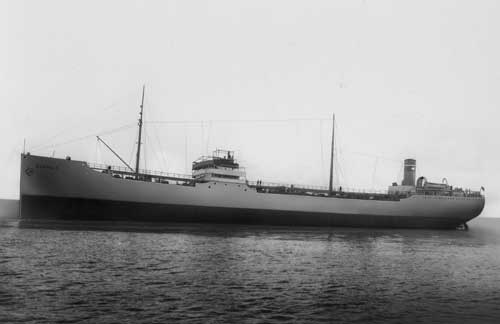
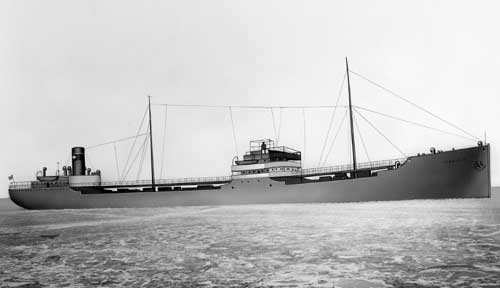
M/T Daghild To Daghild on the "Ships starting with D" page.
Owner: A/S Ocean Built by Burmeister & Wain's Maskin & Skibsbyggeri A/S, Copenhagen in 1927. Captain: Olaf K. Egidius, replaced for a short while by Captain T. Bernt. From Apr.-1940 until she was torpedoed the first time Daghild had transported 270 000 tons oil for the Allies. Related item on this website: Her voyages are listed on these original images from the Norwegian National Archives: Please compare the above voyages with Arnold Hague's Voyage Record below.
(Received from Don Kindell - His source: The late Arnold Hague's database). Follow the convoy links provided for more information on each. Errors may exist and several voyages are missing.
In Aug.-1939 Daghild, on charter to Standard Oil Co. of New Jersey, was en route from Aruba to Hamburg and Bremerhaven with a cargo of 5000 tons diesel oil and 9000 tons fuel oil when they learnt that England and Germany were at war. Shortly thereafter they were ordered to Ponta Delgada, the Azores, but already the next day that order was changed to Glasgow, Scotland. She arrived Horta 3 days later, to find several other neutral ships there, including Norwegian ones. After a few days there they received a telegram from the shipping company telling them to continue to Ponta Delgada to unload the cargo. Having done so, they proceeded in ballast to Caripito where a cargo of crude oil was loaded for Aruba, from there she headed to Las Piedras and took onboard fuel oil for Baltimore. Having discharged cargo there, she was docked for minor repairs, and after 5 days she again headed for Aruba where a cargo of fuel oil was loaded for Chile. From there she went to Talara and loaded crude oil for Campana. With the exception of a voyage to Halifax and one to Montevideo in between, these voyages continued until Norway was invaded on Apr. 9-1940, at which time Daghild was en route from Buenos Aires to Caripito, and at hearing the news the captain decided to head for Port of Spain, arriving Apr. 19(?), continuing to Guiria the following evening, having obtained the necessary insurances and permissions. About 50 ships were at Port of Spain at that time, but only a couple were allowed to leave. Daghild arrived Guiria an hour after midnight of Apr. 21, waited for orders for 3 days, then loaded a cargo for New York, where she again had a brief stay in dock before heading to Caripito. (Note that some of this does not quite match up with what is found on Page 1 of the documents received from the National Archives of Norway. Her 1941 voyages also start on that document).
She now continued in the South America service (except for a single voyage to Halifax), until arrival New York in Aug.(?)-1941 (according to Page 2 she arrived New York on July 23), at which time degaussing was installed, as well as the necessary protection around the bridge and installation of foundations for armament, before loading 14 000 tons crude oil from Thorshøvdi, which had to unload this cargo in order to go in for repairs following a collision in convoy. Daghild then continued to Halifax where a gun was installed aft; they also received 4 machine guns. She subsequently joined a convoy for Liverpool. No dates are mentioned in the captain's report, but Daghild can be found in station 63 of Convoy HX 149 from Halifax on Sept. 10. Having unloaded her cargo in Liverpool, Daghild headed back to New York with the westbound North Atlantic Convoy ON 22*, which left Liverpool on Oct. 2-1941 and dispersed on the 15th, Daghild arriving New York independently on Oct. 19. The Norwegian Bello, Bernhard, Gefion, Helgøy, James Hawson, Kollbjørg, Lise, Nueva Granada, Orwell, Slemmestad, Solstad, Thorsholm and Vivi also took part, and Eglantine is named among the escorts (see ON convoy escorts). While in New York, a steam turbine was installed to insure that they had enough electricity for the degaussing cable. From New York she went to Corpus Christi (this according to the captain), then on to Halifax for convoy and back across the Atlantic to Swansea (A. Hague has included her in Convoy HX 165 from Halifax on Dec. 15-1941. Page 2 gives her arrival Swansea as Dec. 30). She later returned to the U.S. (Houston) and again to Halifax. She had arrived Houston independently on Febr. 2-1942, having sailed in Convoy ON 54*, which had been dispersed on Jan. 17, having originated in Liverpool on Jan. 6 and also included the Norwegian Brant County, Fenja, Gallia, Haakon Hauan, Leiesten (returned) and Lise. In Houston Captain Egidius took a vacation and was replaced meanwhile by Captain T. Bernt. While at Halifax, where she had arrived from Houston on Febr. 18, she experienced some technical problems which resulted in her having to stay there for 2 months while repairing (A. Hague calls it weather damage), and when she could finally leave, she lost touch with the convoy she was in (Convoy HX 185) and had to return to Halifax to wait for the next one, joining the slow Convoy SC 81 a few days later (departure Halifax Apr. 23). She subsequently joined the westbound Convoy ON 95*, originating in Liverpool on May 15-1942. Daghild sailed from Clyde that day and arrived New York on May 30, via Cape Cod Canal (according to A. Hague). She had again been in in the company of several other Norwegian ships, namely Abraham Lincoln, Fernwood, Hardanger, Helgøy, Morgenen, N.T. Nielsen Alonso, Norbryn, Solstad, Stigstad and Trondheim. Captain Egidius now took over again and stayed on board until she was sunk. From New York she went to Galveston where she again had to be docked for misc. repairs before heading to Corpus Christi again, then back to Galveston. Having departed Galveston a couple of days later, the captain says they were ordered into Port Arthur due to the U-boat danger. She was able to leave the next day, but had to make stops at New Orleans and Mobile at night time (these movements are not mentioned on Page 2). She then joined a convoy at Key West, but had to wait a week before she could continue to New York, via Norfolk and Delaware. From New York they proceeded to Halifax (via Long Island Sound) in order to join Convoy SC 96 to Loch Ewe on Aug. 11, and from there in a new convoy to Scapa Flow where her cargo was unloaded (see also Voyage Record above and Page 3). Back to Loch Ewe for convoy which was to join a Liverpool convoy on Sept. 2(?)-1942. While in this convoy (ON 127 - see also A. Hague's listing), Daghild was torpedoed by U-404 (von Bülow) on Sept. 12-1942, 49 02N 33 30W. According to the captain's account, the torpedo made a 50 x 54 ft. hole beneath No. 7 tank on the starboard side, as well as 20 holes on the opposite side, so that it was possible to see straight through the ship. (He gives the date as Sept. 7, which might simply be an error in the typed copy, or a mix up with the Febr. 7-'43 incident mentioned further down on this page?). 13 U-boats took part in the attack on Convoy ON 127 which consisted of 32 ships (number varies according to source). One source says 7 merchant ships, 1 trawler and 1 destroyer were lost, and 4 ships damaged, whereas Captain Egidius' account says 16 ships were torpedoed during 5 days, Daghild being the last one to be hit (though the battle for ON 127 did last for 5 days, I believe this is a memory mix up with the 1943 incident, when Daghild was indeed the last one). Several other Norwegian ships were torpedoed in this convoy battle, namely M/T Sveve, D/T Marit II (also by U-404), M/S Hindanger and M/T Fjordaas. The external website that I've linked to at the end of this page has more on this battle - again, see also my own page about ON 127. Daghild managed to continue to St. John's for temporary repairs, before proceeding to New York for further repairs, via Sydney, C.B. and Halifax for degaussing (see also Page 3).
After having been repaired, which took 2 months, she was fitted with an extra deck for carrying aircraft. She was not ready to go out again until Jan.-1943, at which time she headed for New York(? this is strange; she was already in New York - see also Page 3) to take on board a cargo of 13 000 tons diesel oil for the U.K. En route to Carterett, where the cargo was to be loaded, it was immediately discovered that she was extremely diffcult to maneuver after the new deck had been added. They continued to Hoboken for a deck cargo of landing craft, barges and some aircraft. On their way out on Jan. 11, even the pilot expressed his doubts that she would be able to keep her place in the convoy, saying he had never seen anything like it. She had a tendency to want to go to the right, but in spite of that she was able to keep her post. However, due to heavy snow and high seas from Jan. 16, most of the ships were scattered and on Jan. 19 it was decided to take Daghild to St. John's, N.F. after having searched for the convoy in vain for a whole day, arriving there around Jan. 27 according to the captain, but as per British records and the archive document referred to above, she arrived on Jan. 23 - yet another report gives the arrival date as Jan. 21. The convoy she had been in was SC 117*, which left New York on Jan. 12 and also included Geisha (Commodore Vessel), Petter II (returned), Rena, Sevilla, Solstad and Sommerstad (put back). She left St. John's again on the 30th, joining Convoy SC 118* for the U.K. Other Norwegian ships in this convoy were Annik, Bestik, Cetus, Glarona, Grey County, Maud, Norbryn, Petter II and Sommerstad. On the night leading up to Febr. 7, Daghild was torpedoed by U-402 (Forstner), in 55 25N 26 12W. The torpedo struck on the starborad side foredeck; she immediately developed a list and started to sink. SOS signals were sent out 3 times. All 39 had survived and stayed near Daghild through the night in 3 lifeboats. At dawn she was still afloat, though listing heavily with her foredeck in the water, and again the captain wanted to see if she could be saved so he sent 1st Mate A. Bygnes back on board. While he was on board a U-boat** suddenly came up on the starboard side and he tried to get rid of it with the help of the Oerlikon, but soon realized that the boat was preparing to send off a torpedo so he jumped overboard on the other side and was picked up by a lifeboat, which then rowed away. Shortly thereafter 2 detonations were heard. Her list increased and the deck cargo slid into the water.
Continuing with the summary of the captain's account: The next morning the Admiralty sent a destroyer to assist, and Lobelia was taken in tow, until that evening when the destroyer was ordered to go and look for a lifeboat with 15 men in it, which had been located by aircraft. The destroyer returned the following morning, without having found the lifeboat, and by that time Lobelia was able to do 8 knots on her own and was ordered to proceed alone, as the destroyer, having about 140 shipwrecked people on board had to go to port. Captain Egidius doesn't seem too pleased at the fact that they were left to fend for themselves without escort, but they arrived Greenock with no further incidents. 2 crew members were admitted to a hospital (minor injuries), namely Able Seaman Georg Lillelid and the British Galley Boy Alexander Dalziel. The next day (Febr 13) the others travelled to Glasgow where they were given new clothes and lodgings at various places. The maritime hearings were held there on Febr. 17-1943 with the captain, Able Seaman Rusten (lookout), and the 3rd engineer appearing. The battle for Convoy SC 118 lasted for 5 days, about 20 U-boats had assembled, 11 merchant ships were lost (and around 600 lives). See the external link provided at the end of this page for more on this battle. Some ships lost in Convoy SC 118: The Greek Adamas (no casualties, collision with Samuel Huntington) and Kalliopi (4 died), the British Afrika (23 died), Harmala (53 died), Newton Ash (32 died) and Toward (rescue vessel, 58 died?), as well as the American Robert E. Hopkins (no casualties) and Henry R. Mallory. The latter had 383 passengers (troops) on board and lost 272 people (these numbers vary according to source). Also sunk were the stragglers West Portal (American) and Polyktor (Greek). Rohwer also lists the Polish Zagloba as a possible victim.
External links related to the text on this page: Loss of the Rescue ship Toward - A section of Joining the War At Sea. SC-118, 4 - 8 Feb 1943 - (uboat.net) In the account of the battle here it says "Unfortunately a merchant ship fires accidentally a snow flake and gives the position of the convoy away to U-187". As mentioned, this merchant ship was the Norwegian D/S Annik. The site also has information on LCT 2335, as well as Lobelia. Back to Daghild on the "Ships starting with D" page. This company had previously had another Daghild, delivered as such in Nov.-1916 to The Shipping Controller, London, 7978 gt. Taken over in 1919 by A/S Daghild (John P. Pedersen & Søn, for whom the ship had originally been ordered), Oslo. Sold to London in 1923, and had various owners before she struck a mine in June-1942 as German Katharina Dorothea Fritzen. Lillesand Sjømannsforening's website (external link) also has information on other ships by this name. The text on this page was compiled with the help of: "Nortraships flåte", J. R. Hegland, "The Allied Convoy System", Arnold Hague, "19 Oslo-skips historie under verdenskrigen, fra April 1940 til krigens slutt i 1945" ("The Story of 19 Oslo ships during the World War, from April 1940 until the End of the War in 1945") Harald Nicolaisen - based on the ship's logs and diaries, as well as the captain's report, and "Sjøforklaringer fra 2. verdenskrig", Volume I - ref. My sources.
|