Site Map | Search Warsailors.com | Merchant Fleet Main Page | Warsailors.com Home Merchant Fleet Main Page | Warsailors.com Home |
|
M/T Fjordaas To Fjordaas on the "Ships starting with F" page.
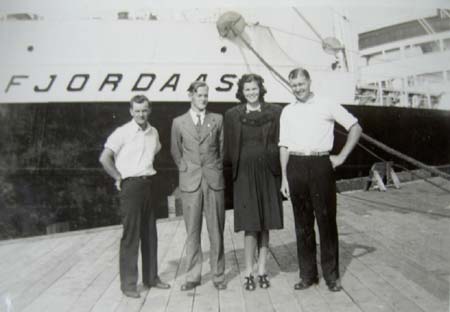
He also sent the above picture showing his father (on the right) in front of the ship, and the next photo
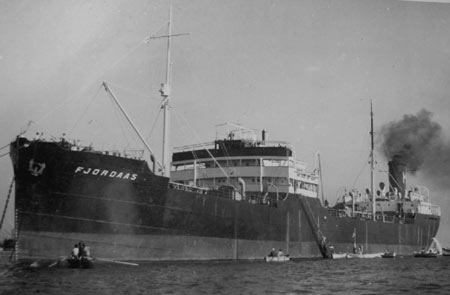
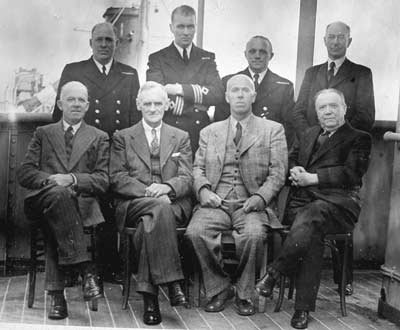
Arne Aresen is No. 2 from the left in the back row. No. 1 is Peder N. A. Saltnes, according to this Guestbook message from his niece - the others are unknown. Owner: Mørlands Tankrederi A/S Built by Deutsche Werke A/G, Kiel, Germany in 1931. Captain: Peder N. A. Saltnes Fjordaas was the only ship in the Mørland fleet to make it through the war. Her voyages are listed on these original images from the Norwegian National Archives: Please compare the above voyages with Arnold Hague's Voyage Record below.
(Received from Don Kindell - His source: The late Arnold Hague's database). Follow the convoy links provided for more information on each. Errors may exist, and several voyages are missing.
Her 1940 and 1941 voyages are shown on Page 1 and Page 2 of the archive documents. It'll be noticed that she spent a long time in New York, where she had arrived from Curacao on June 19-1941. Departure is given as Oct. 7, when she proceeded to Sydney, C.B. in order to join Convoy SC 50* to the U.K. on Oct. 17. Atlantic, Bur, Geisha, Lysaker V, Marianne and Rio Novo are also listed in this convoy. Fjordaas, in station 43, had a cargo of petrol and paraffin and arrived Loch Ewe on Nov. 3. Later that month, she's listed as bound for New York in the westbound North Atlantic Convoy ON 38*, which originated in Liverpool on Nov. 19 and dispersed on the 30th, Fjordaas arriving New York on Dec. 9. Atlantic, Geisha, Hada County, Marit II, O. A. Knudsen, Sandanger, Skaraas, Stiklestad and Troubadour also took part. With a cargo of petrol, she headed back to the U.K. on Jan. 20-1942 in Convoy HX 171 from Halifax, for which Acanthus and Rose served as escorts for a while, subsequently returning to the U.S. with Convoy ON 71* (station 75), originating in Liverpool on Febr. 26, dispersed March 8, Fjordaas arriving Baytown March 22. She had again been in the company of several Norwegian ships, namely Athos, Fagerfjell, Gallia, Garonne, Høegh Giant, John Bakke, Malmanger, Skaraas, Solfonn and Velma, as well as the Panamanian Norvik (Norwegian managers). Fjordaas later spent quite a long time in Halifax; A. Hague says she had arrived there with a cracked deck, and says repairs were made in New York, where she also stayed for over a month - again, see Page 2. In July, we find her in the slow Sydney (C.B.)-U.K Convoy SC 91. She's also listed on the original convoy form for the westbound Convoy ON 125 towards the end of the following month (station 82), but it looks like she must have returned (or did not even join at all?), because when she was torpedoed on Sept. 11 she was in Convoy ON 127 (she could not have crossed the ocean and returned to the U.K. in time to join ON 127 on Sept. 4). Follow the links for further dates and cruising orders. She was hit amidships under the bridge, port side by a torpedo from U-218 (Becker) at 22:30 on Sept 10 (11?)-1942, 51 16N 29 08W, when in Convoy ON 127, as mentioned - date varies according to source and time zone used. According to Page 3, she was bound for Curacao at the time. Another torpedo from the same U-boat had barely missed. The crew got into 2* lifeboats while Captain Saltnes, 1st Mate Arne Aresen and Chief Engineer Arne Hjalmar Olsen stayed on board to inspect the damages. The explosives had made a hole 30 x 60 ft and she was close to breaking in 2, but because of the special way she was built, with 4 tanks right next to each other, she stayed afloat. Further inspections showed extensive damages to the bridge section and instruments there, but the engine and steering mechanisms were intact, so the captain recalled the lifeboats at 02:00, and after the ship had been trimmed they returned to the U.K., arriving Clyde on Sept. 15, having sailed about 1000 n. miles.
George Monk, a visitor to my website has told me that the following men received ungazetted awards for services when the ship was torpedoed and damaged (his source: Seedies List of awards to the British Merchant Navy which includes awards to Allied merchant seamen): Several other Norwegian ships were torpedoed in this convoy, namely M/T Sveve, D/T Marit II, M/S Hindanger and M/T Daghild - follow the links for details. See also the external links at the end of this page. Fjordaas was repaired at Smith's Dock in Newcastle and was ready to return to service in Dec.-1942. She's said to have rescued 17 men from an American ship in the Gulf of Mexico at some point in 1942 - exact date and name of ship not known. In Jan.-1943, she joined the westbound Convoy ON 159, serving as Escort Oiler. This convoy originated in Liverpool on Jan. 4, but Fjordaas joined from Londonderry, having sailed from there on Jan. 5, arriving New York on the 21st - see Page 3. The Commodore's narrative is also available for this convoy, for which Laurits Swenson acted as Commodore Vessel. With a cargo of Admiralty fuel, Fjordaas was scheduled to return to the U.K. with Convoy HX 225 from New York at the end of that month, but instead joined the next convoy on Febr. 8, HX 226 (again with Laurits Swenson as Commodore Vessel), and arrived Clyde on Febr. 23, Bowling the next day. As will be seen when following the link to my page about this convoy, she's named among the ships in the Advance Sailing Telegram for the Halifax section, but she did join from New York. Together with Belinda, Laurits Swenson (Commodore Vessel) and Thorshøvdi, she now joined Convoy ON 172*, which left Liverpool on March 9 and arrived New York on the 27th - Fjordaas again joined from Londonderry. On Apr. 6, she can be found among the ships in Convoy HX 233, which arrived Liverpool on Apr. 21; Fjordaas, cargo of Admiralty fuel, stopped at Clyde that day. A little over a week later, she headed back across the Atlantic with Convoy ON 181, which originated in Liverpool on Apr. 30; see also the Commodore's narrative and HMS Keppel's report. The Commodore says, "Fjordaas carried out the fuelling of the escorts very well under adverse weather conditions but she is too short and lively to make an efficient oiler". In Keppel's report, Fjordaas is mentioned under the heading "Oiling at sea". According to Page 3, she arrived New York on May 17, having started out from Clyde Apr. 30, and already on May 19 she started her return voyage, joining Convoy HX 240 from New York. Her destination is given as Scapa, where she arrived June 5, returning to the U.S. again later that month with Convoy ON 190*, which originated in Liverpool on June 24 and arrived New York July 9, and also included Brajara, California Express, Dageid, Gefion, Høyanger, Lynghaug, Mosli, Norefjord, Norsol, Orwell, Polartank, Skiensfjord and Tarifa. On July 15 she joined Convoy HX 248 from New York, but returned to port that same day, subsequently joining the next convoy on July 23, HX 249, station 92, and arrived Clyde on Aug. 5. (No reason is given for why she returned to New York from HX 248; A. Hague simply states that she broke down on sailing. The Commodore's report mentions a collision taking place, without naming the ships involved, but this appears to have taken place later on in the passage). With Athos, California Express, Gefion, Hardanger, Montevideo (Commodore Vessel), Mosli, Oregon Express, Roald Amundsen, Skotaas and Trondheim, she went back across the Atlantic with Convoy ON 196*, which originated in Liverpool Aug. 8 and arrived New York Aug. 21, and a few days later we find her in station 43 of Convoy HX 254 from New York - her destination is again given as Scapa, where she arrived Sept. 11. Her voyages in this period are shown on Page 4. She now appears, along with Fernmoor, Minerva, Montevideo, Salamis, Solør, Tungsha, Villanger and Viva, in the westbound Convoy ON 204* (from Liverpool Sept. 28, to New York Oct. 15), returning to the U.K. in Convoy HX 262*, departing New York on Oct. 18. California Express, Gallia, Strinda (returned following a collision) and Trondheim are also listed. Fjordaas arrived Clyde on Nov. 2, and from there she later joined the westbound Convoy ON 212, acting as escort oiler, destination New York, with arrival Dec. 4. Eglantine, Rose and Potentilla are named among the escorts. Fjordaas was scheduled for Convoy HX 274 from New York on Jan. 6-1944, but instead joined the next convoy on Jan. 13, HX 275, though returned to port; according to A. Hague she had propeller problems. Her name does not show up again until Convoy HX 278 on Febr. 5, arriving Liverpool on Febr. 21. In March she joined the westbound Convoy ON 229*,which departed Liverpool on March 23 and arrived New York Apr. 7, and also had Helgøy, John Bakke and Katy in its ranks, with Acanthus and Eglantine among the escorts (see ON convoy escorts). Fjordaas went back to the U.K. a few days later with Convoy HX 287, subsequently joining the westbound Convoy ON 236* in May (from Liverpool May 11, to New York May 27; Fjordaas joined from Londonderry - again, see Page 4). Buenos Aires, Montevideo, Norholm, Norvarg, Rena, Solsten, Sommerstad, Thorshov, Titanian and Vera are also named in this convoy. On June 19 we find her in Convoy HX 296 from New York (having been cancelled from HX 294 earlier that month). Her destination is given as Milford Haven and Portsmouth - see Page 5. In July she's listed in the westbound Convoy ON 245*, again joining from Londonderry. This onvoy originated in Liverpool on July 18, arrived New York Aug. 2, and also included Bralanta, Chr. Th. Boe, Emma Bakke (Commodore Vessel), Gudvor, Mathilda, Montevideo, O. B. Sørensen, Petter II and Tanafjord. She now went back in the other direction again in Convoy HX 303 with several other Norwegian ships, namely Tanafjord, Dalfonn, Noravind, Atlantic, Sommerstad, Skotaas, Geisha (Vice Commodore), Thorhild, Petter, Stirlingville, Rena, Para, Titanian, Mui Hock, Romulus and Norse Lady. Fjordaas joined this convoy from Halifax on Aug. 13; her destination is given as Rosyth, where she arrived, via Loch Ewe and Methil Roads, on Aug. 30. At the end of Oct.-1944, she's listed, with Dageid, Helgøy, Norheim, Samuel Bakke (Commodore Vessel) and Tai Shan, in the westbound Convoy ON 263*, which left Southend on Oct. 29 and arrived New York Nov. 15; Fjordaas joined from Clyde and arrived Boston Nov. 14, proceeding to New York the next day. From there, she subsequently joined Convoy HX 321 on Nov. 19, bound for Milford Haven and Swansea - again, see Page 5. Buttercup is named among the escorts - see HX convoy escorts. Fjordaas had time for one more Trans-Atlantic voyage before that year was over, and this was made in the westbound Convoy ON 271*, which sailed from Southend on Dec. 8 and arrived New York on the 28th; Fjordaas started out in Milford Haven Dec. 10. Other Norwegian ships were Dalfonn and Villanger (Commodore Vessel). Fjordaas is also said to have served as oiler for allied patrol vessels in the Bay of Biscay(? I'm not sure this can be correct) at some point of 1944, and also had on board a supply of depth charges in case escort vessels in the area were in need of them. As can be seen in the Voyage Record above, she did serve as Escort Oiler for many of the North Atlantic convoys, also carrying depth charges. Early in Jan.-1945, she's listed, with destination Devonport and Swansea, in the New York-U.K. Convoy HX 330, for which Topdalsfjord acted as Commodore Vessel. They both headed back in the other direction with Convoy ON 282* the following month, Topdalsfjord again serving as Commodore Vessel. Brimanger, Egerø, Ferncourt, Frontenac and Kaldfonn are also listed in this convoy, which originted in Liverpool on Febr. 1 and arrived New York Febr. 19. According to A. Hague, Fjordaas went back to the U.K. again shortly thereafter in Convoy HX 340*, which left New York on Febr. 23 and arrived Liverpool March 10; Fjordaas stopped at Clyde that day (Page 5), and from there she later joined the westbound Convoy ON 292* (originated at Southend on March 22, arrived New York Apr. 8). Both these convoys also had other Norwegian ships, namely California Express, Fagerfjell, Ferncourt, Gefion (returned), Ivaran, Kaldfonn and Tungsha (Commodore Vessel) in HX 340, and Egerø, Fosna, Gefion, Havfru, Ivaran (Commodore Vessel), Lista, Norsol and President de Vogue in the ON convoy. Her subsequent voyages are shown on Page 6 of the archive documents. It looks like she spent a long time in Antwerp at the end of 1945 - she had arrived there from Swansea on Sept. 26/27 and departure is given as Dec. 12, when she proceeded to Falmouth (then on to Curacao). Page 7 has her voyages to Apr.-1946.
According to this external page, she was sold in Aug.-1947 til AB Turret O.Y. (Finska Ängfartygs A/B-Suomen Höyrylaiva O/Y), Helsingfors, Finland and renamed Pansio. Broken up in Finland in 1961. Related external links: Back to Fjordaas on the "Ships starting with F" page. Arnt J. Mørland, Arendal had another Fjordaas post war, delivered in 1957, 22 088 gt. Later named Ronastar 1964 for Einar Saanum, Mandal. This ship had an explosion on board while cleaning tanks in Rotterdam on June 15-1965, with the loss of 16 men. She sank and was subsequently condemned, but was later raised and repaired, entering service as bulk carrier Condo in 1966, managed by Arnt J. Mørland, Arendal. Later names: Herwang 1972 for owners in Kristiansand, Norway, then Italian Falcone 1974 - sold for breaking up in 1983. The text on this page was compiled with the help of: "Nortraships flåte", J. R. Hegland, and misc. (ref. My sources).
|