Site Map | Search Warsailors.com | Merchant Fleet Main Page | Warsailors.com Home Merchant Fleet Main Page | Warsailors.com Home |
|
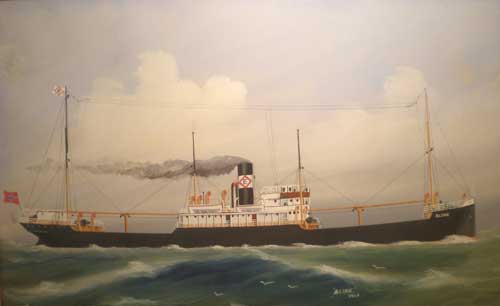
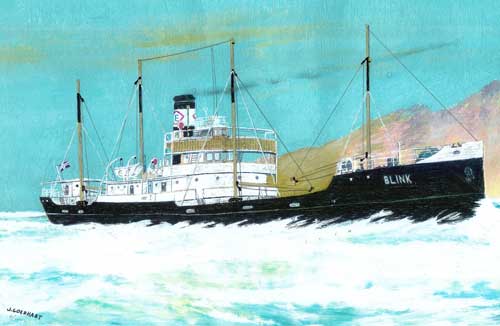
D/S Blink To Blink on the "Ships starting with B" page.
Owner: Skibs-A/S Manitowoc. Built by C. Hill & Sons, Bristol in 1920. Previous name: Arlette until 1933. Captain: Sigvart Ulvestad Related items on this website: See also: Her voyages are listed on these original images from the Norwegian National Archives: Please compare the above voyages with Arnold Hague's Voyage Record below.
Follow the convoy links provided for more information on each.
Errors may exist and several voyages are missing.
As will be seen when going to Page 1 of the archive documents, Blink was on her way from Savannah to Antilla when war broke out in Norway on Apr. 9-1940. The info in the next 2 paragraphs was found in an article in "Krigsseileren" No.1/1979, written by someone who was on board at the time (it'll be noticed, however, when going back to the archive document, that some of this does not quite match up with the details found there): He says she was in New York in the summer of 1940, loading general cargo for Havana, Cuba. After 3 days in Havana she proceeded to a port on the east coast of Cuba (possibly Caibarien? See archive document) to take on board a cargo of sugar for New York, and later headed back to Cuba (Antilla?) to load another sugar cargo for New York. After having unloaded this cargo in New York, they heard they were going to New Jersey to pick up ammunition for the U.K., and as a result of this several crew members left, and she was unable to proceed due to the lack of crew; only 14 out of 30 remained. (As can be seen, Page 1 shows a long stay in New York in the fall of 1940). After having been laid up at Bayonne for a couple of weeks the captain had managed to get together a full crew, partly from the training ship Danmark, which was laid up in Jacksonville, Fl., partly from New York and Boston. After New Jersey, Blink went to Botwood N.F. for a cargo of pyrites. She left for New Orleans around Nov. 1, stopping en route at Newport News for coal bunkers. The captain's wife came on board there, having escaped from Norway to Sweden, from there to Russia, then by way of the Trans-Siberian railway to Vladivostok, across the Pacific on a ship, and finally across the American continent by rail to Newport News. (Blink was on charter to the Philadelphia company Simpson, Spencer & Young; the Simpson in this name being the Simpson whose well known Wallis was the reason for the English King's abdication). Again, compare the details in these 2 paragraphs with the info found on Page 1. Her 1941 voyages also start on this document, showing another long stay in New York that spring and it also looks like she remained in Halifax for quite a long time that summer, having arrived there from Quebec - she proceeded to Sydney, C.B. on Aut. 18. Together with Akabahra, Astra, Audun (from Iceland), Balduin, Carrier (returned), Einvik (sunk, follow link for details), Evviva, Fagersten, Fanefjeld, Grado, Gudrun, Heien, Hestmanden, Hildur I (the last 3 joined from Iceland), Ledaal, Leka, Lom (from Iceland), Marga, Nesttun (from Iceland), Orania (returned), Reiaas (from Iceland), Siak and Spes, A. Hague has now included her in Convoy SC 41, which departed Sydney, C.B. on Aug. 24-1941 and arrived Liverpool Sept. 11; Blink, cargo of pulpwood (station 55), stopped at Loch Ewe that day. Her voyages in this period are shown on Page 2. It looks like her final destination was Rochester, where she arrived on Sept. 17 and again had a long stay in port. SC 41 will be added to an individual page in my Convoys section, but for now, see ships in all SC convoys. The following month she's listed, along with Erica, Hildur I, Lago and Lisbeth, in the U.K.-Gibraltar Convoy OG 76, which originated in Milford Haven on Oct. 26, but Blink (which had sailed from Oban on Oct. 29) returned to port following a collision with the British Empire Pelican (also in OG 76), and arrived Ardrossan Nov. 1. She left Ardrossan again for Clyde on Nov. 8, later joining Convoy OG 77 from there, but again returned (convoy originated in Milford Haven on Nov. 24, Blink had sailed from Clyde Nov. 26). According to Page 2, she had been bound for Huelva. Other Norwegian ships in Convoy OG 77 were Hellen, Selbo and Sirehei (the latter also returned). These 2 OG convoys will also be added to individual pages in my Convoys section; in the meantime, see the page naming the ships in all OG convoys. At the end of that year, we find her in the westbound North Atlantic Convoy ON 49, which originated in Liverpool on Dec. 21-1941 and dispersed on Jan. 5-1942, Blink arriving Tampa independently on the 18th (she had joined from Clyde) - see the section naming ships in all ON convoys. The Norwegian Bur, Ravnefjell, Titanian and Veni are also included in this convoy. From Tampa, she proceeded to Charleston, S.C. on Febr. 4, then embarked on her last voyage. More information on all the other Norwegian ships named here can be found via the alphabet index at the end of this page, or go to the Master Ship Index.
Blink left Charleston again on February 9-1942 (see Page 2). She had a cargo of 3600 tons of phosphates for Ipswich and was bound for Halifax in order to join Convoy SC 70 back to the U.K., but didn't make it to Halifax. On Febr. 11 she was hit by 3 torpedoes from U-108 (Scholtz), position 35 00N 72 27W, about 160 miles east of Cape Hatteras. The first one hit on the port side and went straight through the ship (hold No. 2) without detonating. The next two, about 1 min. later, hit amidships in the engine room, also from the port side, destroying the port lifeboat. The radio station was destroyed, so no SOS was sent out. She was armed with a 3" gun but this was not used as the U-boat was not seen. Uboat.net (external link) gives the date as Febr. 12, attacked at 02:40, German time, sank at 03:34 - "Nortraships flåte" gives time as 20:45 on Febr. 11 for the initial attack, sank at 21:10. Uboat.net adds that she had been "sighted at 14.49 hours the day before and was attacked the first time at 16.11 hours, but the G7e stern torpedo was a dud and a second G7e missed. The U-boat then had difficulties to overtake Blink again due to heavy seas and four hours later almost collided with her during a second attack attempt, avoiding by diving underneath the ship when only 50 metres from her". 5 men were assumed killed, namely 1st Engineer H. Dahlman, Donkeyman K. Johansen, the Dutch Stoker Pieter Roos, Canadian Messboy Robert Siteman, and the British Gunner William Lewis. See my links to the Commonwealth War Graves Comm. website further down on this page. 23 got in the starboard lifeboat, while the South African Stoker H. Gillik and the British Galleyboy A. Pappacena were seen heading for a raft, never to be seen again, though some weak lights were later observed behind Blink, which lead the others to believe that the raft had been launched. The survivors set sail, heading for land. The next morning the lifeboat turned over and Able Seaman R. Graves drowned, the 3d mate having tried in vain to save him. When the boat capsized they lost all their bread and water. They managed to straighten the boat, then swam around while 2 men attempted to get the water out of it, but this proved impossible due to the heavy seas that kept washing over it, so they all swam back and reboarded. The boat capsized several times, and by Febr. 13, 11 men remained, sitting in the boat with cold water up to their chests; one by one the others had died, including the captain. On the 14th only 6 were left, but that afternoon they were spotted by the lookout on the American D/S Monroe (W. W. Glendaniels) in position 33 34N 71 41W and rescued. All of them were hospitalized in Baltimore.
"Thursday Febr. 12: Friday Febr. 13: Saturday Febr. 14: The following were saved: Tuesday Febr. 17: Signed O. Numme, G. Gulliksen and B. Lunde. All of them had hallucinations while in the lifeboat. Gulliksen was fished out of the sea twice, once after having "gone to bed" in a "real" bed he had seen in the water, with white, clean sheets, another time after he had attempted to walk up to a hotel he had seen "further up the street". Again, see also Birger Lunde's letter in the Warsailor Stories section. Here's an excerpt: Despite our best efforts to help one another, slowly one by one the men lost hope and died. Heavy seas ran almost constantly through the flooded lifeboat. Each wave seemed to take away more of our strength. At one point on the second day a man died every hour. All of us had trouble focusing our minds and we all experienced periods of black out and total despair. It was so sad to see them go, one by one. Something I was never able to get over or put behind me. All my life they would follow me especially when I slept. Our Captain spoke at length to me of his family just before he died. When he died, I became the last officer and the remaining men turned to me. Such feelings are difficult to describe and will always be with me. When they died we did what we could and then cast them into the sea. At some point in our ordeal the sharks discovered us. They followed the bodies and now hungry for more began to try to pull us out of the flooded lifeboat. Tired and beyond exhaustion we now found ourselves hitting at the sharks with our last boat hook. Yelling, screaming through swollen lips and tongues and pounding at the sides of the lifeboat, doing anything to make them go away. In an ordeal like this, hope is the great life force and when a man lost it he quickly perished. Hope was the only thing that sustained any of us and only someone who comes through an ordeal like this knows its real value. At some point I realized this and knew I must focus my mind on surviving or be lost. Late on the end of the third day the SS Monroe spotted myself and one other crewman waving. The lookout reported to his captain that "I see two man standing in the water, waving". There were five British Seamen in the lifeboat, four perished during our ordeal. Of the 23 sailors that got into the lifeboat only six in total survived the punishment. I was the only officer to survive and my report to the U.S. Navy was later included in the book Track of the Gray Wolf. I have enclosed a copy of 2 pages out of that book. Because of the hopelessness and hardship the Blink sinking became known as one of Norway's worst wartime disasters. At first the Norwegian press in America wrote articles wondering what we had done wrong. Later I would meet some of the journalists and when they found out the true story they did their best to tell of our suffering. The maritime hearings were held in New York on March 12-1942, with B. Lunde (in his cabin at the time of the attack), Able Seaman Numme (on lookout duty on the bridge), and Steward Friis (in the saloon) appearing. Birger Lunde had previously served on Brimanger and Hosanger, and had been on board M/S Taranger when she was sunk in May-1941 (follow the link for more info), then joined Lysaker IV. After the loss of Blink, he signed on Oregon Express and was injured when she was sunk in Sept.-1943 (again, follow the link for details - see also his letter). He also briefly served on Polarland. During the war he was awarded the St. Olav Medal with oak leaves by King Haakon VII. He later served on American ships, Korean War, settled in the U.S., died in 1996. I have been in touch with his son who has told me that he made a point of visiting all the families of each of Blink's casualties after her loss. Most Norwegian seamen would have known him, as he devoted his life to helping them get their war pensions, working tirelessly to beat the bureaucracy. After his death, a magnificent memorial in the form of a painting depicting his life was hung in the church in his home town of Fana, Norway. For info, U-108 was also responsible for the attacks on Christian Krohg, Tolosa (the latter just a couple of days before Blink was sunk), Norland and Breñas - follow the links for details.
Crew List:
*Stoker Gulliksen had been on board since Dec.-1941. He had previously served on Primo, Brand and Aust (according to this external page). After the loss of Blink, he joined Tropic Star, Thorshammer and Biscaya.
Related external links: Back to Blink on the "Ships starting with B" page. Other ships by this name: This company later had another ship by the name Blink from 1947. See Post War info for Inger Lise. Also, Norway earlier had a whale catcher named Blink, built 1911, 128 gt, sold to Chr. Salvesen & Co., Leith in 1913, then to Durban in 1926. D/S A/S Bestum, Oslo owned a ship by this name in 1932, originally built as War Cross in 1917, renamed Ars for owners in France 1919, Cap d'Ailly 1927, then Blink in 1932. Renamed Hsin Ping in 1933 (Shanghai), lost off Hong Kong in 1937. Additionally, a Blink of 907 gt was delivered in Jan.-1957 for the management of Bøhme & Ursin-Smith, Oslo. Sold to Stavanger in 1969 and renamed Sirabuen, then Normannvik the following year for owners in Oslo. Sailed as Arne Vik from 1973 (Stavanger owners), Panamanian Tropic Venture 1974, Indonesian Batik 1975, broken up 1984.
|
|||||||||||||||||||||||||||||||||||||||||||||||||||||||||||||||||||||||||||||||||||||||||||||||||||||||||||||||||||||||||||||||||||||||||||||||||||||||||||||||||||||||||||||||||||||||||||||||||||||||||||||||||||||