Site Map | Search Warsailors.com | Merchant Fleet Main Page | Warsailors.com Home Merchant Fleet Main Page | Warsailors.com Home |
|
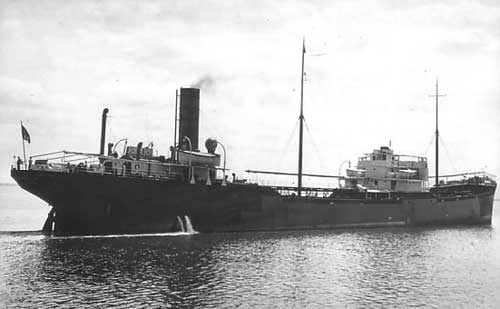
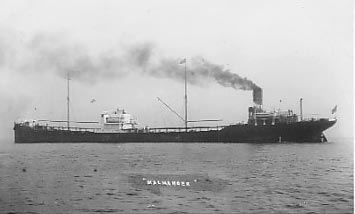
D/T Malmanger To Malmanger on the "Ships starting with M" page.
Manager: Westfal-Larsen & Co., A/S Delivered in June-1920 from Sir James Laing & sons Ltd., Sunderland. 425' x 56.8' x 33', Triple exp. 2200 ihp, 10 1/4 knots. Captain: Jan M. Jacobsen In Admiralty service from 1940 (Royal Fleet Auxiliary, an auxiliary branch of the Royal Navy responsible for, among other things, supplying the fleet with stores and fuel oil. Its vessels were under the control of the Royal Navy but the crews were merchant navy personnel. The vessels were not HMS). Related items on this website: Her voyages are listed on these original images from the Norwegian National Archives: Please compare the above voyages with Arnold Hague's Voyage Record below.
(Received from Don Kindell - His source: The late Arnold Hague's database). Follow the convoy links provided for more information on each.
According to Page 1 of the archive documents, Malmanger was on her way from Abadan to Suez when war broke out in Norway on Apr. 9-1940. Later that month, she's said to have lost a crew member. Oiler Edvin Malvin Klausen is commemorated at the memorial for seamen in Stavern, Norway (see link at the end of this page). "Våre falne", a series of 4 books naming Norwegians who died in the war, says he disappeared on the night leading up to Apr. 27, when Malmanger was en route to Port Said - this agrees with the listing on the archive document. A French visitor to my website has told me that Malmanger sailed from Oran in Convoy 24 RS under French escort on May 14-1940. West of Gibraltar the convoy merged with the French Convoy 97 KS from Casablanca (Rutenfjell is also included). At Le Verdon May 21. Sailed from Le Verdon on June 6 in Convoy 63 X under French escort (Mammy and Star are also listed in this convoy). At Gibraltar June 12; I'm not entirely convinced she sailed in the latter convoy; Page 1 shows that she arrived Trinidad on June 26, Gibraltar is not mentioned for this period. All these convoys are available via the external links provided in the Voyage Record, and as can be seen, A. Hague also appears to be unsure whether she made this voyage independently all the way, or in a convoy from Verdon. From Trinidadd, she proceeded to Bermuda and on July 10, she can be found in the Bermuda portion of Convoy HX 57, bound for Clyde with Admiralty fuel. It'll be noticed, when going back to Page 1, that there's mention of her being drydocked at Greenock. With destination Trinidad, she was scheduled for Convoy OB 250 (ref. external link below), which left Liverpool on Nov. 26, but she instead joined Convoy OB 252 a few days later (originated in Liverpool Nov. 30, dispersed Dec. 4). Andrea Brøvig, Brisk, Elg, Havørn, Profit, Skrim and Solhavn are also named. Malmanger arrived Trinidad on Dec. 21, having started out from Clyde on Dec. 1. In Jan./Febr.-1941 she's listed in Convoy HX 106, for which Topdalsfjord served as the Commodore Vessel. Malmanger again joined from Bermuda. With Belinda, Evanger, Havsten and Strinda, she subsequenly joined Convoy OB 298, leaving Liverpool on March 16, dispersed on the 20th, Malmanger arriving Curacao on Apr. 6, continuing to Gibraltar the next day, then returned to Trinidad (Page 1) and on to Bermuda again. She now headed back to the U.K. on May 25 with the Bermuda portion of Convoy HX 129 (see also the cruising order/Commodore's notes), and in June we find her, whith Alaska, Ferncastle, Norefjord, Skaraas and South Africa, in Convoy OB 338, which left Liverpool on June 21 and dispersed July 3, Malmanger arriving Curacao on July 13 - her voyages in this period are shown on Page 2. She returned across the Atlantic with Convoy HX 141 from Halifax on July 27; according to a report for this convoy, she parted company for Iceland on Aug. 6, escorted by Primrose and Alberni, and arrived Reykjavik the next day. From there, she joined the westbound Convoy ON 19A at the end of the following month - the 3 ships in this convoy are named at the top of my page about Convoy ON 19. Malmanger arrived Curacao on Oct. 19, the convoy having been dispersed on Oct. 4. On Nov. 4, she's listed in the slow Convoy SC 53 from Sydney, C.B. to the U.K. According to A. Hague, she collided with Empire Mariner on Nov. 26. Checking further, I find that the British ship was westbound with Convoy ON 41* at the time and returned to port, joining Convoy ON 45* a couple of weeks later, but returned and does not show up again until ON 72*, returned again, but finally got away with Convoy ON 74*. No further info is available on this collision (A. Hague says Malmanger was undergoing repairs at Clyde from Nov. 26 to Dec. 12. It'll also be noticed that she later spent quite a long time at Falmouth). In Febr.-1942, she's listed as bound for Trinidad in the westbound North Atlantic Convoy ON 71*, which originated in Liverpool on Febr. 26 and dispersed on March 8, Malmanger arriving her destination on March 19. Page 2 has her subsequent voyages.
Related external link:
Malmanger had left Trinidad on July 29-1942 for Pointe Noire with a cargo of fuel oil. She was in a convoy* for a few days until the convoy was dispersed and she continued alone. Torpedoed on Aug. 9 by U-130 (Kals), position 07 13N 26 30W. According to the 2nd mate's statements at the subsequent inquiry she was struck by 2 torpedoes, 1 in the engine room, the other further forward, killing 2 men (he gives position as approx. 07 13N 26 13W). The motorboat on the starboard side aft was destroyed, the engine stopped and lights went out, and she sank by the stern in about 5 minutes.
A lifeboat manned with 4 men was launched, but after it had reached the water the line was cut too soon, and as the ship still had some way, the boat drifted behind it. Some managed to get off on a raft, while others jumped overboard (incl. the 2nd mate) and were later picked up by the lifeboat. Another boat was also lowered, and after they had gotten clear of the ship the U-boat came up and called for them to come alongside. The 1st mate's boat rowed up to the U-boat which submerged shortly afterwards, having taken the captain and 1st Engineer Peder Johan Olsen as prisoners (according to Uboat.net - external page - they were landed at Lorient on Sept. 12). They were later sent to Marlag und Milag Nord (released Nov.-1943). The others set sail in the two lifeboats, having agreed to part company. The 14 in the 2nd mate's boat arrived Ballo near Freetown on Aug. 18, having sailed about 700 n. miles. They were later sent to Freetown where they arrived on Aug. 22. The 2nd mate, the 3rd engineer and the steward continued to Liverpool on a passenger vessel on Sept. 1 with arrival on Sept. 14, while the others remained in Freetown. An inquiry was held in London on Sept. 16-1942 with the 3rd engineer and 2nd mate appearing. The latter stated that one of the casualties, Able Seaman Mathisen, who had been on duty, had last been seen curled up outside one of the forward cabins. The other casualty, Donkeyman Olsen, was on duty in the engine room when the torpedo struck. (I get the impression from the 2nd mate's statements that a 3rd lifeboat had also initially been launched, but had to be let go because it was damaged. It also appears that an SOS had been sent with the emergency set before Malmanger went down). Meanwhile, the 1st mate's lifeboat with 16 men had reached French West Africa, where they were interned (see my page Interned Ships). Gunner John Østerbø managed to escape to Freetown, and in Jan.-1943 he was given passage to the U.K. on S/S Ocean Courage, but this ship was torpedoed by U-182 on Jan. 15, and he lost his life (see link at the end of this page). Bernard de Neumann, a visitor to my website who is researching WW2 prison camps in North and West Africa, has shared with me a telegram from the U.S. Ambassador to the UK to the British Secretary of State for Foreign Affairs transcribing the text of a telegram dated Dec. 7-1942 received from the American Consulate at Dakar, which mentions a British seaman from Malmanger, Alexander Elkin, who at the time was to be sent to Sierra Leone upon his release from hospital at Conakry. Bernard points out that this may mean that other members of the 1st mate's boat might also have been held in Conakry, French Guinea. I looked up some of the names listed in the crew list below as being in the port lifeboat in "Nordmenn i fangenskap" (by Kristian Ottosen - title means "Norwegians in imprisonment") and found 3rd Mate Årås listed as "arrested" on Aug. 18-1942, transferred to Kankan camp, French Guinea, released Dec. 13 same year. The same details and dates are given for Able Seaman Leiknes, Ordinary Seamen Gundersen and Hansen, 2nd engineer Nilsen, Assistant Karlsen, Stoker Halvorsen and Oiler Rasmussen, as well as for Able Seaman/Gunner Østerbø mentioned above, for whom escape date is given as Oct. 1-1942, and Jr. Ordinary Seaman Nonås (born 1924), who is also said to have escaped, but no date is given. Curiously, the info for Stoker Rosland says that he was arrested on June 24-1940, transferred to Oran, then Marseilles, escaped Nov.-1941, arrested Aug. 18-1942, transferred to Kankan camp, released Dec. 13-1942. Had he, perhaps, been on board one of the other interned Norwegian ships previously, possibly President Herrenscmidt (follow link to "Interned Ships" above), then managed to get away to join Malmanger, only to get interned again? (I cannot find 1st Mate Molstad and Ordinary Seaman Wold in this book). Bernard de Neuman has since provided some additional details, which I've decided to add here, in case someone had a relative among the 11 crew members who were in the 1st mate's boat and is looking for more information: "My late father and the crew of Criton (RN prize from Vichy French) were captured after Criton was sunk on 21 June 1941 and taken to a camp at Conakry (the "English" spellings of towns in West Africa vary because they are "anglicisations" of native names). There was a hospital in Conakry and many of Criton's crew spent time there. Eventually the (Vichy) French court-martialled the executive officers of Criton's prize crew, and all European members of her crew, except those in hospital, were transported to Timbuctoo (26 Sept 1941 - 7 October 1941). The native West African firemen of Criton were sent to a camp at Kankan where they lived in the grounds of an agricultural college. About two months later the remaining crew at Conakry hospital were sent to Kankan too, where they were accommodated in a (farm) tractor shed also in the grounds of the college. The 3rd Radio Officer of Criton (Peter LeQ. Johnson) being the only officer there, was appointed "Senior British Officer" and acted as an intermediary between the prisoners and the (Vichy) French Army. On 6 August 1942 the Criton prisoners at Timbuctoo began their move to Kankan, arriving 25 August 1942, and rejoined their shipmates. In November, after the Allied landings in North Africa, the Vichy authorities in French West Africa became jumpy, and started to arrest European civilians in their territory and imprisoned them too in Kankan. They also moved any remaining prisoners at Conakry to Kankan. The camp numbers swelled to nearly 200, but PLeQ (19 years old) remained as Senior camp officer! The imprisoned local civilians were released while the merchant seamen remained in the camp. The seamen were then released on 13 December 1942, and escorted over the border to Sierra Leone, where they were handed over to the British who took them in army lorries to Freetown, arriving on 18 December 1942. So the Criton crew and the occupants of Malmanger's 1st Mate's boat were imprisoned together!" Just 2 days after the attack on Malmanger, U-130 sank the Norwegian Mirlo. (For info, this U-boat was also responsible for the attacks on Frisco, Alexandra Høegh, Varanger, Grenanger and Tankexpress - follow the links for more details).
Crew List:
Related external links: Operations information for U-130. The Oceans - gives more info on the loss of Ocean Courage. See also Back to Malmanger on the "Ships starting with M" page. Other ships by this name: This was Westfal-Larsen's 3rd ship by the name Malmanger. The company also had a ship by this name built in 1910. Sold in 1915 to Johs. Lindvig, Kragerø, renamed Tiro. Sold in 1916 to A/S Gonvik (Christensen & Paulsen), Sandefjord. Sunk by German U-boat northwest of Cape Lizard on Dec. 29-1917. The company had lost a ship named Malmanger to WW I. Some sources say she was torpedoed west of Ireland on a voyage from New York to Avonmouth with a cargo of petroleum on Apr. 22-1917. A visitor to my site has told me that the book "Shipwrecks of the Irish Coast" Vol I says Malmanger was torpedoed 20 miles off Fastnet on March 12-1917, just after her escort Zinna had left her. The latter returned and towed the Malmanger to within sight of land, where she sank bow first with 50 feet of her 300 feet length above water for some time. Baroness di Silva had her chauffeur row around the ship so that she could take photos, one of which is reproduced in the book. The crew were rescued by the sloops, Mignonette and Alyssum. Charles Hocking says she struck a mine south of Ireland on March 22. "Lloyd's War Losses" agrees with this date and the mine theory, as well as with the voyage information. The latter adds that the mine had been laid by the German UC-43, off Baltimore, Ireland. Yet another source (fleet list) also says she was sunk by a German U-boat on March 22-1917, agreeing with voyage and cargo info. This was a tanker, delivered in Febr.-1917. So here we have 3 different dates for the loss. Their 4th Malmanger was built in 1950, became Liberian Grand Integrity in 1965, broken up in Taiwan in 1977. A 5th Malmanger was delivered in March-1968, renamed Star Malmanger in 1972, became Monrovian Star Oasis in 1978, Star Theseus of Piræus in 1979, Star Mindanao of Manilla in 1981. The text on this page was compiled with the help of: "Nortraships flåte", J. R. Hegland, "Sjøforklaringer fra 2. verdenskrig", Norwegian Maritime Museum, Volume II, "Nordmenn i fangenskap", Kristian Ottosen, and misc. (ref. My sources).
|
||||||||||||||||||||||||||||||||||||||||||||||||||||||||||||||||||||||||||||||||||||||||||||||||||||||||||||||||||||||||||||||||||||||||||||||||||||||||||||||||||||||||||||||||||||||||||||||||||||||||||||||||||||||||||||||||||||||||||||||||||||||||||||||||||||||||||||||||||||||||||||||||||||||||||||||||||||||||||||||||||||||||||||||||||||||||||||||||||||||||||||||||||||||||||||||||||||||||||||||||||||||||||||||||||||||||||||||||||||||||||||||||||||||||||||||||||||||||||||||||||||||||||||||||||||||||||||||||||||||