Site Map | Search Warsailors.com | Merchant Fleet Main Page | Warsailors.com Home Merchant Fleet Main Page | Warsailors.com Home |
|
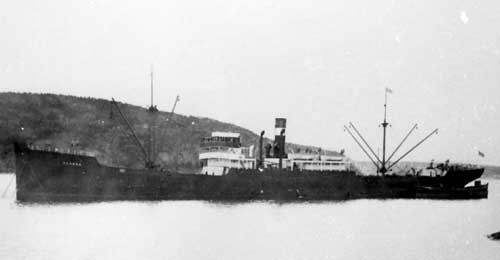
D/S Alaska To Alaska on the "Ships starting with A" page. Owner: Dampsk.-A/S Alaska Delivered in July-1918 from J. Coughlan & Sons, Vancouver, Canada as T/S Alaska, requisitioned same year by The Shipping Controller, London (Furness Withy & Co., Gt. Britain). 410.5' x 54.1' x 27.2', steam turbine (W. & A. Fletcher, Hoboken, N.J.). Returned to owners D/S A/S Alaska (Christian Haaland), Haugesund in 1920, new machinery installed in 1923 - Triple exp. (Swan, Hunter & Wigham). She had the same name until 1930, then renamed Peel County for the same owners. Renamed Alaska in 1934. Captain: Berge Mevatne Her voyages are listed on these original images from the Norwegian National Archives: Please compare the above voyages with Arnold Hague's Voyage Record below.
Follow the convoy links provided for more information on them (please be aware that some of the external listings are incomplete).
Crew List as per Nov. 18-1940 upon departure Middlesbrough for St. John, N.B. (instead went to Halifax)
The majority of the Norwegians were from the Haugesund area. Another crew member, Bernhard Larsen, had been struck by a bus on Nov. 2-1940 and died the next day. According to this posting to my Guestbook, he had joined Alaska on Oct. 22-1940 while she was in Middlesbrough for cargo and repairs. He and two other un-named Norwegians (both firemen) were on their way back to the ship on Nov. 2 after having been on shore leave when he was struck by a Corporation Motor Bus in Queens Square close to The Middlesbrough Mission to Seamen. Mr. Larsen died in The North Riding Infirmary the next day and was buried on Nov. 6 at North Ormesby Cemetary, Middlesbrough. The service was conducted by a Norwegian (Pastor ?) Selinus and the grave number is 378. He was an able seaman, 42 years old, lived at Skaaregaten 189, Haugesund, Norway.
As can be seen when going to Page 1 of the archive documents, Alaska was on her way from Buenos Aires to Buviken (Norway) when war broke out in Norway on Apr. 9-1940. She instead arrived Kirkwall on Apr. 12, proceeding to Avonmouth a couple of weeks later. In May, she made a voyage to New York, having joined Convoy OB 151, which originated in Liverpool on May 19 and dispersed May 22 and also included Fana, Stigstad, and Titanian. Alaska arrived New York on June 4, having started out from Milford Haven on May 20. From New York, she later proceeded to Halifax, and with a cargo of steel and machinery, she joined Convoy HX 52 from there on June 21. She arrived Swansea on July 9, and now appears to have remained there for quite a long time (again, see the archive document referred to above), before heading back across the Atlantic the following month in Convoy OB 202. This convoy, which also had Brask, Bur, Einvik, Mosli and Veni in its ranks, originated in Liverpool on Aug. 22 and dispersed on the 26th, Alaska arriving Montreal on Sept. 5 (she had sailed from Swansea on Aug. 18, from Milford Haven on Aug. 21). See the external links provided within the Voyage Record for more details on the OB convoys mentioned here. Alaska returned to the U.K. again in the slow Convoy SC 5 from Sydney, C.B. on Sept. 18 (she's said to have been cancelled from Convoy HX 74), cargo of lumber and steel for Middlesbrough, where she arrived, via Clyde and Methil Roads, on Oct. 13, remaining there for over a month. She was scheduled for Convoy OB 250, leaving Liverpool on Nov. 26-1940, but she did not sail. Her destination is given as St. John, N.B. As mentioned in my heading for the above crew list, she left Middlesbrough for St. John, N.B. on Nov. 18; from Middlesbrough, she now went by Methil Roads, Oban and Clyde before joining Convoy OB 255, which originated in Liverpool on Dec. 7 and dispersed on the 10th. According to the Voyage Record and Page 1 of the archive documents, she instead headed to Halifax, with arrival there on Dec. 26. Gallia and Torborg are also named in this convoy, though Torborg returned to port. (Nyland was scheduled but had run aground before she could join - follow the link for details). Related external link: With a cargo of copper concentrates and zinc for Swansea, she subsequently joined Convoy HX 140, along with the Norwegian Madrono, Boreas, Velox, Velma, Thorshov, Stiklestad, Vardefjell, Evita, Olaf Bergh, Skiensfjord, Ferncastle, Thorshavet, Bonneville and Helgøy. Beth and Petter were also initially in this convoy but left due to engine problems (Chr. Th. Boe and Bur are said to have joined later from Iceland). HX 140 sailed from Halifax on July 22, but judging from the information found on Page 2, it looks like Alaska joined this convoy from St. John's, N.F. She arrived Swansea, via Belfast Lough, on Aug. 8. Some of the above ships, including Alaska (bound for New York), went back in the other direction again with the westbound Convoy ON 9. She arrived her destination on Sept. 6, having started out from Milford Haven on Aug. 19 (the convoy had been dispersed Aug. 25). See also my page about Inger. A. Hague now has Alaska in the slow Convoy SC 46*. Bestik (returned), Bonde, Bruse Jarl, Fidelio, Gezina, Loke, Senta and Solsten are also listed in this convoy, which left Sydney, C.B. on Sept. 24 and arrived Liverpool Oct. 10; Alaska continued to Garston, arriving there Oct. 11. Later that month she joined the westbound North Atlantic Convoy ON 30. Her initial destination was Sydney, C.B., but according to the comments found under Nov. 8 in the Commodore's narrative her destination was later changed and she arrived Three Rivers on Nov. 13, proceeding to Montreal 3 days later. Note that she's listed as scheduled for the slow Sydney (C.B.)-U.K. Convoy SC 51 on Oct. 23, but of course she could not have been in that convoy, as she was still in the U.K. at that time. She is, however, included in Convoy SC 57 on Nov. 28, cargo of steel for Hull, where she arrived, via Loch Ewe and Methil Roads, on Dec. 21. Alaska returned to New York in Jan.-1942 with Convoy ON 56*, which originated in Liverpool on Jan. 12 and dispersed on the 16th, Alaska arriving New York on Jan. 30. She now remained there for a long time; Page 2 gives departure as May 2, when she proceeded to Cape Town, arriving June 5, later making voyages to Bombay and Colombo - according to A. Hague, she had been under repair while in Bombay for over a month.
Alaska had departed Colombo again on Aug. 28-1942 for the U.K., via Capetown and Freetown, with a cargo of 4268 tons of tea and other general, incl. 15 tons citronella oil and 231 bales of fiber on deck. She arrived Capetown on Sept. 21, then continued the following day after having taken on bunkers and supplies, with arrival Freetown on Oct. 8 (Page 2), departing Freetown on Oct. 16 in Convoy SL 125 (the Norwegian Germa and Belnor were also in this convoy, which can be found via the external link provided in the Voyage Record). On Oct 30, she was ordered by the Commodore to take over as rescue vessel, because the designated rescue ship had been sunk, and immediately started to prepare for this task by getting all lines, ladders, nets, life buoys and lifebelts ready near the railings, while volunteers were chosen to go in the water with their survival suits on, should it be necessary to do so in order to rescue surviors who were unable to help themselves. That same day the British troopship Président Doumer, sailing on their starboard side (a former French passenger vessel) was torpedoed by U-604 (Höltring). The troopship had about 345 people on board, 260 died. According to Alaska's captain, half of the ship's top bridge had been blown off and thrown into the water and therefore, most of the officers were probably killed. In the ensuing panic one lifeboat after another was dropped on the water and destroyed, some were empty, some had people in them. Captain Mevatne states that Président Doumer probably received 2 torpedoes, but she had hardly any list at all, so the lifeboats could have been launched fairly easily, but instead most people fell or jumped overboard, the majority of them without lifebelts. Some of them were good swimmers and were rescued for that reason. Those who managed to get in lifeboats were "like wild cats from panic, and fought with knives and oars to keep their place in the boat and prevent others from entering". This behaviour made the rescue work extremely difficult, especially since none of the survivors made any effort to use the oars to get alongside Alaska, but left it up to the Norwegian ship to come up to them. After about 15 minutes the ship went down, and from that moment the sea was thick with swimming and drifting people, with or without lifebelts, screaming for help. About 30 men of Alaska's crew were standing by the railings on both sides to haul survivors aboard, but as none of them made any effort to tie the lines around themselves, the Norwegians had to get into the water to assist those who were too exhausted. A few were pulled on board in this manner, but these efforts were gradually given up because of the dangers involved due to the highs seas and all the sharks along the side of the ship. A ruined lifeboat with 48 people was alongside, none of whom were able to climb the ladder, so the 2nd and 3rd mates went down in the boat and after a short period of time they had fastened lines around 46 of them, whereupon they were hauled aboard Alaska by willing hands. The remaining 2 were crushed between the side of the lifeboat and the ship because they were hanging outside the boat. On Alaska they had at first thought there were women and children wearing red scarves on their heads in the boat, but upon closer inspection the "red scarves" simply turned out to be bloody sculls. Those people were rescued first, while those who were not injured at all fought with the mates because they were not interested in being pulled up by a line, but the mates for their part had no intention of treating anyone with silk gloves; as many people as possible had to be rescued as quickly as possible.
2 lines were thrown out to another crowded lifeboat on the port side, but this time the rescue was made a little easier in that 2 of the survivors hauled themselves aboard by their own "power", however, they did not take the time to secure the boat alongside Alaska so it drifted passed the poop. Alaska was maneuvering slowly to the right to assist some survivors who were heard crying for help in the water, when she herself was hit by a torpedo from U-510 (Neitzel) in No 1 hold, starboard side. Captain Mevatne says that this happened 2 hours and 40 minutes after Président Doumer had been hit (it was Oct. 31 by then). The explosion was so powerful that they were thrown off their feet, and hatches and other items flew into the air. She started to sink by the bow while the sea washed over her decks. The engine was immediately stopped and emergency signals sent out with the position 35 06N 16 59W (J. Rohwer gives 36 06N 16 59W). 2nd Mate Engel Thuen got the code books, signal books and logs, placed them in the designated weighted box and threw them overboard, then made sure that all the rafts had sufficient provisions and water. The captain went down to the boatdeck where he again encountered complete panic. The steward and 2nd mate had attempted to give first aid to those previously rescued, scattered around on benches and tables in the saloon. 7 were fatally injured, 2 of whom had severe skull injuries. One of the latter, an Indian by the name of Eman Ale died of his injuries, while the other jumped overboard when Alaska was hit by the torpedo. Another 4 had swallowed so much water that it took lenghty revival efforts to bring them back to consciousness. The area looked like a "butcher's house" where they were "wading" in blood. Other survivors rushed to the lifeboats; 2 boats were already being launched, though no orders had been given for this to be done. Fortunately, the crew prevented the tackles from being cut before the boats reached the water, and the 2 boats were successfully lowered with about 25 people in each. The 1st engineer, 1st mate and the radio operator, who carried the emergency radio, and some of the crew as well as some of the rescued survivors went in the motor boat and were ordered to stand by, in case something was to happen to those who had remained on board. This boat also had maps and navigational instruments on board. Sharks were all around them. The boats on the port side could not be lowered due to the heavy weather; an attempt at doing so had resulted in one of them being crushed against the side of the ship. In the meantime, some of Alaska's cargo had fallen out of Hold No. 1, and this straightened her up somewhat. The captain gave the order for the emergency engines to be started so that the pumps could be used. After the new position had been sent out, as well as a report that the ship was slowly sinking (this was to inform any nearby U-boat that more torpedoes were, in fact, not "necessary") the crew and rescued survivors were fed and taken care of, while everything possible was done to prepare for another attack. Damages were extensive, but they were able to make necessary repairs. The lifeboats were later hoisted back on board, though with great difficulty in the high seas, and course was set for Madeira that afternoon at slow speed, until they met a corvette, which asked Alaska to follow her to the abandoned Silverwillow which had also been torpedoed. A tug and escort were en route to take this vessel to port and Alaska was to go along. It appears that some of the crew had had enough, because while en route to the torpedoed Silverwillow, 3 men representing the rest of the crew came to the bridge, demanding that Alaska should not move at all during the night, that the lifeboats should be launched again with the entire crew in them, to remain in the boats through the night then reembark in the morning and continue the voyage (presumably to ensure that they would have a chance of survival, having seen the previous behaviour of their passengers). If these demands were not met, the stokers and able seamen would immediately stop work. Since these conditions were put forth as a threat rather than a request to the captain, no heed was paid to them. The captain's response was that if everyone did their duty they still had a chance to save themselves, the ship and her cargo. Furthermore, they were reminded of their great responsibility to the injured on board, who could not be transferred to a lifeboat, and besides, standing by in lifeboats through the night could be very dangerous if the weather worsened, in which case it would be extremely difficult to get them back on board. Also, they were told that the ship would still be taken care of whether they worked or not. That afternoon, they encountered a Spanish and a Portuguese ship, the latter being a passenger vessel with a doctor on board, whom the corvette requested to see to the injured passengers from Président Doumer, but was told to send them across to the Portuguese ship instead. This was not possible, so they gave up getting any help from that direction and the Portuguese ship continued, as did the Spanish one. In the morning of Nov. 1 all(?) the rescued survivors and some extra provisions were transferred to the corvette with the help of a lifeboat manned by 7 men and the 2nd mate; not an easy task in the heavy seas and strong winds. The next day Eman Ale was "buried", followed by a thorough cleaning of the ship. The corvette requested assistance with Silverwillow's Doxford engine, but Alaska's mechanics had little knowledge of this type so 2 of Président Doumer's engineers were pursuaded to go on board to try and get the engine going, with the help of the Norwegian mechanics, but did not succeed though they worked on it for 2 days, so on Nov. 3 they had to be brought back to Alaska in a lifeboat because of the increasingly heavy winds and seas. Alaska stayed with Silverwillow for several days in such heavy weather that they had to use oil to calm the seas. On Nov. 4, they were told that the tug and escort were not far away, and that they would be taken to Lisbon. Later that day, the corvette experienced engine trouble and one of Alaska's engineers was sent over, then brought some broken parts back. New ones were made and sent back to the corvette within a couple of hours. On the 5th, they were told to leave the area and follow the corvette towards Gibraltar. That same afternoon, they met the tug and escort and the corvette left them, while Alaska joined the other 2 vessels. The next morning, the tug fastened a towline on Silverwillow and Alaska could finally head to Lisbon. The winds increased and this proved to be too much for Silverwillow, which went under on Nov. 11. Alaska's escort left her on Nov. 12 (the tug had departed when Silverwilliow sank) and, though she continued to have problems with the various damages, she was able to proceed without assistance (other than a pilot who embarked just before midnight on the 12th), and arrived her destination in the early morning hours of Nov 13 (Page 2). That same day, surveyors from Lloyds came aboard, and it was decided to unload her cargo, then dock her. J. R. Hegland ("Nortraships flåte") says that Alaska had 56 survivors from Président Doumer as well as some survivors from the British Tasmania on board (sunk by U-103 on Oct. 31, also Convoy SL 125 - according to Uboat.net, Alaska picked up 20 survivors from this ship, see the external link below). He adds that Alaska was temporarily repaired then continued to the U.K. Captain Mevatne later received "Krigskorset" (The War Cross), the highest ranked Norwegian decoration for his actions. The maritime hearings were held in Lisbon on Nov. 18-1942. The captain, 1st Engineer John Natvig, 2nd Mate Engel Thuen and Able Seaman Konrad Aarvik appeared. Some other crew members at the time were: 1st Mate F. Johansen, Donkeyman H. Stokknes and Gunner Olaf Olsen. A visitor to my website, George Monk has told me that the following men received ungazetted awards for rescuing survivors of a torpedoed ship and for saving their own ship after being torpedoed (his source: Seedies List of awards to the British Merchant Navy which includes awards to Allied merchant seamen): Captain Berge Mevatne - Hon OBE(Civ) Berge Mevatne also received Lloyds Bravery Medal The following all received a Commendation: 1st Mate Finn Johansen, 2nd Mate Engel Thuen, 3rd Mate Georg Aschehoug, Steward Trygve Hansen, Cook Kjell Høier, and Able Seaman Olaf Olsen.
Baron Vernon - no casualties, Brittany - 14 died, Bullmouth - 50 died, Corinaldo - 8 died, Hopecastle - 5 died, Nagpore - 19 died, Pacific Star - no casualties, Silverwillow - 5 died, Stentor - 44 died, Tasmania - 2 died, and Anglo Maersk, all British, though the latter was originally Danish - sailing under the British flag. See also the first external link below. Related external links:
Due to the fact that this ship had a Norwegian captain (Karl M. Walløe Valsberg) and 1st mate, (P. L. Brandt) I'll include a brief summary of the captain's report on her final fate. Captain Valsberg had been the mate on M/T Norfold when he on May 8-1941 was requested by the British consul in Bombay to join the Danish ship as mate - later became the captain. Anglo Maersk stopped to repair in the evening of Oct. 19, 3 days after departure Freetown due to engine problems. Continued 27 hours later, at 01:00 Oct. 21. In the afternoon of Oct. 26, in approximate position 28N 22 15W she was hit by a torpedo from U-509, course immediately altered and guns manned. The U-boat surfaced but quickly submerged when Anglo Maersk started firing. Explosion forward had caused damages around the boilers as well as the air compressor. About an hour later the captain ordered course for the Canary Islands. Carpenter was told to pump out the ballast water in No. 9 starboard and port tanks to lift the ship forward. Examination showed the torpedo had hit near the engine room. Boiler room was filled with water, leaking into No. 10 tank on starboard side, other extensive damages found as well. At around 09:30 on Oct. 27 another 2 torpedoes were fired, and at about 11:00 that same day another 3 - all 5 missed. She continued on a more southerly course until 18:10 when hit by a torpedo (U-604) in the starboard side in tank No. 9, causing her to start sinking by the bow. Crew was ordered to abandon ship, 2 boats launched, mate's boat with 17 men, captain's boat with 20. At about 18:30 another torpedo hit amidships, shortly afterwards another hit near the diesel oil tank forward of engine room, approx. position 28N 18 55W, about 43 miles west of Hierro Island. Both boats reached Ferro(?) Island (Canary Islands) about 14:00 on Oct. 28. All 37 had survived, embarked S/S Las Palmas for Teneriffe on Oct. 30, arriving the next day. Departed on Nov. 5 with S/S Isle de Teneriffe arriving Cadiz on the 6th. Departed around midnight on Nov. 8, arriving Gibraltar the next day. 2 naval gunners and Oiler R. Malcolm remained there in hospital, while the rest joined S/S Llanstellan Castle which departed Gibraltar on Nov. 12 and arrived Greenock on the 19th. Captain Valsberg was awarded the British OBE for his actions while in Convoy SL 125. He later became gunnery officer on Duala from June 1-1943 until Jan. 8-1945 and Roseville from Jan. 9-1945 until Oct. 20-1945. Related external link:
As mentioned further up on this page, Alaska had been repaired in Lisbon, with further repairs undertaken at Tyne from March-1943 until Nov.-1943. She can now be found in Convoy OS 59/KMS 33, voyaging from Oban to Buenos Aires in ballast (link in Voyage Record - Lago, Loke and Spurt are also listed). This convoy started out in Liverpool on Nov. 16 and split up on Nov. 28, the KMS portion* heading to Gibraltar, while the OS convoy continued to Freetown. Alaska, however, arrived Montevideo on Dec. 22, continuing to Rosario that same day, having parted company with the convoy on Dec. 1 (she had sailed from Oban on Nov. 17). She later proceeded to Santa Fe, then arrived Buenos Aires on Jan. 1-1944. Page 3 shows her voyages in this period. The following month, we find her going in the other direction with Convoy SL 148/MKS 39, cargo of linseed, meat and general, bound for Loch Ewe. SL 148, in which Alaska took part, departed Freetown on Febr. 1, joined up with the MKS convoy* from Gibraltar on the 12th, the combined convoy arriving Liverpool on Febr. 24 - Alaska stopped at Loch Ewe that day. The Norwegian Norbryn, Norma and San Andres also took part (A. Hague has also included Mathilda). Together with Chr. Th. Boe, Fjordheim, Minerva, Ragnhild, Stirlingville, Tropic Star and Tungsha, she later joined the westbound North Atlantic Convoy ONS 32*, which left Liverpool on March 28 and had Halifax as its final destination, but Alaska was bound for New York, where she arrived on Apr. 20, having sailed from Oban March 29. She subsequently made voyages to San Juan and La Romana, then returned to New York (convoy info in Voyage Record), heading back to the U.K. in Convoy HX 294 from there on June 2, bound for Liverpool with a cargo of sugar and general. Commodore was in Abraham Lincoln, Vice Commodore in Geisha. Alaska subsequently stayed in Liverpool for over a month (Page 3), then in July, she joined the westbound Convoy ON 246*, which departed Liverpool on July 25 and arrived New York on Aug. 9 - Alaska joined from Belfast Lough. Abraham Lincoln had again been in company, as had Atlantic, Brimanger (Commodore Vessel), Dageid, Dalfonn, Danio, Fernwood, Ivaran, James Hawson, Kaldfonn, Leiv Eiriksson, Ørnefjell, Petter, Skotaas, Strinda, Thorhild, Tiradentes, Toronto, Vardefjell and Velox. On Oct. 4, Alaska is listed in the slow Halifax-U.K. Convoy SC 158, cargo of sugar for Liverpool, where she again had a long stay (Page 4). She now made a voyage to Augusta, having sailed in Convoy OS 96/KMS 70, which departed Liverpool on Nov. 23 and also included Bestik and Troubadour; see the external link provided within the Voyage Record. Alaska arrived Augusta on Dec. 6-1944, continuing to Bari a few days later. Skipping now to March-1945, when she's listed in Convoy MKS 87* (left Gibraltar on March 6, arrived Liverpool March 14), and the following month we find her, along with Ferncliff (Commodore Vessel), Hardanger, Lago and Sommerstad, in the westbound North Atlantic Convoy ONS 46*. This convoy departed Liverpool on Apr. 2 and arrived Halifax on the 20th - Alaska, however, was again bound for New York, where she arrived on Apr. 22, remaining there for over 3 weeks (she had started out from Belfast Lough, Apr. 2). In the middle of May, she made a voyage to San Juan. Again, please see Page 4 for a listing of her subsequent voyages (it'll be noticed, that she had a long stay at North Shields that summer). As can be seen, she made a voyage to Norway in Sept.-1945. Page 5 shows her voyages to Febr.-1946 (it looks as though she may have been in Norway for Christmas in 1945, and headed back to Norway again in Febr.-1946 but arrival there is not given).
Renamed Reg III in 1951 for Deutscher Seeverkehr AG Eric Lubert & Co, Hamburg; Renamed Ebba Blumenfeld in 1954 for B.D. Blumenfeld GmbH, Hamburg. Renamed Manfred Stansfield (Standsfeld?) in 1957 for Nordatlantische Kohlen-Schiffahrts-GmbH, Hamburg. Scrapped in Hamburg in 1958. Related external link: Back to Alaska on the "Ships starting with A" page. The text on this page was compiled with the help of: "Nortraships flåte", J. R. Hegland, "The Allied Convoy System", Arnold Hague, "Sjøforklaringer fra 2. verdenskrig", Norwegian Maritime Museum, Volume I, "Våre gamle skip", Leif M. Bjørkelund / E. H. Kongshavn and misc. other for cross checking details. The details on Anglo Maersk are from an article in "Tilbakeblikk", written by J. R. Hegland - ref My sources.
|
|||||||||||||||||||||||||||||||||||||||||||||||||||||||||||||||||||||||||||||||||||||||||||||||||||||||||||||||||||||||||||||||||||||||||||||||||||||||||||||||||||||||||||||||||||||||||||||||||||||||||||||||||||||||||||||||||||||||||||||||||||||||||||||||||||||||||||||||||||||||||||||||||||||||||||||||||||||||||||||||||||||||||||||||||||||||||||||||||||||||||||||||||||||||||||||||||||||||||||||||||||||||||||||||||||||||||||||||||||||||||||||||||||||||||||||||||||||||||||||||||||||||||||||||||||||||||||||||||||||||||||||||||||||||||||||||||||||||||||||||||||||||||||||||||||||||||||||||||||||||||||||||||||||||||||||||||||||||||||||||||||||||||||||||||||||||||||||||||||||||||||||||||||||||||||||||||||||||||||||||||||||||||||||||||||||||||||||||||||||||||||||||||||||||||||||||||||||||||||||||||||||||||||||||||||||||||||||||||||||||||||||||||||||||||||||||||||||||||||||