Site Map | Search Warsailors.com | Merchant Fleet Main Page | Warsailors.com Home Merchant Fleet Main Page | Warsailors.com Home |
|
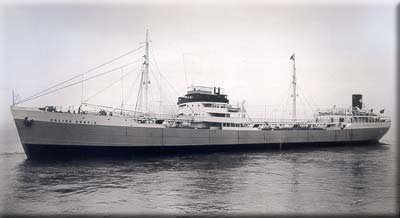
M/T Erling Brøvig To Erling Brøvig on the "Ships starting with E" page. Manager: Th. Brøvig, Farsund Delivered in Dec.-1937 from Bremer Vulkan, Vegesack (739) as Erling Brøvig to Th. Brøvig, Farsund. 492.9' x 66.1' x 28.4', 6 cyl. 2T double acting MAN DM (Bremer Vulkan), 4100 bhp. Captain: Rudolf V. Jacobsen Her voyages are listed on these original images from the Norwegian National Archives: Please compare the above voyages with Arnold Hague's Voyage Record below.
(Received from Don Kindell - His source: The late Arnold Hague's database). Follow the convoy links provided for more information on each.
As will be seen when going to Page 1, Erling Brøvig was en route from Los Angeles to Manila when war broke out in Norway on Apr. 9-1940. Her 1941 voyages also start on this document and continue on Page 2.
Erling Brøvig had been 1 of 7 tankers in Convoy MS 3, which had departed Fremantle in ballast on Jan. 30-1942 to pick up as much oil as possible in Palembang. Four of them were Norwegian; Erling Brøvig, Elsa, Seirstad and Herborg. This was around the time that the Japanese attacked Sumatra with Palembang as their main goal. Around Febr. 12, all the ships in Palembang got the order to sail, as an attack was imminent. That night the Banka Straits was full of ships of all types, trying to retreat ahead of the Japanese threat. On Friday the 13th the convoy of tankers was out of the Straits and headed for Batavia, with the British destroyers Jupiter and Stronghold as escorts, when attacked by at least 8 aircraft*. Erling Brøvig was hit by a bomb and set on fire, a Chinese seaman died and a Norwegian injured. The crew managed to extinguish the fire and, in spite of the damage, reached Batavia safely on Febr. 14. Most of her cargo of 4500 tons fuel oil was transferred to M/T Herborg. After the crew had repaired some of the bomb damages she joined another convoy (SJ 4 - link within the table above) continuing on her way on Febr. 19, arriving Colombo on the 28th, proceeding a couple of days later to Trincomalee where she arrival March 3, and where she took on board bunker oil for Fremantle. She arrived Fremantle on March 24, remaining there until Nov.-1942 while more repairs were carried out. ("Handelsflåten i Krig", book 4, says that while at Fremantle she supplied Queen Elizabeth, Queen Mary and Ile de France, as well as many war ships with oil). Her subsequent voyages are shown on Page 2 and Page 3 of the archive documents, while convoy information for some of them can be found in A. Hague's Voyage Record above.
Erling Brøvig left Bandar Abbas in Convoy PA 69 (external link) in the afternoon of Febr. 16-1944 for Suez (for orders) with a cargo of 14 546 tons of Admiralty fuel oil. The Norwegian Athos, Egda, Ima and Pan Aruba are also listed in this convoy. On Febr. 23* the American E. G. Seubert and the British San Alvaro were sunk by U-510 (Eick) at 03:30 hrs and 03:35 hrs respectively. Alarm for action stations was immediately sounded on Erling Brøvig after the first ship had been attacked, and fire hoses were coupled and made ready, while orders for sharp lookout were given to all stations. As no signals were received from the Commodore, she continued with the same course and speed, keeping her station in the convoy (62). At 04:49 hrs a signal for torpedo track on the port side was given by a ship in one of the port columns, but it was impossible to determine which ship the signal came from. A few seconds later the captain, the 2nd mate and a couple of the crew saw the wake of a torpedo about 45° on the port bow, and before anything could be done Erling Brøvig was struck amidships and severed almost in 2. The torpedo struck at 04:50 at an angle of about 60° on the port side and exploded in tanks No. 5 and 6. Her side tanks No. 17 and 18 were flung open, the deck was torn and set up 8-10' for a length of 30-40' from the port side and well over the midship line, causing the ship to sag heavily in the middle.
The engines were stopped, and after having examined the damages the captain decided it might be possible to save the ship; everything appeared to be in order in the engine room and the steering gear also seemed to be working fine. They attempted to keep up with the convoy at moderate speed but the ship started breaking more and more abaft of the pump room. The shell plating on the starboard side protruded outwards, forming an arc, and the deck was set up, as were the whole deck plating and flying bridge on the port side, so her engines were again stopped and they had to watch the convoy and escorts disappear in the distance. Erling Brøvig continued to break and loud crashes were heard as rivets and bulkheads cracked and sprang aleak, with oil flowing out from the tanks. The pumproom filled with oil and water. The valves for tanks 3, 4 and 12 were opened to the sea in order to get rid of some of the oil and make the ship lighter. Having spotted what was believed to be a periscope about half a mile off at 06:15, and fearing another attack, the crew was sent away in lifeboats at 06:30, while the captain, the 1st mate, the radio operator, the 3rd engineer, Able Seaman Skjerdal and Mechanic Meling remained on board. At 06:50 an aircraft was seen, but it passed along the coast. A message was sent to the Admiralty in Aden at 08:00 hrs (05:00 GMT) requesting immediate assistance. At 08:20 a decision was made to try to take the ship in towards the coast at dead slow speed, true course 330°, then about 09:00 the corvette Orissa arrived and the lifeboats, which were about 1.5 miles astern were taken in tow. In response to the captain's request for a chart covering the anchorages on the coast, a chart was handed to one of the lifeboats which pulled up to Erling Brøvig to deliver it, before the corvette proceeded on her way to catch up with the convoy. Meanwhile, Erling Brøvig headed towards the coast, while aircraft circled above them now and again, but although they used the engines at dead slow and stop in order to put as little strain as possible on the ship, she continued to break. At around 11:00 a warship was spotted on the horizon. This turned out to be the escort vessel Tamworth and she made for the lifeboats which at that time were about 45° on their starboard bow about 2-3 miles away. Erling Brøvig had been listing about 25° to port, but after another bulkhead broke at around 11:30 (probably to tank No. 13) she straightened up somewhat, but sank about 7' in the middle, while shell plating protruded about 4' on the starboard side, and the deck plating was rising upwards about 4' from deck level. The main deck on the starboard side was now about 5' under water, and on the side where the torpedo had detonated the deck plates were set up 12-15', with the ship's side torn open for a length of 15-20'. The oil was streaming out and she continued to sink in the middle, so they feared the 2 parts would separate at any moment. They had still not received any reply to their request for assistance from Aden, and the radio operator's attempt at sending another message failed as the aerials were fouled. At this time the confidential books and papers were thrown overboard, and at about 12:00 the remaining 6 men took to the rafts. The motorboat came up and towed the rafts away from the ship. After morse signals had been sent to Tamworth, she came up to within hailing distance and the captain reported the situation to the commander and asked him to stand by the ship as protection, but was told that their Asdic and radar were out of action due to explosion of depth charges, and since she already had 87 survivors from other ships he did not consider it advisable to remain longer than necessary. The lifeboats were set adrift and everyone taken on board the corvette which sent the following message: "Erling Brøvig still afloat. Back broken. Taken off crew. Position: 13 46N 48 46E". They had managed to sail Erling Brøvig about 6 miles towards the coast before the attempt was abandoned. Her crew was landed in Aden in the morning of Febr. 24. (A personal story found in "Sjøfolk i krig" by Leif M. Bjørkelund, says the crew reached Aden in lifeboats after the torpedoing and were placed in a British military camp there. After some time they were able to get to Cape Town on board the Panamanian Seawall, commanded by the Norwegian Captain Sveen. According to A. Hague, this ship left Aden on March 27 in Convoy AKD 19 - external link). The following day, the captain was informed that salvage vessels had been sent out to the ship, and in spite of several requests for permission to go out to Erling Brøvig this was denied. He was later told that she had been taken in tow and was approaching Aden at 2 knots. Finally, on March 3 he was told that she was getting close and Captain Jacobsen, the 1st mate and the 1st engineer were allowed to go on board together with an MoWT representative, a Lloyd's surveyor and Royal Navy officers. At 14:10 that day they arrived at Erling Brøvig to find her in tow of Confederate and Ocean Salvor. Her Norwegian flag had been taken down and replaced by an English one. She was anchored up off Jezt Salil in about 9 fathoms with a salvage vessel nearby. The next day, March 4, the captain and the 1st mate were requested by the Royal Navy to go on board together with a Lloyd's surveyor and representatives from MoWT and SOI in order to pick up drawings and plans for the ship. They arrived to find that most of their personal belongings as well as the ship's equipment, parts of her interior, and all her provisions including tobacco and alcohol were gone. On March 5 the crew went on board to rescue what was left of their personal belongings, and when an armed guard from Royal Navy boarded Ocean Salvor quite a few of the missing items from the ship and crew were found. The next day some of her provisions were found on board Confederate. Erling Brøvig was moved to a better anchorage on March 6 and the following day the captain went on board with Commodore Aylmar in order to inspect the situation. M/T British Justice was requested to go alongside to take Erling Brøvig's cargo, but the captain and 1st engineer of that ship found they did not want to do so. However, following continuous discussions and negotiations it was finally decided on March 27 that her cargo was to be transferred to the barge(?) Danube Shell. The transfer took place from March 29 until Apr. 13. Erling Brøvig was subsequently temporarily repaired and on Sept. 16-1944 Captain Jacobsen took her to Massowah for her own power - note that Page 3 of the archive documents gives departure Aden as Sept. 12, arrival Massowah Sept. 16. The next Norwegian victim of U-510 was M/S Tarifa on March 7-1944. This U-boat had also been responsible for the attacks on Alaska and B. P. Newton - follow the links for details.
On Aug. 22-1946, she left Massowah in tow for Italy in order to be repaired, but after one day's travel she broke in two behind midships, both parts still floating. The tug continued with the forepart, the captain moved to the afterpart, sailed her (with the help of Chief Engineer Edvin Dahl and others) as far as Suez by her own power, got a tug's help through the canal and arrived Genoa safely. Repaired in Genoa and entered service as Bramora in March-1947 for Ludv. G. Braathen, Oslo. Sold to China in 1961 and renamed Chien She 113 for Bramera & Laon Tschau, Shanghai. Renamed Ta Ching 13 in 1972, Da Qing 13 in 1975, and eventually broken up. External links related to the events in the above text: Back to Erling Brøvig on the "Ships starting with E" page. The text on this page was compiled with the help of: "Sjøforklaringer fra 2. verdenskrig", Volume I (Norwegian Maritime Museum), Lloyd's War Losses, Vol. 2, and misc. sources as named within above narrative - ref. My sources. Also, some details received in an E-mail from Tor Leiv Tørvik, Norway.
|