Site Map | Search Warsailors.com | Merchant Fleet Main Page | Warsailors.com Home Merchant Fleet Main Page | Warsailors.com Home |
|
M/S Nyhorn To Nyhorn on the "Ships starting with N" page.
Manager: Christian Haaland, Haugesund Delivered in Dec.-1929 from A/S Burmeister & Wain's Maskin- & Skibsbyggeri, Copenhagen as Nyhorn to D/S A/S Idaho, Haugesund (Chr. Haaland). Transferred to A/S Atlas in 1933. Captain: Frants Askeland. Related items on this website:
Her voyages are listed on these original images from the Norwegian National Archives: Please compare the above voyages with Arnold Hague's Voyage Record below.
(Received from Don Kindell - His source: The late Arnold Hague's database). Follow the convoy links provided for more information on each.
As can be seen when going to Page 1 of the archive documents, Nyhorn was in New York when war broke out in Norway on Apr. 9-1940, departing that day for Gibraltar, where she arrived on Apr. 22, proceeding to Algiers the next day, later making voyages to Tunis and Marseilles, before heading back to New York on May 11.
Nyhorn was 1 of the 26 Norwegian ships interned in North and West Africa in the summer of 1940 (follow the link for a list of all 26). She had arrived Casablanca with general cargo from New York on June 30-1940 (July 1?), via Lisbon June 22/June 28, having departed New York on June 10. Ole Sundby says in his story that while in Lisbon a ship had accidentally run into her, causing damages to her bow, so that she had to spend 6 days in dock while repairing. According to a story written by the 2nd mate, Nyhorn had been under French charter since Dec.-1939 and was en route from the U.S. for Marseilles with war stores when ordered to go to Casablanca to unload her cargo there. After having unloaded in Casablanca she was kept back by the Vichy French authorities, then on Sept. 10(?) she was placed in a French convoy along with other allied ships and taken to Port Lyautey, arriving the next day (compare with the details found on Page 1, which gives arrival 10/3, but the month [March] is probably a typing error. The document says she was still in Casablanca on Sept. 17, and if this is correct, she must have arrived Port Lyautey some time after that date). The 2nd mate adds there were 6 Norwegian, 5 Danish, 1 Dutch and 1 English ship interned there at the time, moored along the Sebou River, 4 miles up from the coast. "Nortraships flåte" says she was interned on June 30-1940, while R. W. Jordan's "The World's Merchant Fleets 1939" states she was seized in Casablanca June 3-1940 (date probably just a printing error?).
In June-1941, 13 men from various interned ships attempted to escape in a lifeboat from M/S Batavia. They were 1st Mate W. Andresen, 2nd Mate Helge Gundersen and 5 crew (from Batavia?), as well as 1st Mate Tønseth and the 4th engineer from M/S Gran, 1st Mate Møller from Birgit (Danish), 1st Mate Michelsen from Storaa*, Steward A. Jørgensen from Hilde (Danish) and Nyhorn's 2nd Mate Ingolf Sexe. But they didn't get very far. Ingolf Sexe says they were fired upon with machine guns when they were about 400 meters from the Media Fortress that night and had to jump overboard so as not to get shot. The boat was destroyed, but they were all able to swim ashore where 30-40 men awaited them, and they were subsequently placed in a cell in the old fort (from 1680). They had to stand straight up and down all night, then the next morning they were marched off into town 7 km away, where they were given a 15 days' jail sentence, though being as the prisons were overcrowded the officers were ordered to "serve their time" on board ship, while Batavia's crew stayed in jail. (Note that according to Ole Sundby's story, this escape was made with the 2nd boat made in the hold of Nyhorn, not the lifeboat from Batavia).
Ingolf Sexe tried again, this time in a boat built in No. 1 hold of Nyhorn, the first of 3 built in that ship and used in successful escapes. The construction started on Sept. 15-1941, and in on the scheme were Electrician Olaf Ballestad, Assistant William Høibo, 2nd Engineer Alf Skogland, as well as Ingolf Sexe. Only 5 days later they left Nyhorn in the 16 ft long vessel, and this time they slipped passed the fortress unnoticed. They had a few mishaps en route, but were eventually picked up by the Spanish trawler San Pelayo of Vigo and taken to Gibraltar, arriving in the morning of Sept. 24. (Ingolf Sexe later joined a British Royal Navy vessel where he stayed for 7 months before joining the Norwegian Navy).
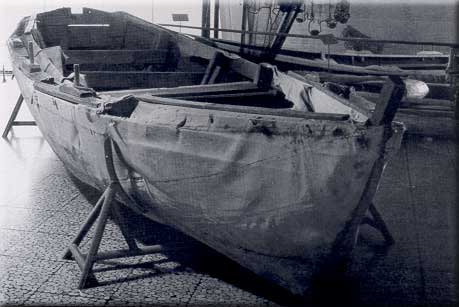
The 2nd boat built in Nyhorn's hold left Port Lyautey on Dec. 8 that same year with 5 men (one source says 11 came along), 1 of them being Ordinary Seaman Ingolf Tvedt who, just before midnight on Dec. 10 fell overboard, off Cape Spartel (Espartel?) light, Spanish Morocco. The others searched for him until after daylight the next day with no luck, then continued their voyage. In the afternoon of Dec. 13 they encountered the Spanish fishing vessel Machaco of Almeira. The captain wished to put into Tangier which was 5 miles away, but the escapees persuaded him to take them to Gibraltar, which they reached in tow of the fishing vessel the following morning, Dec. 14-1941. A hearing was held there on Dec. 17 in connection with Ingolf Tvedt having fallen overboard. At that time they all feared he had drowned, though hoped he might have been able to get to shore. Nobody had actually seen him fall, they only heard the splash and immediately threw out a lifebelt. The others were: 1st Mate Hans Omland (who had served on Nyhorn for 10 years), 3rd Engineer Karluf Karstensen (on board for 6 years), Cook Magne Thordal (on board for 3 1/2 years), and Ordinary Seaman Sigurd Langeland (on board for 2 1/2 years). Meanwhile, Ingolf Tvedt had managed to swim ashore (about 1 mile away), where the light keeper took care of him. The next day he was arrested and put in jail at Tetuan for 2 months in terrible conditions. With the help of the British legation at Tanger he later came to Gibraltar where he joined M/T Slemdal, only to be torpedoed in June-1942 (follow the link for details). He then went to the Norwegian Radio School in London and sailed on G. C. Brøvig for the rest of the war. The 3rd boat was finished and ready to go on May 10-1942, and also reached Gibraltar safely. Some sources say this was the canvas boat Norge in which my father's Captain Messel (of D/S Ringulv) escaped with 5 other men, namely Ringulv's 2nd Mate Ingolf Valvatne, Nyhorn's Able Seaman Hans Johansen, Ordinary Seaman Lars Aursand and Oiler Karl Linnerud, and Ida Knudsen's Egil Strømmen. The boat is now on display at the Maritime Museum in Oslo. As will be seen in the notes below, there's some disagreement as to the identity of this boat.
Crew List:
By Aug.-1942 most of Nyhorn's crew had escaped. The remaining men were interned on shore, while a French crew manned Nyhorn. I decided to check some of the above names against what can be found in "Nordmenn i fangenskap" (Kristian Ottosen), and here is the result: I can't look up each and every name, that would take too much time, but I'd be glad to look up a name on request, if anyone had a relative on board. Just contact me at the address provided at the bottom of this page.
Following Operation Torch in Nov.-1942, all the interned ships were freed. Nyhorn had been sunk by the French in the river Sebou, to prevent the Allies from penetrating, but she was raised in the spring of 1943 - this is when my father joined her, after having spent several months in various camps. She was temporarily repaired, and was returned to Nortraship's register on Aug. 20-1943. Shortly thereafter, she headed to the U.K., having sailed in Convoy SL 135 / MKS 22, voyage Casablanca-Loch Ewe, cargo of phosphates. SL 135 had originated in Freetown on Aug. 14, joined up with MKS 22* from Gibraltar on the 26th, the combined convoy* arriving Liverpool on Sept. 6 - ref. external link provided in the Voyage Record for more details on this convoy; Borgholm, Bosphorus (also from internment), Spurt, Thalatta and Viva are also named. Going back to Page 1, we learn that Nyhorn had left Casablanca on Aug. 23 and arrived Loch Ewe Sept. 5.
As will be seen when going back to the archive document referred to above, no 1943 voyages are listed after Sept. 10, when she arrived Tyne, so this was probably when she was being repaired. My father's Certificate of Registration was issued in London on Nov. 26-1943, and his last address is given as S/S Nyhorn, so he probably paid off on arrival U.K. after this convoy voyage. (He subsequently went to the Norwegian Radio School in London, then joined Thorshov). Having spent several months at Tyne, we now find Nyhorn, along with Leiv Eiriksson, Marathon and Washington Express, in the westbound North Atlantic Convoy ON 220*, originating in Liverpool Jan. 15-1944. She arrived New York on Febr. 4, having joined the convoy from Loch Ewe. Later that month, she headed to Bone and Augusta, arriving Bone on March 14, Augusta on March 16. The following month, she made a voyage from Augusta to Algiers in Convoy MKS 45* (originated in Port Said March 30 - Nyhorn left Augusta Apr. 4, arrived Algiers Apr. 8 - other Norwegianships were Brajara, Ingertre, Pronto, Tanafjord and Thorshavn). From Algiers, she proceeded to Casablanca, then back to New York, where she arrived May 11, having sailed from Casablanca on Apr. 25. In June, she went to Port Said, where she arrived on June 28. Her voyages in this period are listed on Page 1, while Page 2 shows further voyages - convoy information for some of them can be found in the Voyage Record above. Skipping now to Jan.-1945, when she appears in Convoy MKS 77*, departing Gibraltar Jan. 15, arriving Liverpool Jan. 23 - Nyhorn, cargo of ground nuts, stopped at Clyde (Para is also listed). The following month, she's listed, with Emma Bakke (Commodore Vessel), Kaia Knudsen and President de Vogue, in Convoy ON 283*, which departed Southend on Febr. 5 and arrived New York on the 27th; Nyhorn, however, arrived Halifax on Febr. 24, having started out from Clyde on the 6th. She now appears to have remained in Halifax for several weeks, before proceeding to New York, subsequently heading back to Alexandria and Port Said - again, see Page 2. From this document we also learn that she got to go home to Norway in Sept.-1945, staying there for quite a while. See also Page 3.
In the Concordia Line from 1948. Sold in 1962 to Valida Cia. Nav. S.A. (N.A. Karageorgis), Piræus and renamed Maritsa. Under Panamanian flag from 1965 as Mastrostamatis, then renamed Sandimitrios (Sandimitrios Cia. Nav.) in 1966. Deleted from Lloyd's register in 1967. Related external link: Back to Nyhorn on the "Ships starting with N" page. Other ships by this name: The company later had another ship by the name Nyhorn, built 1975, 17 922 gt. Had various owners, became 17 645 gt in 1989. Sold to Cyprus and renamed Silver Horn in 1991, Lady Ina 1995 (Norwegian), Ina of Oslo 1997, Gina in 1998. The text on this page was compiled with the help of: "Nortraships flåte", J. R. Hegland, "Sjøfolk i krig", Leif M. Bjørkelund, "Våre motorskip", Leif M. Bjørkelund & E. H. Kongshavn, article in "Krigsseileren", No. 2/1982 by 2nd Mate Ingolf Sexe, "The World's Merchant Fleets 1939", R. W. Jordan, "Sjøforklaringer fra 2. verdenskrig", Volume II (Norwegian Maritime Museum), "Nordmenn i fangenskap" (Kristian Ottosen) and misc. as named within the text above - See Sources/Books.
 |
||||||||||||||||||||||||||||||||||||||||||||||||||||||||||||||||||||||||||||||||||||||||||||||||||||||||||||||||||||||||||||||||||||||||||||||||||||||||||||||||||||||||||||||||||||||||||||||||||||||||||||||||||||||||||||||||||||||||||||||||||||||||||||||||||||||||||||||||||||||||||||||||||||||||||||||||||||||||||||||||||||||||||||||||||||||||||||||||||||||||||||||||||||||||||||||||||||||||||||||||||||||||||||||||||||||||||||||||||||||||||||||||||||||||||||||||||||||||||||||||||||||||||||||||||||||