Site Map | Search Warsailors.com | Merchant Fleet Main Page | Warsailors.com Home Merchant Fleet Main Page | Warsailors.com Home |
|
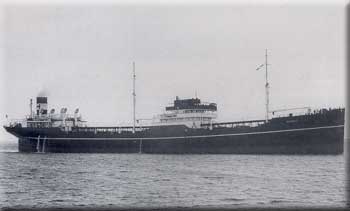
M/T Nyholt To Nyholt on the "Ships starting with N" page.
Manager: Christian Haaland, Haugesund Delivered in Apr.-1931 from Odense Staalskibsværft, Odense as Nyholt to D/S A/S Idaho, Haugesund (Chr. Haaland). Captain: Alf P. Andersen In Admiralty service from 1940 (Royal Fleet Auxiliary). Related items on this website: Her voyages are listed on these original images from the Norwegian National Archives: Please compare the above voyages with Arnold Hague's Voyage Record below.
(Received from Don Kindell - His source: The late Arnold Hague's database). Follow the convoy links provided for more information on each. Errors may exist, and some voyages may be missing.
As will be seen when going to Page 1 of the archive documents, Nyholt was in Los Angeles when war broke out in Norway on Apr. 9-1940, leaving that day for Curacao, where she arrived, via Balboa and Kingston, Jamaica, on May 9. Some of her 1941 voyages are also shown on this document. At the end of May-1941, she joined the Bermuda portion of Convoy HX 130. Her destination is given as Clyde, cargo of Admiralty fuel. Cruising order/Commodore's notes are also available for this convoy. Together with Brisk, Evanger, Fana, Leikanger, Novasli, Nueva Granada, Polartank, Ringstad, Sommerstad, Thorøy, Thorshavn, Thorsholm and Vigsnes, she now appears in Convoy OB 341, originating in Liverpool on June 30, dispersed July 6, Nyholt arriving Curacao on July 19 (she had started out from Clyde on June 30). Please note that I believe some of the above ships belong in Convoy OB 341A - see Evanger for an explanation. Nyholt left Curacao already the next day to head to Halifax in order to join a convoy back across the Atlantic. In Fact, Tony Cooper, a visitor to my website has told me that she was in station 56 of Convoy HX 142*, together with the Norwegian Siljestad, Kristianiafjord and Morgenen (A. Hague has also included Sama). Corvus was also initially in this convoy but was sent to Convoy SC 39* because she was too slow for HX 142. HX 142 departed Halifax on Aug. 1-1941 and arrived Liverpool on the 18th, but as will be seen when going to Page 2 of the archive documents, Nyholt did not follow this convoy to the U.K., but stopped at Reykjavik on Aug. 13. According to Tony's information 63 ships sailed from Halifax in this convoy, while 8 joined from Sydney, C.B. Kirkpool and Scottish Musician had engine defects and were sent back to Halifax. Like Corvus, Hercules (Dutch) was also sent to join SC 39 because of her slow speed. Rotterdam, Murena, Hjelmaren and Narragansett went missing in the fog (from HX 142). Empire Sailor did not join HX 142 till Aug. 6. Perth was the rescue ship for HX 142. The following comes from the Commodore: It looks like Nyholt remained at Reykjavik for almost 2 months; her departure is given as Oct. 8, and she's listed in the westbound North Atlantic Convoy ON 23*, which had originated in Liverpool on Oct. 4 and arrived Halifax on the 19th. Nyholt, however, was bound for New York, where she arrived on Oct. 24. Astrell, Jan Mayen (for Iceland), Lancing and Suderholm are also listed in this convoy. Nyholt remained in New York for over a month before proceeding to Halifax, and according to Arnold Hague, she joined Convoy HX 163, departing Halifax on Dec. 3. She again stopped at Reykjavik, arriving there on Dec. 17 - again, see Page 2. Nyholt left Reykjavik again on Jan. 4-1942, joining Convoy ON 52* in order to return to New York. Bello, Brasil, Kaia Knudsen, Katy, Morgenen, Mosli, Solsten, Stigstad, Thorshøvdi, Tungsha and Vanja are also listed in this convoy, which originated in Liverpool on Dec. 31 and was dispersed Jan. 11-1942. Montbretia and Rose are named aong the escorts (see ON convoy escorts). Nyholt, however, did not make it to her destination.
Nyholt was torpedoed by U-87 (Berger) 180 n. miles south of Cape Race (45 46N 54 18W) in the evening of Jan. 17-1942, after having lost contact with Convoy ON 52 in thick fog south of Greenland on a voyage in ballast from Reykjavik to New York. As already mentioned above, this convoy had started out in Liverpool on Dec. 31-1941 and was dispersed Jan. 11-1942; Nyholt had joined from Iceland on Jan. 5. At the time of attack 3rd Mate Hermansen was on watch on the bridge, with Able Seaman Knarvik at the wheel, and Able Seaman Østgaard and Ordinary Seaman Rolfsen on lookout duty. The explosiond destroyed 3 tanks on the port side, but she stayed afloat and tried to get away at full speed, adapting a zig-zag course for Cape Race. However, about 4 hours later (Jan. 18) she was hit by another two torpedoes, also port side. The men had left the ship before it was shelled for about half an hour and sunk. 4 lifeboats had been launched. Those who were in 2 of the boats were later transferred to the larger motorboat, because the other 2 had been damaged in the explosion. The captain and 2 men fell (jumped?) into the sea; the captain was picked up by one of the boats, but Mechanic Skaaland and Galley Boy Hopland were lost. The lifeboats did not have contact with each other that first day, but met up again on the 19th. They decided to head south in order to try to reach warmer waters, the motorboat taking the other boat in tow. As per Jan. 20, after some redistribution of men had taken place, there were 15 in the lifeboat and 24 (incl. the captain) in the motorboat. Late that night a snow storm blew up, and the motorboat used a sea anchor, still with the lifeboat in tow. During the night the latter boat drifted off, and though they met up again the following morning, the seas were so heavy that it was impossible to resume the towing. Before parting company, those in the motorboat had hailed the others and told them it was probably best to steer in a northerly direction afterall, in order to reach an area with more traffic and a better chance of being rescued. The lifeboat was never seen again. For 9 days the people in the motorboat battled the sub zero temperatures. It's important to keep in mind that this took place from Jan. 18 and onwards in the waters between Iceland and Greenland, and there were times when the boat was covered in an inch thick layer of ice, when hurricane force winds were howling and the huge, cold waves threatened to swallow them. There's a vivid and extremely moving account of the days spent in the open lifeboat in the book "Tusen norske ship" by Lise Lindbæk, written by Dr. Adam Egede Nissen, a passenger on Nyholt. This book was translated to English under the title "Norway's New Saga of the Sea" - see my page "Books" (link at the bottom of this page) for tips on how to find a copy. It's mainly based on Lise Lindbæk's interviews with seamen during the war; the Norwegian version was published in New York in Nov. 1943. 1st Engineer Olaf Egeland died, and his wool sweater was given to someone who had none. Just as they were about to bury their Scottish shipmate, Oiler Michael Duffy, in the sea on Jan. 26 they were spotted by a Lockheed Hudson which kept circling above them as if to give them encouragement, and dropped a lifevest containing 2 thermoses with warm liquids, apples, oranges, cigarettes and some sandwiches from the pilots' own lunch down to the exhausted seamen. Egede Nissen had nearly frozen to death himself during the last night in the lifeboat. He hadn't slept for more than an hour during the 9 days, and had lain down next to the engine box, covered by a sail. He was woken up by somebody knocking against him when he realized he was passing out. Another man next to him was in the same situation, but he woke him up, thereby probably saving his life. A few hours after the aircraft had circled around them they were picked up by the Canadian destroyer St. Clair and landed in Halifax the next day, Jan. 27. By then the captain had died on board the destroyer. He had clung to life until he saw his men rescued, then gave up his battle and simply let go. 1st Engineer Knut Meland, who had survived the sinking of Taranger the year before, and who had been a passenger on Nyholt, died at a hospital on Febr. 5.
Related external links:
The 20 year old Ordinary Seaman Johannes Bauge (Haugesund) had gangrene in both his hands, but was operated and allowed to keep his hands. He received unexpected visitors at Camp Hill Hospital, Halifax when Crown Prince Olav and Crown Princess Märtha (the parents of Norway's present King Harald) came by to see him and others in the room. The Crown Princess pulled a chair up to his bed and sat down for a chat while the Crown Prince wandered around talking to the others. 2nd Mate Haaland had both his legs amputated (he had previously served on Ila). An ordinary seaman had all his toes removed (Louis Rolfsen?), 1st Mate Hansen lost part of his foot, and several had some toes removed. 6 ended up staying in a hospital; some for just a few weeks, others up to 2 years. An inquiry was held at this hospital on Apr. 23-1942. The 1st and 3rd mates, engine Room Assistant Strømsnes and the carpenter were questioned. The 2nd mate had just undergone the operation at that time and was too weak to be questioned as was Ordinary Seaman Rolfsen. According to Dr. Egede Nissen's statements the lifeboats had collided with the U-boat and literally had to pull themselves free from it.
It later became clear that those who did not wear the so called Vaco suit suit (follow the link for a description) were the ones who did not survive the ordeal. The captain had not had time to put his on, and after his stay in the cold water he had to endure the days in the boat without the protection of the suit. Michael Duffy did not wear his suit, and the 2nd mate who had to have both his legs amputated was also without one; the same mate had tried to warm his dying shipmate Michael Duffy's frozen body with his own, while blowing his own warm breath on him and into his mouth in a desperate effort to save his life there in the boat.
1st Mate Harald Hansen later received "Lloyds War Medal for Bravery at Sea", for the way he distinguished himself in commanding the lifeboat. This medal was instituted by the Corporation of Lloyd's in Dec.-1940, from an idea by Sir Percy Graham, a member of Lloyd's Committee. It's made of silver, and on one side there's a figure of a man (sitting) symbolizing Courage and Endurance. He's looking across the sea and in the distance a ship can be seen. He holds a wreath in his right hand, possibly a laurel wreath symbolizing victory? Along the edge it says "Awarded by Lloyd's". On the other side (reverse side) there's a Trident which symbolizes Sea Power. This is surrounded along the edge of the medal by a wreath of oak leaves and acorns. Across the center is the word "Bravery". It has a silver and blue ribbon with 2 narrow silver edges and a wide silver stripe in the center. This medal would be worn on the right breast. Only 530 were awarded, several to Norwegian seamen. 5 were awarded to women, namely Miss Virginia A. Drummond, 2nd Engineer(?) S/S Bonita, Miss M. E. Ferguson, Passenger S/S Avila Star, Dr. A. N. Miller, Ship's Doctor S/S Britannia, Miss E. M. Owen, Stewardess S/S St. Patrick, and Mrs. E. Plumb, First Class Stewardess M/V Rangitane. Some of the Norwegians who received it were Captain Albert Toft of Talabot, 1st Mate Arnt Olav Torgersen of D/S Segundo, Captain Thoresen, 1st Mate Arntsen and Pumpman Larsen of Frontenac among others. The external websites that I've linked to at the end of this page have more info (with a picture of the medal). 11 Norwegian ships were sunk in Jan.-1942, 155 crew and 5 passengers died. (One source says 8 ships were Norwegian, and 75 lives lost). Crew List:
Related external links: Operations information for U-87 Lloyd's War Medal for Bravery at Sea - With a picture of the medal Crews & Gallantry Awards - (A section of the National Maritime Museum in Greenwich). This is simply a research guide with advice on how and where to find information on the various medals awarded to Merchant Seamen. According to this, a register of awards of Lloyd's War Medal for Bravery at Sea 1939–1945 can be found in "Under Hazardous Circumstances" compiled by R J Scarlett. Back to Nyholt on the "Ships starting with N" page. Other ships by this name: The company later had 2 more ships named Nyholt. One was delivered in June 1951, 10 358 gt. Sold in Jan.-1965 to Spanish breakers. The other was built 1975, 17 958 gt. Had various owners, then became Silver Holt of Cyprus in 1991, Bow Explorer 1995 (Liberia), Norwegian Gyda in 1999. The text on this page was compiled with the help of: "Nortraships flåte", J. R. Hegland, "Våre motorskip" by Leif M. Bjørkelund and E. H. Kongshavn, "Tusen norske skip", Lise Lindbæk, "Sjøforklaringer fra 2. verdenskrig", Norwegian Maritime Museum, Volume II, and misc. others for cross checking facts. Details on Lloyd's medal is from an article by Ian A. Millar found in "Krigsseileren" - Ref. Sources/Books.
|
||||||||||||||||||||||||||||||||||||||||||||||||||||||||||||||||||||||||||||||||||||||||||||||||||||||||||||||||||||||||||||||||||||||||||||||||||||||||||||||||||||||||||||||||||||||||||||||||||||||||||||||||||||||||||||||||||||||||||||||||||||||||||||||||||||||||||||||||||||||||||||||||||||||||||||||||||||||||||||||||||||||||||||||||||||||||||||||||||||||||||||||||||||||||||||||||||||||||||