Site Map | Search Warsailors.com | Merchant Fleet Main Page | Warsailors.com Home Merchant Fleet Main Page | Warsailors.com Home |
|
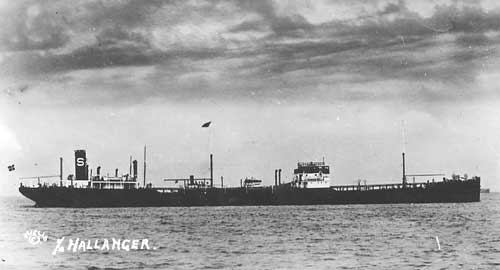
M/T Hallanger To Hallanger on the "Ships starting with H" page.
Uboat.net has another picture (external link). Manager: Westfal-Larsen & Co. A/S, Bergen Captain: ? Eriksen (first name unknown), later Karl Bjerring Hansen. In Admiralty service. Related items on this website: Her voyages are listed on these original images from the Norwegian National Archives: Please compare the above voyages with Arnold Hague's Voyage Record below.
(Received from Don Kindell - His source: The late Arnold Hague's database). Follow the convoy links provided for more information on each. Errors may exist, and some voyages are missing.
According to Page 1 of the archive documents, Hallanger was on her way from Yokohama to Los Angeles when war broke out in Norway on Apr. 9-1940. From Los Angeles, she later proceeded to Balboa and Bermuda, and with a cargo of diesel oil, she's listed among the ships in the Bermuda portion of Convoy HX 45 on May 23. She arrived Swansea on June 7 and later that month, she joined Convoy OB 169. She arrived Kingston, Jamaica on July 6, the convoy having been dispersed June 22. From Kingston, she later proceeded to Curacao and from there to Bermuda, with arrival Aug. 5, and was scheduled for the Bermuda portion of Convoy HX 64 shortly thereafter, but did not sail; there's a note in the original document for this convoy saying "to be held at Halifax"*, and she does not show up again until Convoy HX 86 from Halifax on Nov. 10, bound for Clyde with fuel oil, station 43. She arrived Clyde on Nov. 26, Bowling on Nov. 30.
At the beginning of the new year, she's listed in Convoy OB 268, which originated in Liverpool on Jan. 1-1941 and dispersed on the 4th, Hallanger arriving New York Jan. 20 (she had joined from Clyde - see external link provided within the above table for more convoy information; Brisk, Egda, Facto, Nesttun and Senta are also named). She subsequently spent a long time there; departure New York is given as May 21, at which time she proceeded to Halifax, and from there, she joined Convoy HX 130 on June 1. Cruising order/Commodores notes are also available for this convoy. Hallanger, cargo of fuel oil, arrived Bowling on June 19/20, according to Page 1. A few days later, she headed to Curacao, having joined Convoy OG 66*, which originated in Liverpool on June 24 and arrived Gibraltar July 8. Hallanger, however, did not go to Gibraltar, but detached from the convoy around June 30 in order to proceed to her destination, where she arrived July 17. She proceeded to Halifax on the 19th, subsequently joining Convoy HX 144 on Aug. 10, together with the Norwegian Suderøy, Polartank, Orwell, Eidanger, Havprins, Grena, Evanger, Norse King, Vinland and Sommerstad. A. Hague has also included Ranja in this convoy. The following month Hallanger, with destination Trinidad, joined the westbound North Atlantic Convoy ON 21*. Note that the first external website that I've linked to at the end of this page lists her as bound for Trinidad in Convoy OS 7 that month (left a few days before ON 21) - it's possible she had started out in this convoy, but returned to port and later joined ON 21 instead(?). ON 21 originated in Liverpool on Sept. 28 and dispersed Oct. 14; according to Page 2, Hallanger sailed from Oban on Sept. 29 and arrived Trinidad Oct. 24. She was scheduled to return to the U.K. with the slow Convoy SC 54 from Sydney, C.B. on Nov. 10, but did not sail (Eglantine and Montbretia are named among the escorts). She was also cancelled from SC 55, but eventually got away with Convoy SC 56 on Nov. 22, and arrived Clyde on Dec. 9, Bowling on Dec. 11. We now find her in station 86 of Convoy OS 15 later that month, voyaging from Clyde to Trinidad in ballast. She arrived there on Jan. 13-1942, having parted company with the convoy on Dec. 31 (OS 15 had originated in Liverpool on Dec. 23 and also included Dagfred, Estrella and Fernbank - see the external link provided in the Voyage Record. It'll be noticed that A. Hague has also named Dageid, but this appears to be an error, follow the link for an explanation). She headed back to the U.K. again on Jan. 30-1942 in Convoy SC 67 from Halifax (in which Heina was sunk; follow the link for more info). Hallanger arrived Bowling on Febr. 16. The following month, she made a voyage to New York, having joined the westbound Convoy ON 79*. Her final destination is given as Trinidad, but as can be seen when going back to Page 2, it looks like she did not go to Trinidad until June that year. She arrived New York on Apr. 7, having sailed from Clyde on March 23 (ON 79 originated in Liverpool March 23 and arrived Halifax Apr. 7). From New York, she later proceeded to Halifax in order to join Convoy SC 80 back to the U.K. on Apr. 17. The company's Spinanger also sailed in this convoy, as did Empire Kittiwake which was to become the Norwegian Norfalk just a few days after arrival U.K. She's now listed in Convoy OS 29 (originated in Liverpool on May 22), voyaging from Oban to Trinidad in ballast. Note that she's also listed in station 85 of the previous convoy, OS 28, but according to A. Hague, she had returned to port with engine defects on that occasion. She arrived Trinidad on June 14, having parted company with OS 29 around May 31. Both these convoys also had other Norwegian ships - ref. links in the table above. According to "Nortraships flåte" Hallanger was one of 2 oilers for the "Pedestal" convoy (Convoy WS-21S) in Aug.-1942. The external links at the end of this page provide more information on this convoy. Captain at that time was Captain Eriksen. The oilers had their own escort consisting of 4 corvettes and were to wait in the western part of the convoy route to supply the convoy escort if necessary. On August 10, the aircraft carrier HMS Eagle was supplied from Hallanger. The oilers then cruised back and forth until dark at which time they returned to Gibraltar, where they were later told that Eagle had been torpedoed (Aug. 11, U-73/Helmut Rosenbaum - ref. link at the end of this page). On Aug. 29, we find Hallanger in Convoy HG 88 from Gibraltar, bound for Clyde in ballast, with arrival Sept. 8. She now remained there for quite a long time; departure Clyde is given as Oct. 18. According to A. Hague, this long stay was due to her requiring machinery repairs. She subsequently proceeded to New York, having joined the westbound Convoy ON 140*, which originated in Liverpool on Oct. 17-1942 and arrived New York on Nov. 7 (as already mentioned, Hallanger had sailed from Clyde on Oct. 18). Extracts of a crew member's diary mentions these dates in connection with the first voyage he made with Hallanger after having joined her on Oct. 14 (this was Able Seaman Thorleif Hansen, previously of the torpedoed Tankexpress). He adds that they remained in New York for quite some time while her engine was undergoing repairs, following a collision, before joining a return convoy to the U.K., arriving Gourock on Jan. 1-1943, Bowling on Jan. 4. This voyage had been made in Convoy SC 113*, which left New York on Dec. 12. This convoy is not yet available among the SC convoys included in my Convoys section, but will be added. Hallanger had a cargo of FFO and had station 103. I have no further info on when the collision had taken place, but A. Hague mentions that the British Fort Lamy was involved in a collision while in Convoy ON 140, and had to return to port in tow - perhaps this is the ship Hallanger had collided with? We now find her in the westbound Convoy ON 160 to New York. Tormund Gjertsen (or Tormod, as I knew him), whose story can be found on this page (Norwegian text), mentions an episode when his ship Hallanger was en route to the U.S. in a horrendous storm. He says he has never forgotten it, because they saw an SOS signal from a ship in the convoy and signalled her that they would assist. However, just then Hallanger herself experienced engine problems which forced her to stop, and they were never able to rescue any men from the sinking ship. I believe this must have been while they were in ON 160, and the ship in difficulty must have been the Commodore Ship, Ville de Tamatave, which went down with all on board. For several hours it looked bad for Hallanger as well, but they were eventually able to fix their problems and continued to New York; according to Page 2, she arrived there on Febr. 5-1943, having started out from Clyde on Jan. 11. Tormod told me that after this voyage they proceeded directly from the U.S. to North Africa. From various statements in his story, and also those in the diary mentioned above, my guess was that they were in Convoy UGS 6 for this voyage, and this has since been confirmed - ref. link within the table above. It departed Hampton Roads on March 4-1943 and arrived Oran on March 22 - Hallanger started out from New York on the 4th. The French Wyoming, and the American Benjamin Harrison, Molly Pitcher and Keystone were torpedoed - ref. external links provided at the end of this page for further details. Hallanger had 10 aircraft on deck, and the forward hold was full of petrol in barrels, so it was rather a tense voyage with that kind of cargo. The majority of the ships in the convoy fired back at the attacking U-boats, so that the ocean was completely lit up by the tracers etc., and the bullets "rained" around Hallanger. Her original destination had been Algiers, but they were ordered to Oran instead, and while they were waiting to go into harbour in the very early morning hours of the 23rd, they witnessed Garonne from Convoy KMF 11(?) receiving an air torpedo (Garonne had also arrived from the U.S. in UGS 6). Hallanger left Oran again in the morning of March 25-1943 (see Page 3), proceeding in convoy to Algiers (possibly a TE convoy, according to A. Hague) where cargo was discharged, having arrived there in the afternoon of the 26th (archive doc gives arrival March 27). While there, they endured a massive air attack. According to T. Hansen's diary, 700 shots were fired from Hallanger, and he adds that in this attack an aircraft fell down in the water not far from them. The attack is also mentioned in Tormod Gjertsen's story, which I've linked to above. As the fallen aircraft's bombs exploded it felt as if Hallanger was lifted clear out of the water, and 2 of her crew members were injured when they were thrown against the "wall" by the air pressure. The unloading was completed on March 29 (including the 10 aircraft she had had on deck), and the next morning she started on her return voyage to New York, but she did not get very far, as will be seen from the next paragraph.
Captain Karl Bjerring Hansen. Hallanger was on a voyage in ballast (except for 1000 tons fuel oil) from Algiers for New York via Gibraltar in station 52 of Convoy ET 16 on March 30-1943 when she was hit by a total of 3 torpedoes from U-596 (Jahn), immediately following the attack on the British Fort a la Corne (station 41). The Norwegian Torfinn Jarl is also listed in this convoy. 1 torpedo hit at 19:10 in No. 8 tank port side, 1 at 19:12 in No. 6 tank and 1 at 19:20 in the aft bunkers, also port side. She listed heavily, which made it difficult to get the lifeboats launched. The 40 crew had managed to get in the aft lifeboats and clear of the ship just before the 3rd torpedo struck. At dawn the next morning the motorboat took the other boat in tow and headed towards land. The boats had encountered the British minesweeper Albacore (J 101) and returned to the scene with her to see if the ship could be taken in tow, but upon seeing that heavy firing was taking place near Hallanger, they withdrew. About an hour later Albacore announced that both torpedoed ships had sunk - 36 55N 01 39E. "The World's Merchant Fleets 1939" by Roger W. Jordan gives the position as 36 52N 01 47E. This position is also given for Fort a la Corne on the website covering the Fort ships. See also Uboat.net's account on the attack on Fort a la Corne (both are external links). As already mentioned, both ships were sunk around the same time. Hallanger's lifeboats reached land at Dupleix later that morning, where 2 of the deck crew, who had been injured, were taken care of by a doctor. They were all given food and lodgings by private families overnight, then sent to Algiers with U.S. Army trucks the following morning, Apr. 1. There, they were taken to a British Army camp where they slept in tents that first night, before staying for a while at a British military school. The hearings were held in Algiers on Apr. 3-1943 with Captain Bjerring Hansen (on the bridge when torpedo struck), the 1st mate (on the bridge), the 1st engineer (on deck, ran down to engine room to stop engines) and Able Seaman Egset (at the wheel) appearing. It looks like most of them were subsequently sent to the U.K. on Apr. 5, while 3 others did not leave for England until Apr. 24 on board the British troop transport Franconia. The convoy she was in was attacked by German aircraft en route, but no ships were hit, and they arrived Liverpool in the afternoon of May 2, where the Norwegians got lodgings at the Norwegian Seamen's Home. This information fits in with the fact that Franconia is listed in Convoy MKF 13 (external link), which left Algiers on Apr. 24; she arrived Liverpool on May 2. For info, U-596 (but with a different commander), was also responsible for the attack on Marit later that year. Crew List - No Casualties: *Waldemar Larsen's other ships are listed on this external page. Thorleif Hansen had also experienced the loss of Tankexpress and Edvard Lilleheil is included in the crew list for Norland. Others who had served as gunners on Hallanger (but paid off in 1942) were Einar Pedersen and Hans A. Lasken, while Olaf Terjesen, Lars. R. Slotsvik (and possibly Reidar Andresen?) had paid off in 1943, prior to the loss of the ship.
Related external links: Convoy WS 21S - Based on Arnold Hague's database, as section of the above website. Operation Pedestal and SS Ohio save Malta - A section of the USMM website. There's a book entitled "Pedestal - The Malta convoy of August, 1942" by Peter Charles Smith, availble from misc. Internet bookstores. Several other books have also been written on the subject. Back to Hallanger on the "Ships starting with H" page. Other ships by this name: Westfal-Larsen had another Hallanger later on - originally delivered as Mechanicsvill from Kaiser Co. Inc., Portland to United States War Administration in Oct.-1943, 10 448 gt. Purchased by Westfal-Larsen in Jan.-1948, renamed Hallanger. Sold in Oct.-1959 to Harald A. Møller, Oslo, renamed Asato. Sold in 1961 to Union Marine Corp., Panama, converted to bulk carrier, renamed Ally. Sold in 1966 to Victoria Ocean Transport, Monrovia, renamed Victoria Faith, renamed Grand Trust in 1967. Sold in 1975 to Concord Panama S.A., Panama. Broken up in Taiwan in 1978. In June-1960 another Hallanger was delivered to Westfal-Larsen from Rosenberg Mek. Verksted, Stavanger, 20 416 gt. Sold to Compania Velventos de Navigacion, Piræus in July-1973, renamed Rodosto. (Info from Westfal-Larsen fleet list). The text on this page was compiled with the help of: Misc. sources, incl. "Nortraships flåte", J. R. Hegland, "Sjøforklaringer fra 2. verdenskrig", Volume I (Norwegian Maritime Museum) and misc. for cross checking - ref. My sources.
|
|||||||||||||||||||||||||||||||||||||||||||||||||||||||||||||||||||||||||||||||||||||||||||||||||||||||||||||||||||||||||||||||||||||||||||||||||||||||||||||||||||||||||||||||||||||||||||||||||||||||||||||||||||||||||||||||||||||||||||||||||||||||||||||||||||||||||||||||||||||||||||||||||||||||||||||||||||||||||||||||||||||||||||||||||||||||||||||||||||||||||||||||||||||||||||||||||||||||||||||||||||||||||||||||||||||||||||||||||||||||||||||||||||||||||||||||||||||||||||||||||||||||||||||||||||