Site Map | Search Warsailors.com | Merchant Fleet Main Page | Warsailors.com Home Merchant Fleet Main Page | Warsailors.com Home |
|
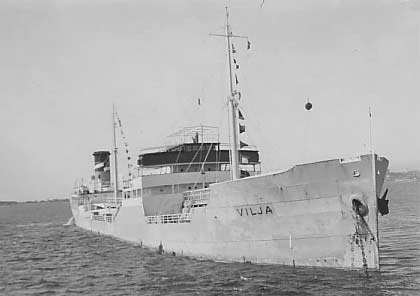
M/T Vilja To M/T Vilja on the "Ships starting with V" page. Owner: Skibs-A/S Nordheim Built by Kockums Mekaniska Verksteds A/B, Malmö in 1928. Captain: Karl Andersen (previously E. Karlsen? - see narrative below). Under Ministry of War Transport from Jan.-1940, operated by Anglo American Oil Company, London. Other Halfdan Ditlev-Simonsen vessels: Her voyages are listed on these original images from the Norwegian National Archives:
(Received from Don Kindell - His source: The late Arnold Hague's database). Follow the convoy links provided for more information on each. Errors may exist, and some voyages are missing.
A French visitor to my site has told me that Vilja was at Casablanca on Sept. 13-1939 when the French minelayer Pluton blew up. Undamaged, but entire crew grounded as a safety measure. According to a posting to my Ship Forum, Vilja was on a voyage from Constantza to Manchester on Apr. 3-1940 when she collided in convoy with the British Blairatholl (voyage from Bone to Liverpool) in Liverpool Bay. (When reading that posting, I'm not entirely sure if it means the 2 vessels collided with each other, or whether each collided with another ship?). From Page 1 of the archive documents, we learn that Vilja had started out in Constanza on March 14, and had arrived Gibraltar, via Istanbul, on March 22/23. Both ships are listed in Convoy HGF 24, which left Gibraltar on March 25 and arrived Liverpool on Apr. 3. The British ship received damage to three frames and had stem pushed back, while Vilja had damage to her port side. This was repaired at Liverpool(?). Going back to the archive document, we see that she arrived Eastham on Apr. 4, Eccles Apr. 6/7, and the next entry shows her leaving Manchester on Apr. 26, to pick up a cargo in Tripoli, Syria. With the Norwegian Italia, A. Hague has included her in Convoy OB 138, which departed Liverpool on Apr. 28 and joined up with Convoy OA 138 on May 1, the combined convoy forming the Gibraltar bound Convoy OG 28F, which arrived there on May 6 (see ships in all OG convoys). Vilja proceeded to Port Said and Tripoli that same day; arrival Tripoli is not given on the archive document, but A. Hague says she arrived on May 16. She left again already the next day, arriving Gibraltar May 26, continuing to Brest 2 days later, with arrival June 5 (another source, based on the captain's report, gives arrival Brest as June 15). For this voyage she's listed, with a cargo of crude oil, in Convoy HGF 32; the captain's name is given as E. Karlsen in the original convoy document, station 62, sailing right next to Torfinn Jarl. She departed Brest again on June 22 (see note in the Voyage Record above) then, like a lot of other Norwegian ships in France at the time, she proceeded to the nearest British port, namely Swansea, where she arrived June 24, remaining there for several weeks. (In one report there's a statement saying she was sent from Swansea to Abadan, and this agrees with the information in the next paragraph). In Aug.-1940 she rescued 50 survivors from the British Boma, 3 died (ref. external link at the end of this page). According to J. Rohwer, this ship had been torpedoed by U-56 on Aug. 5 while in Convoy OB 193. Vilja is also listed in this convoy, which originated in Liverpool on Aug. 4 and dispersed on the 7th, Vilja arriving Freetown on Aug. 23 (she had started out from Milford Haven on the 4th) - more convoy information is available via the link provided in the Voyage Record - Berto, Corvus, Ingertre, Loke, Ringhorn and Thermopylæ are also listed. From Freetown, Vilja later continued to Table Bay and Abadan, arriving the latter on Oct. 10. Vilja was in Abadan again in Dec.-1940, having arrived on Dec. 4 from Table Bay (Capetown), and on Dec. 15 she was in Aden, en route to the Suez Canal, with arrival Dec. 25. According to A. Hague, this voyage was made in Convoy BN 11, in which he has also included the Norwegian Eidsvold, Fosna, Gunny, Gylfe, Norfold and Velma (see link in Voyage Record). It's possible Vilja was subsequently used as depot ship, either in Suez or Alexandria? (not much can be found about this period because most of the records were lost in the Haifa explosion later on). It'll be noticed, when going back to Page 1, that there's now a long gap in her voyages. On March 11-1941 she was en route from Alexandria to Haifa for cargo (this date, taken from the captain's report, does not agree with what can be found on the archive document referred to above, which says she left Alexandria on March 15, having arrived on the 11th), then went back to Alexandria where the cargo was unloaded before returning to Haifa for another cargo, also for Alexandria. She was later sent through the Suez Canal to Abadan, arriving June 15 (agrees w/Page 1). She was back in Suez on July 6 and stayed for quite a while in Port Said and Alexandria (judging from Page 2, she had also had a long stay at Suez that summer - Alexandria is not mentioned for this period). The captain says she arrived Haifa on Dec. 12-1941, while the archive document gives arrival as Dec. 19; she unloaded cargo until Dec. 20. She was still there on Christmas Eve (as were the Norwegian M/T Athene and M/T Thordis) when the French tanker Phenix* suddenly blew up while maneuvering out from the harbour. Her crew could be seen crying for help on her after deck. Several motor boats came out in an effort to help, and Vilja's captain, who had been in his cabin when the explosion occurred, also tried to assist by launching one of the lifeboats, but when it had gotten half way over to Phenix, the oil that had spread across the water caught on fire and the boat was ordered to return. It wasn't long before Vilja was completely surrounded by flames. Most of the ships there managed to get clear of the burning and sinking Phenix, but Vilja was very badly damaged, as she was unable to get passed (Phenix was in front of her a little to the port side, and the wreck of Patria was on the other side of her - ref. text for Thermopylæ, under the heading "A new Year-1941"). Seeing no possibility of saving her, Captain Andersen gave the orders to abandon ship. As the starboard lifeboat left her side, Vilja's bridge was on fire and by the time they reached the pier she was burning from bow to stern. The port boat also made it to safety, and as the crew members ran for their lives along the pier, Vilja's ammunition exploded, causing even further damages, with debris "raining" all around them. Nobody was hurt, but all the ship's papers, diaries and logs were lost, as were of course, all personal belongings, but her cargo was found to be intact.
The next day Vilja, or what was left of her, was tied up to the wreck of Patria, but on Jan. 2-1942 a storm caused even more damages when she drifted into the pier. Following temporary repairs in Haifa she was taken to Port Said to unload her cargo at the end of Febr.-1942, where she underwent further (extremely primitive) repairs before continuing to Suez 3 months later - she had to be towed through the canal by 2 powerful tugs, because her steering mechanism had been heavily damaged in the fire and was still not quite in order. She then proceeded to Aden where some cargo was loaded in her center tanks, from there to Durban (at 7 knots) where some of this cargo was transferred to various ships that needed bunkers, the rest to oil tanks on shore. Further repairs were made there, again very primitive. Naval authorities also demanded that foundations for guns should be installed, one on each side of the bridge (which had been "built" in Haifa with the help of wreckage for materials due to the lack of lumber in Egypt, later replaced in Port Said by a bridge taken from a British ship that had struck a mine), one on each side forward of the poop and one on each side of the funnel. However, when all this had been done, no guns could be obtained, so she continued to Port of Spain with no armament, and general conditions on board were dreadful (again, see Page 2). From Port of Spain, she was sent in Convoy TAG 5 to New Orleans in order to undergo more permanent repairs of all the damages, but in the middle of the night of Sept. 13-1942 (she had departed early the previous morning, Sept. 12) she was torpedoed by U-558 (Krech)*, 12 15N 62(63?) 52W. The Norwegian Alar and Høegh Silverdawn are also listed in TAG 5. Other ships in the convoy had already been torpedoed, so all on board Vilja had been called out and were prepared for attack. On watch on the bridge at the time was 1st Mate Ivar (Lars?) Andreassen. Others on board were Radio Operator Nicolaysen, Able Seaman Ludvig Gusfre (at the helm - his other ships are named on this external page), 1st Engineer Peder Samuelsen, 3rd Engineer Dag Berg (on watch in the engine room), and Oiler Steen. 4 gunners were on duty by the gun(? so it looks like she did have some armament). The torpedo had struck on her port bow in the deeptank, causing a powerful explosion. Debris was flung high in the air, most of which was misc. damaged materials from the midships building that had been removed in Port Said and placed in one of her holds. There were no casualties. Fearing another attack, the captain ordered the crew to the boats, which stayed at a safe distance from the ship, and when nothing further happened, they went back on board about 4 hours later (daylight) and, following an inspection, decided to take her back to Port of Spain, though damages were extensive. Several of her cargo holds as well as the pump room were half full of water and the sea could be seen through the bottom of No. 5 tank. Additionally, the entire ship had a large bulge all the way around, as if she had been squashed together.
En route back to Trinidad an aircraft appeared, and they were able to signal to the pilot that they had been torpedoed. That afternoon an escort arrived which stayed with her all the way back to port. Earlier that morning they had spotted what looked like a sail in the horizon. Not sure whether it was a trap concocted by a U-boat, they discussed what to do and decided to ease a little closer to inspect. It turned out to be a lifeboat from one of the other ships that had been torpedoed in the convoy, namely the British Empire Lugard, sunk by U 558 on Sept. 13. (The Dutch Suriname had also been sunk by this U-boat - see external links at the end of this page). Vilja landed the 45 (6?) survivors in Port of Spain on Sept. 15 (Page 2 gives arrival Trinidad as Sept. 14 - another source says Vilja rescued 47 from Empire Lugard). After repairing there for 3 months she again headed out to sea on Dec. 28-1942 in a convoy of 6 small ships for New Orleans via Guantanamo Bay, Cuba, at 5 knots (the archive document referred to above gives departure Trinidad as Dec. 30). More ships were meant to join at Guantanamo, but 3 days after arrival the 6 ships were ordered to continue. Technical problems still proved to be an issue for Vilja, especially with regard to the steering, and just before arrival New Orleans it failed altogether. A radio they had previously received while in Port Said after the fire was also of no use by that time, meaning she was unable to get in touch with shore authorities, so they had to wait for the next ship to pass by so that they could signal for help. A tug was summoned which towed her to New Orleans on Jan. 16. Most of her crew paid off, but as of July 28-1943 (1944?*), the captain, the 1st mate and the 1st and 3rd engineers were still on board. She remained there for the rest of the war as damages were found to be beyond economical repair. Condemned on Oct. 26(?)-1943 and eventually broken up. (Page 2 says "Abandoned to Underwriters" on Oct. 18-1943).
For info, U-558 had also been responsible for the attacks on Erviken and Rym in Oct.-1941, and Eidanger in Febr.-1942. For more information on the other Norwegian ships named on this page, please see the alphabet index below, or go to the Master Ship Index.
Vilja's machinery was sold to a Norwegian ship owner after the war and placed in the Haugesund ship Norseman, another rescued war victim. Norseman sailed for Odd Godager for a while, but was later sold abroad (not the Norseman in my N-list). Related external links: Back to M/T Vilja on the "Ships starting with V" page. Ditlev-Simonsen lost a steamship by the name Vilja to WW I, built 1915, 1149 gt - torpedoed and sunk by a German U-boat off the southwest coast of Ireland on Apr. 5-1917. The text on this page was compiled with the help of: "Nortraships flåte", J. R. Hegland, "19 Oslo-skips historie under verdenskrigen, fra April 1940 til krigens slutt i 1945" (The story of 19 Oslo ships during WW II), Harald Nicolaisen - 1945, "Sjøforklaringer fra 2. verdenskrig", Volume II (Norwegian Maritime Museum), "Axis Submarine Successes of World War Two", Jürgen Rohwer, and misc. - (ref. My sources).
|
||||||||||||||||||||||||||||||||||||||||||||||||||||||||||||||||||||||||||||||||||||||||||||||||||||||||||||||||||||||||||||||||||||||||||||||||||||||||||||||||||||||||||||||||||||||||||||||||||||||||||||||||||||||||||||||||||||||||||||||||||||||||||||||||||||||||||||||||||||||||||||||||||||||||||||||||||||||||||||||||||||