M/S Troja
Updated Oct. 12-2012
To Troja on the "Ships starting with T" page.
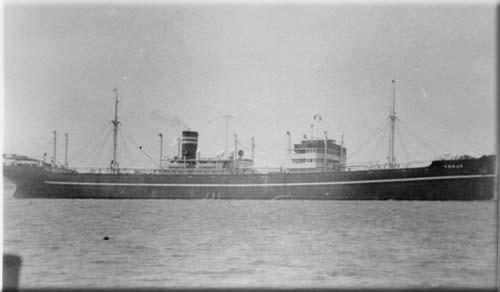
Photo by Herbert Baasch, author of "Handelsschiffe im Kriegseinsatz".
The picture was taken in 1961 off Cuxhaven (Germany).
Received from the owner of Baasch's photo collection.
The Australian War Memorial has another picture of this ship, dated Sept.-1941.
Lillesand Sjømannsforening also has a picture; click in it to enlarge (all links are external).
Manager: Wilh. Wilhelmsen, Tønsberg
Tonnage: 6650 gt, 4084 net, 10 706 tdwt.
Dimensions: 461.4' x 60.6' x 29.0'.
Machinery: two 8 cyl. 4 scsa oil engines totalling 6550 ihp by the shipbuilders, driving twin screws. Service speed 14.5 knots, 11 passengers.
In Nov.-1927 Wilhelmsen made an agreement with Barber Steamship Company, New York to provide tonnage for Barber's regular service between the New York area and the Far East, in co-operation with the Liverpool firm, James Chambers & Company. Each company was to have 5 ships available. Existing tonnage was used at first, but between 1929 and 1930, 10 almost identical motor liners were built, specially adapted for transportation of vegetable oil and reefer cargo. 5 of the ships were given Chinese names, beginning with the prefix "Tai". Tai Yang was the first in the series, Troja was the 10th and last. Launched on Oct. 2-1930 by Burmeister & Wain's Maskin- og Skibsbyggeri, Copenhagen (Yard No. 572), completed Nov. 27-1930.
Captain: Arne O. Ommundsen (also served on Tai Yang). According to this external page, which shows all the ships he served on, he had previously been Troja's 1st mate (starting 1937).
Related items on this website:
Warsailors Stories - John Simpson's story about his time on Troja, as well as Elsa and Tiradentes.
A Guestbook message from someone whose father served on Troja during the war.
Another Guestbook message from someone whose father, Bruce Gamble, served on Troja as well as Temeraire.
Her voyages are listed on these original images from the Norwegian National Archives:
Page 1 | Page 2 | Page 3 | Page 4 | Page 5 | Page 6
Please compare the above voyages with Arnold Hague's Voyage Record below.
Voyage Record
From May-1940 to May-1945: |
(Received from Don Kindell - His source: The late Arnold Hague's database).
Follow the convoy links provided for more information on each.
Errors may exist, and as can be seen, the record is incomplete.
| 1940 |
May 15 |
Gibraltar |
Liverpool* |
May 25 |
HG 30 |
Earlier voyages, Page 1
*Arrived Falmouth, May 23, on to London
(Page 1) |
|
June 13 |
Southend |
– |
– |
OA 167 |
For Philadelphia.
Dispersed June 16.
Convoy available at OA 167
(external link - incomplete)
Page 1 gives arrival Philadelphia June 26
(also, missing voyages). |
|
Nov. 8 |
Bermuda |
– |
– |
BHX 87 |
See HX 87 and narrative below |
|
Nov. 13 |
BHX 87 joined HX 86 |
Liverpool* |
Nov. 26 |
HX 86 |
Page 1 says:
"Presumed arrd. Oban" Nov. 25 |
|
Nov. 28 |
Clyde |
Methil |
Dec. 1 |
WN 46 |
Convoy available at WN 46
(external link - incomplete listing)
Missing movements, Page 1 |
|
Dec. 24 |
Methil |
Oban |
Dec. 27 |
EN 46/1 |
Convoy available at EN 46
(external link) |
|
Dec. 29 |
Oban |
– |
– |
OB 266 |
For Baltimore.
Dispersed Jan. 1-1941.
Convoy available at OB 266
(external link)
Page 1 gives arrival Baltimore, Jan. 10-1941 |
|
Page 1 also shows some missing 1941 voyages, as does Page 2. |
| 1942 |
Febr. 14 |
Colombo |
Rangoon |
Febr. 23* |
JS 2X |
Earlier 1942 voyages:
Page 2.
Convoy available at JS 2X
(external link)
*Page 2 gives arrival Febr. 21.
Missing 1942 voyages:
Page 2 & Page 3 |
| 1943 |
Apr. 2 |
Madras |
Colombo |
Apr. 5 |
CJ 1A |
Earlier 1943 voyages, Page 3.
Convoy available at CJ 1A
(external link)
Missing 1943 voyages:
Page 3 & Page 4 |
|
A. Hague has also included Troja in Convoy AB 19 from Aden Nov. 2 (external link). There's a note saying she was detached for Colombo Nov. 6 escorted by Quickmatch (compare w/Page 4). |
| 1944 |
July 27 |
Durban |
– |
– |
DN 67 |
Earlier 1944 voyages, Page 4.
Dispersed July 28.
Convoy available at DN 67
(external link) |
|
July 28 |
DN 67 dispersed |
Melbourne |
Aug. 16 |
Independent |
Missing 1944 voyages:
Page 4 & Page 5 |
| 1945 |
March 19 |
New York City |
Liverpool* |
Apr. 2 |
HX 345 |
Earlier 1945 voyages, Page 5.
*Page 5 gives arrival Avonmouth, Apr. 2
(also, missing movements).
Convoy will be added.
See ships in HX convoys |
|
May 17 |
Liverpool* |
– |
– |
OS 129/KMS 104 |
*From Milford Haven, May 18
(Page 5).
Dispersed 46N 9 40W, May 21.
Convoy available at OS 129/ KMS 104
(external link - incomplete)
Arrived Port Said, May 30.
Subsequent voyages:
Page 5 & Page 6 |
For information on voyages made in between those mentioned here, please see the documents received from the National Archives of Norway and A. Hague's Voyage Record above. Follow the convoy links provided for further details; several Norwegian ships took part.
As will be seen when going to Page 1 of the archive documents, Troja was on her way from Calcutta to Oslo, Norway when the country was invaded (Apr. 9-1940), but was diverted to London. Via various other ports, she arrived Gibraltar on May 15 and with general cargo for Falmouth, she's listed in station 83 of Convoy HG 30 from there that same day. She arrived Falmouth on May 23, later proceeding to London, with arrival May 26. The following month, she shows up among the ships in Convoy OA 167, which left Southend on June 13 and dispersed on the 16th, Troja arriving Philadelphia June 26. The Norwegian Heina, Lysaker IV and Tungsha are also listed - ref. external link provided within the Voyage Record (Svint was also scheduled, but did not sail). The archive document has a listing of Troja's subsequent voyages.
In Nov.-1940, she's listed in Convoy HX 86. According to A. Hague, she had started out in Bermuda on Nov. 8 with the Bermuda portion of Convoy HX 87, which joined up with HX 86 on Nov. 13(?*). This latter convoy had originated in Halifax on Nov. 10. There was also a Bermuda portion for HX 86, departing on Nov. 3, but this convoy had returned to Bermuda on Nov. 5, hence the unusual combination (the BHX convoys usually joined the HX convoys with the same number). Troja was bound for Clyde with general cargo - Page 1 says: "Presumed arrd. Oban" Nov. 25.
*This is confusing, because Convoy HX 87 did not leave Halifax until Nov. 14.
In Dec.-1940, we find her in Convoy OB 266, departing Liverpool on Dec. 28, dispersed Jan. 1-1941 (again, ref. external link in the table above). Her destination is given as Baltimore, where she arrived Jan. 10, having started out from Oban on Dec. 29, according to Page 1. This document also shows a few more 1941 voyages, while the rest are listed on Page 2 (it'll be noticed that she had quite a long stay at Port Said that fall). The latter document also has some 1942 voyages. See also Page 3, which shows more long stays in port.
What follows has been extracted from John Simpson's story in my Warsailors Stories section - he had just survived the sinking of Elsa, so he must have joined Troja some time after Apr.-1942 (compare with the archive documents):
I reported to the Norwegian Consulate in Sydney, because it was the best way to get in touch with the Norwegian shipping line that had employed me, and told them everything that had happened to the Elsa. I said I wanted another job, and they posted me to the Troja in Melbourne. The ship was Norwegian, owned by Wilh. Wilhelmsen Lines, a very large shipping company which had 73 ships at the outbreak of war.
Norway was occupied by the Germans, but the Norwegian merchant fleet, anything that had got away from Germany, was all over the world working for the Allies. The Troja had been doing regular runs to Australia and was on charter to the Australian government. It was a ship of the line, not a tramp, you see. Tramps went all over the place, but ships of the line had a regular run, for instance between Europe and the Antipodes.
I joined the Troja during her fitting out as a DEMS, a Defensively Equipped Merchant Ship - 4.7 inch guns on the poop, Holman projectors, Bofors on the wings of the bridge. The Holman projectors fired grenades using compressed air.
On the subsequent voyage to the Middle East carrying military equipment for the Australian forces we used to have gun practice. I remember the Holman projector wasn't aimed very well and the grenade dropped down onto the deck. Everybody scattered like mad. Nobody got hurt - they were very lucky. It went off as it hit the deck.
We discharged at Lake Timsah on the Suez Canal and Port Said, and made a return voyage with phosphate and copper; phosphate from Port Safaga on the Red Sea and copper ingots from Beira in Portuguese East Africa, as it was then. We returned to discharge in Hobart, Tasmania.
On the next voyage to the Middle East our main cargo seemed to be beer for the Australian Army. After landing 500 tons of Richmond Bitter at Lake Timsah, handled by the army, the Australian diggers, we were the most popular ship in the Middle East. For the Australians, anyway!
After discharge we proceeded to Port Said waiting for orders, and then had orders to proceed to Haifa with all speed. That was an overnight run from Port Said to Haifa. There were explosions during the night where somebody was being attacked by either the Eyeties or the Jerries, we don't know which, but we were not allowed to stop to find out.
We were told at Haifa that they were trying to make up a convoy to go to the relief of Malta. Anyway, back in Haifa, the requirement was for ships that could sail at 15 knots or more, and as we could only manage 13 knots we were not included in the convoy. All the Norwegians were quite disappointed, as they wanted to be in the action. So we had a couple of holds converted into troop quarters, and we took about 300 Australian soldiers on leave back to Australia.
After three or four voyages to and from the Middle East, I asked the shipping company if I could get a ship going back to the UK. They agreed to do this, with the Chief Engineer's backing. They were very good to me. And I joined the Tiradentes in Sydney, which was due to return to Liverpool via the Middle East.
My Warsailors Stories section has more on his story.
Troja's 1943 voyages start on Page 3 and continue on Page 4, which also has most of her 1944 voyages, while the rest are listed on Page 5 (all documents show occasional long stays in port). Convoy information for some of them can be found in the Voyage Record above.
Skipping now to March 19-1945 when she, according to Arnold Hague, joined Convoy HX 345 from New York, together with Abraham Lincoln (Commodore Vessel), Emma Bakke, Kaia Knudsen, Montevideo, Solfonn and Toledo. This convoy is not yet available among the HX convoys included in my Convoys section but will be added - see Ships in all HX convoys. From Page 5, we learn that Troja arrived Avonmouth on Apr. 2, remaining there for almost 3 weeks before proceeding to Newport, where she also had a long stay. She later served as Commodore Vessel for Convoy OS 129/KMS 104, which left Liverpool on May 17 and dispersed on the 21st (link in Voyage Record). Her destination is not given, but she arrived Port Said on May 30, having started out from Milford Haven on May 18. She subsequently continued to Aden and Bombay, where she also remained for quite a long time. She also had a long stay in Liverpool that fall, and again in Bombay later that year. Page 5 indicates she went home to Norway in Jan.-1946, but arrival there is not given.
Page 6 lists her voyages to Apr.-1946.
More information on the other Norwegian ships mentioned here can be found via the alphabet index at the end of this page, or go to the Master Ship Index
Sold on Apr. 2-1962 to Mardita Cia. Naviera S.A. (Michail A. Karageorgis), Greece and renamed
Ioanna. Transferred to Panamanian registry in 1964. When on a voyage from Tarragona to Rangoon with a cargo of soya bean oil, she had an engine room explosion on March 20-1966, in the Red Sea about 200 miles from Jeddah, position 24 06N 36 12E. The resulting fire was extinguished on March 22, and she arrived Suez in tow on March 25, but was found to be beyond economical repair and was declared a constructive total loss. Sold to S.p.A. Cantieri Navali del Golfo for scrapping. Arrived Spezia in tow on Nov. 18-1966 and demolition commenced the following month.
 Merchant Fleet Main Page | Warsailors.com Home