Site Map | Search Warsailors.com | Merchant Fleet Main Page | Warsailors.com Home Merchant Fleet Main Page | Warsailors.com Home |
|
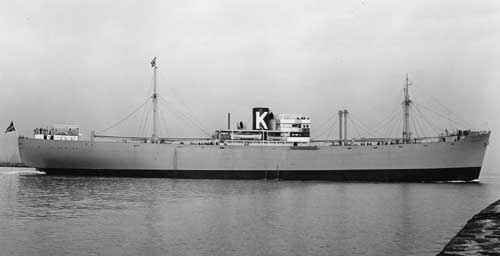
M/S Skjelbred To Skjelbred on the "Ships starting with S" page.
Owner: Skjelbreds Rederi A/S Built by Burmeister & Wains Maskin- og Skipsbyggeri, Copenhagen in 1937. Captain: Torjus Emil Johnsen Related item on this website:
Her voyages are listed on these original images from the Norwegian National Archives: Please compare the above voyages with Arnold Hague's Voyage Record below.
(Received from Don Kindell - His source: The late Arnold Hague's database). Follow the convoy links provided for more information on each.
As will be seen when going to Page 1 of the archive documents, Skjelbred was in Japan when war broke out in Norway on Apr. 9-1940. She had arrived Yokohama from Boston on Apr. 5. Her 1941 voyages also start on this document and continue on Page 2 (it'll be noticed, that she spent quite a long time in Baltimore at the end of that year). Page 2 also has some 1942 voyages while the rest can be found on Page 3, which shows another long stay in Melbourne that fall. According to Arnold Hague, Skjelbred took part in Convoy HX 230, departing New York on March 18-1943, arriving Liverpool Apr. 2; Skjelbred stopped at Clyde on Apr. 1. This convoy is not yet available among the HX convoys included in my Convoys section, but will be added; for now, see ships in all HX convoys. She had a cargo of sugar, sailing in station 12. Later that month, she went back to New York with Convoy ON 180*, which originated in Liverpool on Apr. 24 and arrived New York May 14 (Skjelbred had joined from Clyde). It looks like this convoy encountered bad weather; several ships became stragglers, others returned, and there's mention of the Norwegian Reinholt (Commodore Vessel) arriving New York with ice damage. Skjelbred headed back across the Atlantic on June 23 in Convoy HX 245 from New York, bound for Glasgow with general cargo, station 11. According to the Commodore's notes for this convoy (follow link to HX 245), she was among several ships that were detached as a fast portion at 12 knots on July 4 - she arrived Glasgow on the 7th, subsequently returning with Convoy ON 193*, which originated in Liverpool on July 16 and arrived New York on the 31st. Judging from her station number, which was 142, this convoy had 14 columns. The following month, we find her in Convoy HX 252 from New York (in which Santos was lost - follow the links for more info). Destination is given as Leith Dock, general cargo and explosives, station 44. According to the Commodore's notes, Skjelbred was again one of several ships that were detached in a fast convoy to the U.K. at 14:00Z on Aug. 25, position 54 28N 21 35W. The Commodore's narrative is also available, as are some collision reports (one of which involves Santos) and a report from the Flag Officer/Newfoundland. Skjelbred arrived Leith on Aug. 29 (Page 3), and this turned out to be her last eastbound North Atlantic convoy voyage, as she was lost when returning to the U.S.
Skjelbred left Leith again in ballast* on Sept. 12-1943 for Methil, then continued from there to Loch Ewe in convoy on Sept. 14 (see Convoy EN 280 - external link), departing for New York the following evening in Convoy ON 202. According to a report I found in Issue No. 2 for 1974 of the Norwegian magazine "Krigsseileren", Skjelbred had station 102 in the convoy, while a visitor to my website says she was in station 108. The captain simply gives the station as "No. 2 on the right wing", so if there were 10 columns it would mean station 102. Please follow the link to my page about ON 202 for much more information - see also the Commodore's report, as well as several other reports.
At 02:20 GMT (02:15?) on Sept. 23-1943 she was struck on the port side between hold No. 5 and the after peak tank by a torpedo from U-238 (Hepp). At the time of attack she was on a course 260° true, sailing at a speed of 6.5 knots in smooth seas, but weather was overcast with poor visibility, some fog and no moonlight, so it was very dark, wind west force 3. There were 4 lookouts; 2 on flying bridge and 2 gunners on the after gun platform. (Time given on Page 3 of the archive documents is 07:35). The torpedo was believed to have exploded on contact since there was no shock prior to explosion. There was a loud explosion which threw a column of water high in the air on the port side; much of explosion was outside the ship. The plates of No. 5 hold and after peak tank ruptured, but the hatch cover was not blown off, nor were deck plates ruptured. Water was leaking into No. 5 hold (eventually had 12' of water), the tunnel shaft and engine room, engines immediately stopped, the aft port lifeboat was blown away and the propeller, rudder and steering gear broken. Several crew members attempted to abandon ship immediately after the torpedo had struck, but were ordered back on board by the captain. Emergency steering was applied and slow speed ahead with hard right rudder attempted after about an hour, but she went in circles to starboard, the rudder having been bent, so the engines were stopped again. She listed to starboard and was slightly down by the stern as she drifted back. Several messages were sent to the Commodore, advising him of her condition. Captain Johnsen planned to rig up an emergency rudder, but when the escorting British Northern Foam arrived towards morning, the 43 men from Skjelbred were ordered on board, under repeated protests from the captain who felt the ship could be saved and taken to the nearest port. However, as no escort vessel could be spared to stand by her, he had no choice but to obey orders. Skjelbred was left in a sinking condition with a 6 or 7° list to starboard at 07:10 GMT (53 18N 40 24W), but was not seen to sink. They were landed in St. John's on Sept. 26, where the maritime inquiry was held on Sept. 29 with the captain, the 2nd mate, the 1st and 3rd engineers, Able Seaman Alexandersen (lookout) and Able Seaman Saltnes (helmsman) appearing. The captain later travelled to New York by train, arriving there on Oct. 2. The captain later stated that Skjelbred, being capable of 16-17 knots, should not have been placed in such a slow convoy. After departure Loch Ewe speed had been 9.5 knots, but when other ships joined, the speed was reduced to 6.5 knots (Convoy ON 202 and Convoy ONS 18 had joined up). Several ships were sunk in this convoy - again, please go to my page about Convoy ON 202/ONS 18 for much more information (many Norwegian ships took part); see also Oregon Express for further details, as well as the external link at the end of this page. Crew List - No casualties:
Related external links: Convoys ONS-18/ON-202 - article. NOTE: Rohwer has this ship listed as a steam ship. The strange thing is that he also has a Skjelbred with the same tonnage listed in his other book, "Allied Submarine Attacks" (again as a steam ship), under the name Wartheland, damaged on May 17-1943 by an unexploded torpedo from the Russian submarine S-56 (Shchedrin), position 70 49N 29 34E. It would appear from this she was under German control in May-1943, yet torpedoed and sunk in the Atlantic in Sept.-1943? I also have some information that the Norwegian M/S Falkanger, seized by the Germans in April-1940 while building, was completed as Kriegsmarine target ship Wartheland. There's obviously some confusion with regard to Skjeldbred/Falkanger/Wartheland, but a posting to my Ship Forum comes to the rescue. It says there were 2 Wartheland, one being the Falkanger listed on my F-page. The author of this posting also gives information on another Wartheland, built in 1907, 3716 gt (G. Freymann, Danzig) and this is the one that was torpedoed by S-56 in Kongsfjord on May 17-1943 (the entry in "Allied Submarine Attacks" with regard to Skjelbred must be an error). According to the forum message, this ship was also damaged by bomb off Petsamo on Jan. 30-1944, involved in a collision off Kirkenes on Apr. 29 that same year, and sunk in an air attack in Eidsfjord on Dec. 12-1944. The website "Sjømennenes Minnehall" (Memorial for Seamen in Stavern, Norway) has listed a casualty on a D/S Varteland, after a bomb attack at Nordfjordeid in Dec.-1944, see link below. Related external link: Back to Skjelbred on the "Ships starting with S" page. The text on this page was compiled with the help of: "Nortraships flåte", J. R. Hegland, "Sjøforklaringer fra 2. verdenskrig", Norwegian Maritime Museum, Volume II , "Summary of Statements by Survivors", a Memorandum dated Oct. 29-1943 and signed USNR Ensign B. A. Conrad, received from Tony Cooper, England, and misc. (ref. My sources).
|