Site Map | Search Warsailors.com | Merchant Fleet Main Page | Warsailors.com Home Merchant Fleet Main Page | Warsailors.com Home |
|
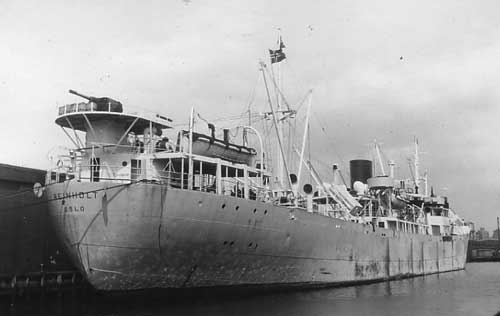
M/S Reinholt To Reinholt on the "Ships starting with R" page. Owner: Ivarans Rederi A/S Built by Kockums Mekaniska Verksteds A/B, Malmö, Sweden in 1939. Captain: Hans Nilsen. According to this external page, Thorvald Arnfeldt Hellenes (Thomassen) served as her captain from Nov.-1943 to Dec.-1943 (previously of Herbrand). Some others are named within the narrative below. Her voyages are listed on these original images from the Norwegian National Archives: Please compare the above voyages with Arnold Hague's Voyage Record below.
(Received from Don Kindell - His source: The late Arnold Hague's database). Follow the convoy links provided for more information on each. Errors may exist, and as can be seen, several voyages are not included.
According to Page 1 of the archive documents, Reinholt was in Hong Kong when war broke out in Norway on Apr. 9-1940. Her 1941 voyages also start on this document and continue on Page 2.
Reinholt was shelled continuously for 20 minutes by U-752 (Schroeter) on Apr. 23-1942, when on a voyage from Santos, Brazil to New York with a cargo of hides, having departed Santos on Apr. 6, according to the captain's report, which gives the position for the attack as 39 28N 72 16W* - see also Page 3. She was on a course 303° true, sailing at a speed of 12 knots, not zig-zaggig, daylight attack just before sun-up, in calm seas with no wind, fair visibility, slight fog on surface of the water. 3 lookouts were on watch, 2 on the bridge and 1 at the stern gun. "Nortraships flåte" states that earlier that morning, when about 70 n. miles southeast of Ambrose Light Vessel, 3rd Mate Thorvald Knudsen had observed a light signal and had awakened the captain, who then ordered a zig-zag course. About three and a half hours later, at 05:20, the mate on duty spotted an object off the port side and noticed that a U-boat was about to surface. Shortly thereafter the first shell was fired, falling short of the ship. The shelling continued, killing boatswain John Sætre, injuring Radio Operator Hans Mortensen and Carpenter Karl Innstrøm (Lundstrøm?). Reinholt's gunners replied by firing a round every 30 seconds, but while they were defending their ship, it caught on fire after having been hit where the ammunition was stored, so after 14 rounds had been fired they could no longer get to the ammunition. However, at this time the U-boat submerged. The fire was eventually brought under control, and in the meantime, at around 06:00 a destroyer had been sighted on the horizon. The two injured men were transferred to USS Rhind at around 12:10 and taken care of there, then admitted to a hospital in Brooklyn that same day. Reinholt later arrived pier 33, Brooklyn at 23:00.
The incident received a lot of publicity on arrival New York. 15 men later received Krigsmedaljen, while the captain received the higher ranked Krigskorset (see my War Medals page). Related external links: Note also that
There's a vivid account of this incident in the book "Tusen norske ship" by Lise Lindbæk. The book was translated to English under the title "Norway's New Saga of the Sea" in 1969 (my Books page has tips on how to find a copy). It's mainly based on Lise Lindbæk's interviews with seamen during the war, and first published in New York in Nov. 1943. In the chapter about Reinholt she describes the damages on the ship in detail, and judging from that it's a miracle only two were injured. A brief summary has been added below. (According to this book, Captain Hans Nielsen was only on board for that one voyage, stepping in for his brother, the "real" captain of Reinholt): The captain was on the bridge during the attack and still couldn't understand how he had survived it. All he did was swear and smoke; swear because they didn't have a big enough gun to get rid of the intruder. He was right next to the radio operator when he was hit, and there were at least 20 shrapnels around him, but not a scratch on himself. He says "the crew was absolutely fantastic, escpecially the 21 year old gunner, Sverre Batalden who was just fabulous". When the shelling started very early that morning the Danish radio operator was barely able to send out an SOS before the radio stopped working. He hadn't been able to give the position so tried to get the emergency radio going but that was shot to pieces too. He then went out on deck and was hit himself (practically had his legs torn off). The U-boat kept firing and many fell over just from the sheer impact; their hearing was affected for days afterwards. Most of the shells hit on the after part of the ship, especially the gunners' platform. The gunnery crew had used up all the ammunition on the platform and the ammunition below deck had caught on fire, while the shots kept coming, leaving "shells with German names and Swastikas on them scattered all over the deck". The mate gave orders to extinguish the fire but the water hose didn't work, so they had to use the CO2 bottles which had to be carried from their location on the aft deck; 2 men even went down into the burning ammunition hold, though explosions had started to occur down there. After about 20 minutes they saw smoke on the horizon and heard an aircraft approaching, then the U-boat disappeared. Shortly thereafter the American destroyer appeared, then a blimp, so after the 2 wounded men had been transferred to the destroyer for medical care Reinholt was escorted the rest of the way. She had a complement of 34 at the time. Lise Lindbæk says the crew consisted of 1 Swedish, 1 Finnish, 2 Danish, 1 American, 1 Portugese, 1 Brazilian and the rest Norwegian. When Reinholt arrived New York that evening she got quite a reception. The captain received an invitation from Rear Admiral Adolphus Andrews (U. S. Navy Commander, Eastern Sea Frontier) who wanted to hear all the details, and the newspapers were equally interested, covering the story widely. Lise Lindbæk also briefly spoke with the gunner, who said he served during the war in Norway, was on board Heimdal, then escaped to England where he went to gunnery school (probably at Dumbarton?) and had since been on Norwegian ships in "the danger zone" for about 1 1/2 year. Jon Sætre was 40 years old and from Haugesund. Funeral services were going to be held from the Seamen's Church that same day. Radio Operator Hans Mortensen was from the Faroe Islands. He had been on Reinholt for just 18 days when the attack took place, having transferred from a Danish ship that had been requisitioned by the Brazilians at Santos. Some other crew members were 1st Mate Fredrik Olausen, Able Seaman Arnold Skaar (helmsman at the time of attack), Able Seaman Jens Olden, Able Seaman Peder Pettersen, Ordinary Seaman Alf Nautnes, 2nd Engineer Arne I. Kallevik, 3rd Engineer Ludvig Larsen. Reinholt underwent repairs for 17 days, then went to Buenos Aires, where she arrived (via Santos) on June 29, according to Page 3 (the document says she had left New York on May 30). It appears she barely avoided being hit by a torpedo when on her way back to New York on Aug. 3 (she had left Santos on July 22). She was not far from Port of Spain when a periscope and a torpedo wake were believed to have been seen, and this happened again a little later. Nothing further happened, but an SOS was received from a torpedoed ship in the course she was heading, so course was chosen accordingly. She arrived Trinidad on Aug. 5, departing again on the 8th, and on Aug. 13 the convoy she was in, Convoy TAW 12, was in Old Bahama Channel when the Commodore Ship was torpedoed*, and Reinholt took over - Bajamar and Boreas are also mentioned in this convoy (Boreas returned). They arrived Key West on Aug. 16, where a new convoy was formed for New York on the 18th, with Reinholt continuing as Commodore Vessel. She's listed (with Aragon, Garonne, Norheim and Thorshov) in Convoy KN 131, which arrived Hampton Roads on the 23rd; Reinholt arrived New York that day. Both these convoys are available via the external links provided within the Voyage Record above (though the listing for TAW 12 appears to be incomplete).
From New York Reinholt subsequently entered into Trans-Atlantic service, by this time with better armament. On one such voyage, with ammunition in her cargo, she was involved in a collision in Liverpool harbour (no further info available). Another time she had a big hole torn in her underside by an iceberg (see next section).
As already mentioned above, Reinholt had arrived New York on Aug. 23-1942. She now started Trans-Atlantic voyages, joining Convoy HX 208 on Sept. 17, cargo of steel and food for Liverpool; according to A. Hague, she also had 360 troops on board. The Commodore's report is also available for this convoy. The following month, we find her in the westbound North Atlantic Convoy ON 139* (left Liverpool on Oct. 16), but she returned to port, arriving Belfast Lough on Oct. 18 (Page 3), later joining Convoy ON 141* from there (convoy originated in Liverpool on Oct. 24 and arrived New York, which was Reinholt's destination, on Nov. 10). On this voyage she had 2 passengers on board. Both these convoys had several Norwegian ships, namely Fernmoor (returned), Idefjord, Norsktank, Trondheim (returned), Tungsha and the Panamanian Vestfold (Norwegian managers) in ON 139 and Albert L. Ellsworth, Anna Odland, Aun, Fagerfjell, Fernmoor, Fernwood, Gallia, Herbrand, Jenny (returned), Pan Aruba, Salamis, Samuel Bakke (Commodore Vessel), Skiensfjord, Trondheim and Ørnefjell in ON 141. Some of these ships, including Reinholt, headed back to the U.K. in Convoy HX 216 on Nov. 19. She had a general cargo for Liverpool, and sailed in station 132 (became a straggler when the convoy encountered a gale, see the Commodore's notes on my page about this convoy). Christmas that year was celebrated while in the westbound Convoy ON 155, which arrived New York on Jan. 6-1943, having left Liverpool on Dec. 19; see also the Commodore's narrative (Reinholt is mentioned under Dec. 23 and Dec. 24). Acanthus and Eglantine are named among the escorts. She headed back to the U.K. again on Jan. 22-1943 in Convoy HX 224 from New York, bound for Liverpool with a general cargo, station 132. She also had explosives as well as passengers on board, and it looks like she had been cancelled from the previous convoy, HX 223, from which Nortind and Kollbjørg were lost - follow the links for details. Reinholt subsequently returned to New York with Convoy ON 168*, which left Liverpool on Febr. 21 and dispersed March 12 and also included Brajara, Brimanger, Egda, Gallia, Heranger, Lynghaug, Maud (returned), Meline, Morgenen, Slemmestad and Tigre (the corvette Buttercup, which came under the Norwegian flag the following year, is named among the escorts - see ON convoy escorts). According to Arnold Hague, Reinholt later joined Convoy HX 231*, which left New York on March 25 and arrived Liverpool on Apr. 10 - this agrees with the details found on Page 3. Athos, Katy, Mosdale, Norheim, Ørnefjell, Scebeli, Slemmestad and the Panamanian Norvinn (Norwegian managers) are also listed in this convoy, which lost several ships - ref. external link at the end of this page. Together with Belinda, California Express, Norsktank, Norsol, Skandinavia, Skjelbred, Thorhild and Velma, Reinholt now joined the westbound Convoy ON 180*, departing Liverpool on Apr. 24. Reinholt served as the Commodore Ship and is said to have arrived New York with ice damage on that occasion. She did not leave New York again until June 15, when she can be found in Convoy HX 244. She was again bound for Liverpool with general cargo and passengers, station 52. Vice Commodore was in Samuel Bakke. The following month she joined the westbound Convoy ON 192* in order to return to New York (left Liverpool July 9, arrived New York on the 22nd). She had again been in the company of several other Norwegian ships, namely Anna Knudsen, Buenos Aires, Emma Bakke, Ferncourt, Ivaran, Laurits Swenson (Commodore Vessel), Norholm, Petter, San Andres, Skaraas (returned), Tai Shan, Topdalsfjord, Vest and Villanger, as well as the Panamanian Norvinn. With a general cargo and explosives for Liverpool, Reinholt departed New York again on Aug. 7 in Convoy HX 251, station 106, arriving Liverpool Aug. 22 - Laurits Swenson had again served as the Commodore Ship and Acanthus, Potentilla and Rose are named among the escorts - see HX convoy escorts. At the beginning of the following month we find her, along with Biscaya, Bralanta, Buenos Aires, Emma Bakke, Fagerfjell, Haakon Hauan, Herbrand, Ivaran, Laurits Swenson, Norden, Norheim, O. B. Sørensen and the Panamanian Norbris (Norwegian managers), in the westbound Convoy ON 200* (from Liverpool Sept. 2, to New York Sept. 18). A. Hague now has her returning in Convoy HX 259*, which left New York on Sept. 28, arrived Liverpool on Oct. 13 and also had Bañaderos, Cypria, Emma Bakke, Pan Scandia (returned) and Velma in its ranks - Reinholt's voyages in this period are shown on Page 4. Later that month she shows up, with Emma Bakke and Thorhild, in the westbound Convoy ON 208*, leaving Liverpool on Oct. 24, arriving New York on Nov. 7. Reinholt had served as Commodore Ship again and also acted as Commodore Vessel for Convoy HX 268*, which left New York on Nov. 26 and arrived Liverpool on Dec. 11. Duala, John Bakke, Pan Scandia and Strinda are also listed. Reinholt left again on Christmas Eve-1943, joining the westbound Convoy ON 217*, which arrived New York on Jan. 10-1944. Brimanger, Duala, Fagerfjell, John Bakke, Norheim and Pan Scandia are also named in this convoy. On Jan. 28-1944, we find her in Convoy HX 277 from New York, general cargo for Cardiff, where she arrived Febr. 13, subsequently joining the westbound Convoy ON 226*, which originated in Liverpool on Febr. 29 and arrived New York on March 15 (South America is also included). The following month, she's listed as bound for Liverpool with general cargo in Convoy HX 286, for which Acanthus and Eglantine served as escorts (again, see HX convoy escorts), and with Gallia, Germa, Ivaran, Katy and Marit II, she later joined the westbound Convoy ON 235* in order to head back to New York (left Liverpool May 4, arrived New York May 18), again acting as the Commodore Vessel. She returned to the U.K. in June with Convoy HX 294 from New York (Commodore in Abraham Lincoln, Vice Commodore in Geisha). At the beginning of July she joined the westbound Convoy ON 243*, together with Geisha, Grey County, Kaia Knudsen, Mosli, Norden, Noreg, Norse Lady, Rutenfjell, Skaraas, Sommerstad, Sørvard and Velma (convoy left Liverpool July 3, arrived New York July 18). Reinholt again acted as the Commodore Vessel. Later that month I have her as the Commodore Vessel for Convoy HX 301, general cargo for Liverpool - Vice Commodore was in Samuel Bakke. As will be seen when following the link to this convoy, it was very large, but the previous convoy, HX 300, was the largest ever to cross the Atlantic. Reinholt now joined Convoy UC 34, which left Liverpool on Aug. 17-1944 and arrived New York on Aug. 28; her destination is given as Baltimore, where she arrived on the 29th. This convoy will be added to an individual page in my Convoys section, but for now, the ships sailing in it (and escorts) are named on the page listing ships in all UC convoys. Hegra and Tai Shan also took part. Reinholt was scheduled for Convoy HX 308 from New York on Sept. 13 (she was still in Baltimore on that date, see Page 4 - Vice Commodore was in Villanger), but instead joined Convoy HX 310 on Sept. 21, again acting as Commodore Vessel, while the Vice Commodore was in Høyanger; Acanthus and Rose are named among the escorts, as are Tunsberg Castle and Buttercup, though the latter did not come under the Norwegian flag until after the loss of Tunsberg Castle. Reinholt subsequently headed back to the U.S. on Oct. 21 with Convoy ON 261, arriving New York on Nov. 5, and later that month she's listed as bound for Liverpool with general cargo in Convoy HX 322, which arrived Liverpool Dec. 8. She now joined the westbound Convoy ON 273* (left Liverpool on Dec. 19), but returned to port, later joining ON 275*, departing Liverpool on Dec. 29, arriving New York on Jan. 13-1945. Both these convoys also had other Norwegian ships, namely Fridtjof Nansen, Glarona, Kaia Knudsen, Morgenen, Skotaas and Sverre Helmersen in ON 273 while President de Vogue and Havkong are listed in ON 275. On Jan. 23-1945, we find her in the New York-U.K. Convoy HX 334, bound for London with grain (Commodore in Samuel Bakke). Acanthus was among the escorts for a while. Together with Anna Knudsen, Anna Odland, Morgenen and Strinda, Reinholt went back across the Atlantic with Convoy ON 286*, which departed Liverpool on Febr. 21 and arrived New York on March 9. On her return voyage she served as Commodore Vessel for Convoy HX 346* (Commodore H. G. Clayton, R.N.R.), which departed New York on March 24 and arrived Liverpool on Apr. 7. Dageid, G. C. Brøvig, Polartank, Strinda and Thorshavn are also listed. The last ON convoy she sailed in was ON 298*, which left Liverpool on Apr. 22 and arrived New York on May 7. Dalfonn, Fenris, Marit II, Morgenen and Thorsholm also took part, as did the Panamanian Norlys. Reinholt again served as the Commodore's ship. From New York, she now sailed to another part of the world, having joined Convoy UGS 95, which originated at Hampton Roads on May 28-1945 and dispersed the next day - ref. external link provided within the Voyage Record. She was bound for Karachi, where she arrived, via Gibraltar, Suez and Aden, on June 24, proceeding to Bombay a few days later. Her voyages in this period are listed on Page 5 (to Apr.-1946).
Reinholt arrived Norway with cargo in Febr.-1946. Sold in 1965 by Ivarans to "Bulet" State Economic Enterprise, Bulgaria, renamed Topaz. According to Uboat.net (external link), she was sold to Greece in 1968 and renamed Eleni for V. Hadji Ioannou. Broken up at Karachi in Jan.-1973. Related external link: Back to Reinholt on the "Ships starting with R" page. The text on this page was compiled with the help of: Misc. sources as named within the above narrative, and summary of statements by survivors (in a memorandum to Navy Department, Office of the Chief of Naval Operations, Washington, dated May 1-1942 and signed U.S.N.R. Ensign A. J. Powers), received from Tony Cooper, England.
|
|||||||||||||||||||||||||||||||||||||||||||||||||||||||||||||||||||||||||||||||||||||||||||||||||||||||||||||||||||||||||||||||||||||||||||||||||||||||||||||||||||||||||||||||||||||||||||||||||||||||||||||||||||||||||||||||||||||||||||||||||||||||||||||||||||||||||||||||||||||||||||||||||||||||||||||||||||||||||||||||||||||||||||||||||||||||||||||||||||||||||||||||||||||||||||||||||||||||||||||||||||||||||||||||||||||||||||||||||||||||||||||||||||||||||||||||||||||||||||||||||||||||||||||||||||||||||||||||||||||||||||