Site Map | Search Warsailors.com | Merchant Fleet Main Page | Warsailors.com Home Merchant Fleet Main Page | Warsailors.com Home |
|
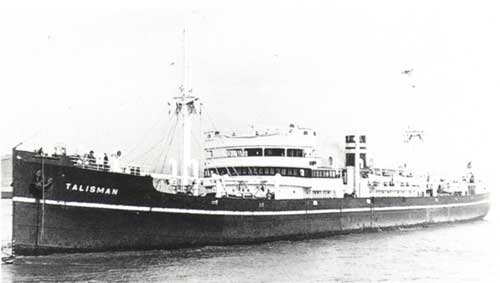
D/S Ringstad To Ringstad on the "Ships starting with R" page. Owner: Skibs A/S Gdynia Launched Jan. 27-1923 by Deutsche Werft A.G., Hamburg (Yard No. 61), completed Apr. 10-1923 as Talisman for Wilh. Wilhelmsen, Tønsberg. Sold on Nov. 3-1936 to Bruun & von der Lippes Rederi A/S (Bruun & von der Lippe), Tønsberg, and renamed Vigilant. Sold in 1937 to Skibs A/S Gdynia (Olav Ringdal), Oslo. Renamed Ringstad in 1940. Captain: Jacob K. Knudstad Her voyages are listed on these original images from the Norwegian National Archives: Please compare the above voyages with Arnold Hague's Voyage Record below.
(Received from Don Kindell - His source: The late Arnold Hague's database). Follow the convoy links provided for more information on each.
According to Page 1 of the archive documents, Ringstad was on her way from Buenos Aires to Norway when war broke out on Apr. 9-1940, but put into Lisbon on Apr. 16, proceeding to Falmouth a few days later then on to Plymouth, where she remained for almost a month. She's subsequently listed among the ships in Convoy OA 163, which left Southend on June 7 and joined up with Convoy OB 163 on June 9, the combined convoy forming the Gibraltar bound Convoy OG 33F (see my page listing ships in all OG convoys - Olaf Fostenes, Sildra and Tana are also listed, all from the OB convoy). Her destination is not given, but from the archive document, we learn that she arrived New York on June 23, having started out from Plymouth on June 9. According to A. Hague, she had left the convoy on June 11 to proceed to her destination, where she stayed until July 18, when she headed to Halifax in order to join Convoy HX 60 on July 23, general cargo for Glasgow, station 52 (she had been cancelled from the previous convoy, HX 59, on July 19). Together with Heina, Idefjord, Nea, Sama, Thalatta and Thorshavn, she later joined Convoy OB 203, originating in Liverpool on Aug. 24, dispersed on the 28th. Ringstad's destination is given as Montreal, general cargo. According to Page 1, she arrived Quebec on Sept. 9, Montreal Sept. 11, having started out from Clyde on Aug. 25. The external site that I've linked to in the table above has more on the OB and OA convoys. From Montreal, she proceeded to New York on Sept. 13, remaining there for until Dec. 9 - A. Hague says she underwent engine and hull repairs. On Dec. 14 we find her in Convoy HX 96 from Halifax, again bound for Glasgow with general cargo, arriving there on Dec. 30. At the end of Jan.-1941 she shows up, along with Bjørkhaug, Kaia Knudsen, Ringhorn (sunk, follow link for details), Sandar and Vanja, in Convoy OB 280, which originated in Liverpool on Jan. 31 and dispersed Febr. 3. Again, no destination is given for Ringstad, but from Page 1, we learn that she arrived St. John, N.B. on Febr. 17, having sailed from Clyde on Jan. 31. She again had a long stay in port, before proceeding to Halifax, then headed back to the U.K. again on March 17 with Convoy HX 115, general cargo for Avonmouth, station 83, arriving there on Apr. 4. She now joined Convoy OB 315 in order to go back to Montreal. The convoy, which also included Sandanger, left Liverpool Apr. 27 and dispersed May 4; Ringstad started out from Milford Haven on Apr. 26 and arrived Montreal May 14. Carrying a general cargo as well as trucks, she went back to the U.K. later that month in Convoy HX 129, bound for Avonmouth, station 122, arriving that destination on June 14. See also the Cruising order/Commodore's notes. In July, she joined a convoy which A. Hague has given the designation OB 341A, originating in Liverpool on July 2. However, as can be seen when following the link in the table above, escorts only are named. Instead, she has been included among the ships in Convoy OB 341, which originated in Liverpool on June 30 and dispersed July 6, but it looks like the ships in these 2 convoys have been listed on the same page (it'll be noticed that there are too many ships - among them are Brisk, Evanger, Fana, Leikanger, Novasli, Nueva Granada, Nyholt, Polartank, Sommerstad, Thorøy, Thorshavn, Thorsholm and Vigsnes). Ringstad was again bound for Montreal, where she arrived on July 19, having sailed from Milford Haven on July 1. A. Hague says she had been detached from the convoy (OB 341A) on July 14. She subsequently remained in Montreal until Sept. 4 when she proceeded to Halifax in order to join Convoy HX 149, which left Halifax on Sept. 10-1941 and arrived Liverpool on the 25th. Ringstad arrived Avonmouth on the 26th, then headed back across the Atlantic the following month with Convoy ON 28, together with Beth, Brant County, Grena, Laurits Swenson, Morgenen and Polartank (convoy left Liverpool on Oct. 20, dispersed Nov. 3 - see ships in all ON convoys). She arrived Montreal on Nov. 7, having sailed from Milford Haven Oct. 19 (Page 1), and on Dec. 3 she started on her return voyage in Convoy HX 163 from Halifax. According to Page 2, Ringstad arrived Cardiff (via Belfast Lough) on Dec. 23.
Together with Alaska, Andrea Brøvig, Leiesten, Pan Norway (both sunk - follow links for details), Polarsol, Solstad, Topdalsfjord and Vardefjell, Ringstad now joined the westbound Convoy ON 56, originating in Liverpool on Jan. 12-1942, dispersed on the 16th (again, see ships in all ON convoys). She was on a voyage from Cardiff to St. John, N. B. with a cargo of 2600 tons china clay, having departed Belfast Lough on Jan. 13 (note that Page 2 gives her destination as St. John's, N.F.). Due to several days of stormy weather she had lost touch with the convoy and was alone on Jan. 24 when she was torpedoed and sunk by U-333 (Cremer), 45 50N 51 04W (off Cape Race). She had received a radio message the day before that the Norwegian Leiesten had been torpedoed about 100 miles from their position, and more or less in their intended route, so she had immediately altered course. According to the captain's report this new course would take them about 80 n. miles south of Cape Race and about 70 miles north of their intended route. The torpedo struck on the starboard side between hatch No. 2 and 3, causing a powerful explosion and she sank down with the foreship. The aft port lifeboat filled with water and was ruined, but all on board got safely away in the 3 remaining boats. After Ringstad had gone down (in about 20 minutes) the U-boat came up and from the tower someone pointed in the direction of the nearest land, before the boat disappeared. The weather worsened and the boats were unable to stay together. Captain Knudstad's boat (motor) with 13 on board headed northwest for 5 days, their boat completely covered in ice and constantly taking in water in the heavy seas, so they had to keep bailing. On Jan. 29 they saw smoke from a convoy far away, an escorting aircraft spotted them and sent the American destroyer Swanson to assist. The exhausted and frostbitten men were landed at Reykjavik on Febr. 5. The captain, who was sick for a year after his ordeal, assumed, based on his own experiences, that the 30 missing men in the other 2 boats had frozen to death (27 crew, 3 passengers). See also link to the external website re USS Swanson provided at the end of this page, which includes a report on the rescue of Ringstad's survivors, as well as the names of those rescued (including the captain's dog Prinz, who was later presented to Swanson's captain) and a brief report on the sinking. The page says the following: The rescue was effected at Latitude 47-55 North and Longitude 50-53 West, which is 60 miles southeast of Cape Race. The rescued men were: Captain J.K. Knudstad, O.S. Olsen, L. Meen, E.C. Streton, E. Oygarden, B. Borresen, T. Eklud, O.A. Eniks, A. Egge, S. Goodwin, R.Fairey, F.W.J. Bowley, W.J. Hiton, and Prinz (Captain’s Alsatian dog.) The Swanson then sank the lifeboat using 5”/38 gunfire. Captain Knudstad, the Master of the SS Ringstad submitted the following report to the Commanding officer of the Swanson: The following men, among others, are believed to have been in one of the other two lifeboats: Lt. Williams, Royal Navy (Special Branch), bomb disposal expert enroute to Ottawa, Canada; Sub-Lieutenant Jameson, Royal Navy (Special Branch), Canadian: William Laurie, Ordnance Seaman, (Special Branch), Canadian. Captain Knudstad before leaving the Swanson presented his dog Prinz to Captain Kingsley, who proudly accepted the gift and upon return to the United States took Prinz to his home." It adds: "By mid morning on Thursday 5 February 1942 the Swanson had arrived in Reykjavik, Iceland and moored alongside the tanker Rapidan to fuel. Within minutes the Hospital ship Avon Glen came alongside and the survivors from the SS Ringstad and Fredrick Heath from the SS Barrister were transferred (Barrister had been in Convoy HX 172, for which Swanson had acted as escort. Gunner Fredrick Heath had been injured by shrapnel in his chest). The inquiry was held in Reykjavik on Apr. 25-1942 with the 2nd mate and Oiler Børresen appearing (the latter was in the engine room at the time of attack). The captain was still in the Norwegian Hospital there at that time.
Cremer says: "I submerged for an underwater attack and delivered a shot from Tube 1 (time given as 15:25, German time). The torpedo ran at three meters depth and struck. The steamer, a Norwegian by name Ringstad, stopped, settled by the bow and blew off steam. Shortly afterwards she slid stem-first into the depths." He seems impressed with the behaviour of the seamen who were "extraordinarily calm and had already dressed their wounded". He says the lifeboats were "large and well equipped, provided with a quenched-spark transmitter which they were using. We gathered they were reporting their torpedoing and exact position, so I could not stop any longer but had to make a quick get-away." 37 years later he learned more from one of the crew members' report, Oiler Roar Boye Børresen (captain Knudstad had died by then) who thought the torpedo must have hit in their china clay cargo. At the time, they intended to clean the oil tanks in order to be ready for arrival St. John the following day. They did not feel the explosion in the engine room, just a heavy bump. Fearing another torpedo the 2nd mate sent them to the lifeboats, and Ringstad sank within 20 minutes. Børresen indicates their fear of being shot when the U-boat came towards them, but instead the commander offered them food and water (which was declined), pointed them in the direction of East Newfoundland saying they were about 85 n. miles from land, wished them good luck and said he hoped they would be picked up, then disappeared. Børresen adds "he was a seaman, one of the type that we produce. He behaved according to the code of seamen who take no oath on it but know: help one another when in trouble at sea!"
Related external links: Stavern Memorial Commemorations - Norwegians only - some of the names a spelt a little differently; some of the titles are also different. Ships hit from convoy ON 55 - As can be seen, Uboat.net has included Ringstad and Silveray in this convoy. Again, A. Hague has listed Silveray in Convoy ON 53, while he has Ringstad in ON 56. Here is Uboat.net's listing of ships sunk in ON 53, and ships hit from convoy ON 56 (Pan Norway and Leiesten included). Back to Ringstad on the "Ships starting with R" page. Olav Ringdal, Oslo had another Ringstad post war, built 1969, 21 819 gt. Sold to China in 1977 and renamed Jin Hai. The text on this page was compiled with the help of: Wilh. Wilhelmsen fleet list, "Nortraships flåte", J. R. Hegland, "Sjøforklaringer fra 2. verdenskrig", Norwegian Maritime Museum, Volume II, and misc. for cross checking details, as named within above text (ref. My sources).
|
||||||||||||||||||||||||||||||||||||||||||||||||||||||||||||||||||||||||||||||||||||||||||||||||||||||||||||||||||||||||||||||||||||||||||||||||||||||||||||||||||||||||||||||||||||||||||||||||||||||||||||||||||||||||||||||||||||||||||||||||||||||||||||||||||||||||||||||||||||||||||||||||||||||||||||||||||||||||||||||||||||||||||||||||||||||||||||||||||||||||||||||||||||||||||||||||