Site Map | Search Warsailors.com | Merchant Fleet Main Page | Warsailors.com Home Merchant Fleet Main Page | Warsailors.com Home |
|
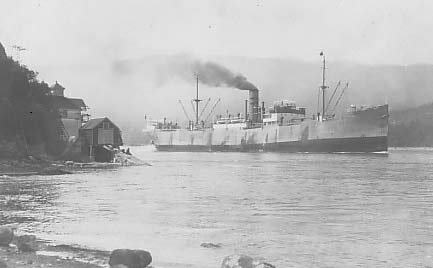
D/S Leikanger To Leikanger on the "Ships starting with L" page. Manager: Westfal-Larsen & Co. A/S, Bergen Delivered in Nov.-1923 from Lithgows Ltd., Port Glasgow. Captain: Eugen de Lange Hansen. Her voyages are listed on these original images from the Norwegian National Archives: Please compare the above voyages with Arnold Hague's Voyage Record below.
(Received from Don Kindell - His source: The late Arnold Hague's database). Follow the convoy links provided for more information on each. Errors may exist, and some voyages are missing.
Together with John Knudsen, Leikanger is listed in Convoy OA 133GF in Apr. 1940. This convoy left Southend on Apr. 20, joined up with Convoy OB 133 on the 22nd, the combined convoy forming the Gibraltar bound convoy OG 27F (see my page naming ships in all OG convoys). Leikanger's destination is given as Dartmouth, N.S. From Page 1 of the archive documents we learn that she arrived Halifax on May 5, having detached from the OG convoy on Apr. 24, according to Arnold Hague. She headed back to the U.K. with Convoy HX 46 from Halifax on May 28, cargo of lumber for London, where she arrived on June 13. Later that month we find her in Convoy OA 175, which departed Southend on June 27 and dispersed on July 1. Her destination is given as Sydney, C.B. (Cape Breton), station 23, sailing right behind the company's Brandanger. Boreas and Topdalsfjord are also listed - ref. external link provided within the Voyage Record, as well as my own page related to OA 175 (Vice Commodore's report). Leikanger arrived her destination on July 10, proceeding to Buctouche 2 days later. She headed back across the Atlantic with Convoy HX 61 from Halifax on July 27 (having been cancelled from HX 60, July 23), pit props for Hull, station 32, arriving Hull Aug. 14, remaining there for quite a long time (Page 1). The following month, she shows up, together with Ila, in Convoy OA 213, which left Methil Sept. 12 and dispersed Sept. 16, Leikanger arriving Halifax on Sept. 27. She was scheduled to return to the U.K. with Convoy HX 80 on Oct. 12, but instead joined the next convoy on Oct. 16, HX 81, steel and lumber for Hull, station 12. It looks like she dropped out of the convoy on Oct. 24/25, reason not given (see Commmodore's notes for HX 81), but possibly because of the bad weather. She arrived Oban on Oct. 31 (Hull Nov. 10). According to the external website that I've linked to below Leikanger, with destination Havana, was scheduled for Convoy OB 262, leaving Liverpool on Dec. 20, but did not sail. Arnold Hague instead has her in the next convoy, OB 263, which left Liverpool on Dec. 23 and dispersed on the 27th. Going back to Page 1 of the archive documents, we find that she arrived Havana on Jan. 14-1941, having started out from Oban on Christmas Eve. Brasil, Garonne, Hjalmar Wessel and Primero are also listed. From Havana, she headed to Galveston on Jan. 22-1941, then proceeded to Bermuda in order to join Convoy BHX 108 on Febr. 7 (the Bermuda portion of Convoy HX 108 - see ships in all HX convoys), and at the end of the following month she's listed as bound for St. John's, N.F. in Convoy OB 303, originating in Liverpool on March 28, dispersed Apr. 3. Other Norwegian ships were Benwood, Evviva, Facto and Troubadour - again, ref. external link provided in the Voyage Record. According to Page 2 of the archive documents, she arrived St. John's on Apr. 9, having started out from Loch Ewe on March 30. It'll also be noticed that she subsequently spent quite a long time at St. John's; departure is given as May 10, when she proceeded to Halifax then on to Montreal, later heading to Sydney, C.B. in order to join the Sydney portion of Convoy HX 131 on June 7, bound for Newcastle with a cargo of grain and beans in station 44. She's now listed on Convoy OB 341 (convoy left Liverpool June 30, dispersed July 6); Brisk, Evanger, Fana, Novasli, Nueva Granada, Nyholt, Polartank, Ringstad, Sommerstad, Thorøy, Thorshavn, Thorsholm and Vigsnes are also named, but please note that it looks as though some ships from Convoy OB 341A have also been included in the listing for OB 341 at the link provided in the Voyage Record which, in fact, states that Leikanger sailed in the latter convoy, rather than OB 341. She arrived Sydney, C.B. on July 17, having started out from Loch Ewe on July 4 (Convoy OB 341A originated in Liverpool July 2, arrived Halifax July 18). From Sydney, C.B. she made a voyage to Parrsboro, where she remained for over 2 weeks before proceeding to Halifax in order to join Convoy HX 145 back to the U.K. on Aug. 16. According to A. Hague, she had a cargo of lumber, and also had 2 passengers on board on this voyage. He names 2 Kos whalers among the escorts, namely Kos IX and Kos VIII. On Sept. 18-1941, Leikanger was passing Flamborough Head on the east coast of the U.K. in convoy* when attacked by a German Ju 88 bomber. This appeared to have been shot down by the escorting destroyer Westminster before it could do any damage, but the convoy was attacked again that same evening and Leikanger was hit, though the bomb landed on deck without detonating and was carefully thrown overboard. About a week later Leikanger, bound for New York, joined the westbound North Atlantic Convoy ON 20, together with several other Norwegian ships. A. Hague says she became a straggler on Oct. 6, and as can be seen when following the link to my page about this convoy, this is also mentioned in the Commodore's notes, saying she stopped with defects at 16:00 on Oct. 6 in 47 9N 39 32W, adding she apparently had no ballast, and "as remainder of convoy had this almost necessary commodity for western passage in Oct., she was 1 knot slower than remainder". She arrived New York on Oct. 15, having sailed from Clyde on Sept. 25. Having remained in New York for about 2 months, she proceeded to Halifax, then on to Sydney, C.B. and Christmas and New Years Eve of 1941 were celebrated in the slow Convoy SC 61, general cargo for Cardiff, where she arrived Jan. 11-1942. Her voyages in this period are shown on Page 3.
In Febr.-1942 she's listed as bound for Portland, Maine with the westbound North Atlantic Convoy ON 62, which left Liverpool on Febr. 1 and dispersed on the 15th - please scroll down to this convoy in the section listing ships in all ON convoys. Leikanger arrived Portland on Febr. 18, having sailed from Milford Haven on Jan. 31. From the U.S., she later headed to Capetown - again, see also Page 3. More info on all the other Norwegian ships mentioned here can be found with the help of the alphabet index at the end of this page, or go to the Master Ship Index. Related external link:
Leikanger was on a voyage from Beirut and Table Bay to Trinidad and Baltimore with 1000 tons of chrome ore when she on July 27-1942 was struck in No. 2 and 3 holds, starboard side, by 2 torpedoes from U-752 (Schroeter), 04N 18W. (Some sources give convoy as FN 20, FN=Freetown North, but I'm not sure about this designation. She had arrived Table Bay on July 10-1942 and left again on July 13, parting company with the convoy at some point during the voyage north - A. Hague says she was sailing independently). See also Page 3. On board were 29 crew and 2 British gunners. She was practically blown to bits, and the captain, 12 other Norwegians, 3 from Britain (incl. one of the gunners), 1 Canadian and 1 Danish died. The 13 survivors suddenly found themselves in the water among all the debris but managed to get on 2 rafts which floated nearby. Among the debris a crate containing signal flags proved useful, in that they used the flags as protection against the sun during the day and for warmth during the night, as they were practically naked. They were found in the evening of July 31 by the American S/S Harry Luckenbach, which took them to Capetown on Aug. 12. A survivor report claims that blackout regulations were not inforced; men smoked on deck and lights were often shining from open portholes. The same document (a memorandum dated Sept. 15-1942) gives the time of the first attack as 10:55 ships' time, with the 2nd attack some 12 seconds later, adding that she was on a course 268 degrees true, not zig-zagging, 3 lookouts, no other ships in sight. The ore (for ballast) was carried in all but 1 of the 5 hatches. The ship began sinking with the first explosion and 2 minutes later, heeling to starboard, slid out of sight. The 1st explosion occurred on the starboard side at No. 2 hatch, the 2nd on the starboard side either in the after end of No. 3 hatch or foreward of boiler room. Fragments of the ore in the hold rained down on the scene for several seconds. The engines were not stopped, the radio was demolished, the gunners "made a gesture of manning the guns". Hands attempting to get port side boats out went down with the ship. Boats on the action side were demolished. Some of the survivors were standing on the deck when Leikanger slid under and were sucked down about 10 ft. The rafts (with the survivors) remained in the area for about 8 hours, but no sub was ever seen. The survivors were very critical of the rafts' releasing gear (owing to lead[?] painters running through a block on a kingpost). "If there's time to lower rafts, there's time to lower boats", they argued. More of the equipment usually stored in boats should be put in rafts, they contended. The breaker(?) in one of the rafts was punctured by debris and should be better protected. Flashlights, aspirin tablets, laxative pills and splints should be included among the rafts' equipment. The Norwegian maritime gunners spent more time working on the basis of their AB ? than on gun lookouts, it was charged (the text in this memorandum is very blurry, hence my question marks).
2nd Mate Østervold was in bed when the ship was torpedoed. He jumped up and grabbed a shirt holding his papers, having just gotten it in his hand when the second torpedo struck, causing everything in his cabin to collapse around him. He struggled to get the door open, then ran into the passage which was full of smoke, then aft to the deck and up the ladder to the boatdeck. At this time he felt the ship going straight down and tried to throw himself overboard, but got only his upper body out before he was jerked in by the sea and followed the ship down. He was under for a long time, but managed to get to the surface where he rested on some debris before swimming towards one of the rafts that had floated free, then tried to row it towards others whom he could see in the water. Another raft had also floated free and the two were tied together. With the help of whistles they were able to find and rescue all those who were in the water. The water keg on one of the rafts was broken but by careful rationing they managed well with the one keg they had, and the 2nd mate feels they could have managed another week. He estimates that there was enough food to keep them all alive for a month and a half. Once rescued, both he and the 3rd mate were extensively questioned by an American lieutenant by the last name Berg on S/S Harry Luckenbach, presumably for a report to naval authorities in Capetown. 3rd Mate Olav Høyem was on duty on the bridge. The 2nd and 3rd mates both mention the fact that the ship should have had more people on proper lookout at all times, and that daily work on board should be secondary to this task. They had discussed this with the captain and 1st mate on several occasions. In fact, Able Seaman Kåre Knutsen had written to the Seamen's Union about this on behalf of the crew. The latter was at the helm at the time Leikanger was torpedoed. Ordinary Seaman Hilmar Haug was also on watch but was working on deck, which was usual during the daytime when the visbility was good (both lost their lives). The British Gunner Harry Pluck (survived) was lookout on the port side of the bridge, while the 3rd Mate had been keeping a lookout on the starboard side, but at the moment the torpedo struck he was helping 3 crew members who were working on the port side (all of whom died), so that at the time of the attack there were no lookouts on the starboard side at all. The Norwegian Able Seaman/Gunner Theodor Økland was on duty by the aft gun - this duty alternated between the 2 Norwegian gunners over a 24 hour period, while the 2 British gunners shared the watch on the bridge from 6 morning till 6 afternoon. Otherewise, there were no other lookouts. (There was a lookout "barrel" on board, but it was never used). That same morning they had been informed over the radio that a vessel had been torpedoed in Leikanger's intended course about 450 miles away and, therefore, they had had gunnery practice about 25 minutes before the torpedo struck. The 3rd mate had taken part in this. He says that when the first explosion occurred, the ship shook violently, and debris from the cargo and pieces of the ship as well as oil were flung high in the air. The Danish Galley Boy Thor Sort (died) had just happened to be on the bridge at that time, and he and Gunner Pluck immediately left the bridge, while the helmsman (K. Knutsen) remained. The 3rd mate ran into the radio room next to the wheel house to instruct the radio operator to get an SOS sent but was told the equipment did not work, so he told him to leave as quickly as he could and bring 2 lifebelts, 1 for the helmsman. At the same time the captain came up carrying a bag with the ship's papers, and at that moment the second torpedo exploded amidships beneath No. 3 hatch, causing the ship to break and go straight down. The captain, the radio operator and the helmsman ran out to starboard while the 3rd mate ran to port and was pulled down with the ship. When he surfaced he was surrounded by debris, then managed to get on one of the rafts, which in his opinion was the best rescue equipment they had on board, being as the lifeboats would not float free like the rafts would. In this case, all the lifeboats were lost. He feels there should be many more rafts on a ship. As mentioned, Able Seaman/Gunner Theodor Økland was on duty by the aft gun when the attack occured. He was in the process of cleaning the gun, ordered to do so by the 1st mate following the practice run they had just had, so he was not keeping a lookout at the time. He grabbed his lifevest which he always had with him - all crew members had one, of course, but in the tropical heat they did not wear them all the time. Gunner Gregorius Økland had also come up to the gun platform and together they ran down to the deck. Since departure Capetown on July 13 these two had not been set to do any other work on board than keep watch by the guns. The entire foredeck was already under water so all those who were there just threw themselves overboard. T. Økland got away from the suction and swam around for about an hour and a half in the direction of the rafts, one of which held 3-4 men who tried to maneuver the rafts so that everyone in the water could eventually be picked up. The British Cook John Mealim (possibly Mealin?) had just looked at his watch which showed 10:55 when the first torpedo hit. He saw the starboard lifeboats blow up before running to the boat deck, but the second explosion occurred while he was at the top of the ladder. He says he was blown out of his shoes, his shirt was blown off him and his glasses disappeared. He managed to get down to the main deck in a semi conscious state, and all he can remember is that his feet were in water before he left the ship. He saw the propeller pass him in the water. The cook does not believe the ship was hit in No. 2 hold but just behind the bridge; otherwise the lifeboats could not have gone like they did. He believes the second torpedo must have struck in the boiler room because he was covered with oil. He had no lifevest on, but was able to keep himself afloat on a hatch cover until he was picked up by one of the rafts, where he collapsed. This was the 5th time he had been torpedoed. Additionally, he had lost his wife, 2 children and his home in Liverpool during the blitz in Nov.-1940. On the Tobruk run his left foot had been hit by shrapnel and he was also burnt. Needless to say, with this 5th torpedo incident his nerves were more than a little frazzled. He too expresses relief that the rafts were positioned so that they floated free as the ship sank, but feels the provisions ought to include canned vegetables, because all the existing provisions in them tended to make people even more thirsty. Though the rafts had some medical supplies there were no splints, which in this case would have come in useful because the Czechoslovakian Josef Schwartz had a broken arm (he was later seen to at a hospital in Capetown). U-752 was also responsible for the attacks on Reinholt and Bidevind earlier that year.
Related external links: Operations Information for U-752 Convoy OS 33 - For more information on Leikanger as well as a picture of her, and some details on Harry Luckenbach go to "other losses". Please note that Leikanger was not in Convoy OS 33, but U-752 was one of the 6 U-boats that had left France to rendezvous south of the Canary Islands in order to attack this convoy. Afterwards, this group of boats was dissolved (July 21-1942) and, acting independently, went on to sink another 8 ships, Leikanger being one of them. The website has more details on the others. Back to Leikanger on the "Ships starting with L" page. Other ships by this name: Westfal-Larsen had previously had another ship by this name, built in Sunderland 1916. Sunk by a German U-boat off the coast of Spain on May 7-1917, voyage Baltimore-Nantes with wheat - no casulaties. Another Leikanger was delivered in Febr.-1958 (built in Japan). Sold in Jan.-1965 to Mil Tankrederi A/S, Oslo and renamed Norsk Barde. Sold in 1969 to Svend Foyn Bruuns Rederi, Tønsberg, renamed Petunia. Broken up in China in 1969. (Westfal-Larsen fleet list). The text on this page was compiled with the help of: "Nortraships flåte", J. R. Hegland, "Sjøforklaringer fra 2. verdenskrig", Norwegian Maritime Museum, Volume I, and misc. others for cross checking info. The memorandum mentioned in the narrative was received from T. Cooper, England.
|
||||||||||||||||||||||||||||||||||||||||||||||||||||||||||||||||||||||||||||||||||||||||||||||||||||||||||||||||||||||||||||||||||||||||||||||||||||||||||||||||||||||||||||||||||||||||||||||||||||||||||||||||||||||||||||||||||||||||||||||||||||||||||||||||||||||||||||||||||||||||||||||||||||||||||||||||||||||||||||||||||||||||||||||||||||||||||||||||||||||||||||||||||||||||||||||||||||||||||||||||||||||||||||||||||||||||||||||||||||||||||||||||||||||||||||||||||||||||||||||||||||||||||||||||||||||||||||||||||||||||||||||||||||||||||||||||||||||||||||||||||