Site Map | Search Warsailors.com | Merchant Fleet Main Page | Warsailors.com Home Merchant Fleet Main Page | Warsailors.com Home |
|
M/S Primero To Primero on the "Ships starting with P" page.
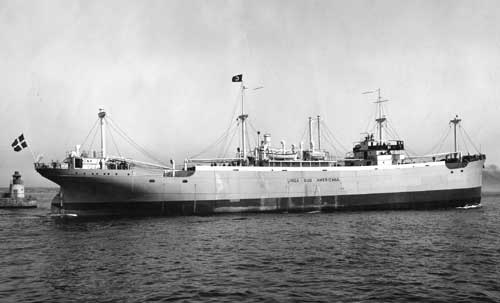
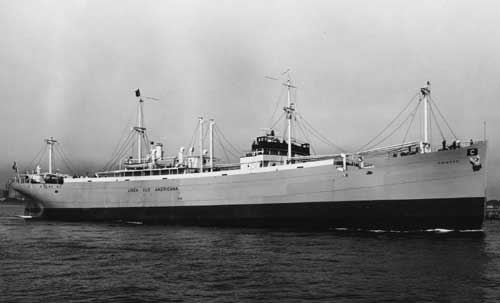
Owner: A/S Ivarans Rederi Completed in July-1925 by Burmeister & Wains Maskin- og Skipsbyggeri, Copenhagen (Yard No. 336) as Primero for A/S Ivarans Rederi (Ivar An. Christensen), Oslo. 368.5' x 53.7', twin screw, 10 1/4 knots. Renamed Sud Argentino in 1928 (same owners), Primero in 1930. S. Holter-Sørensen became manager in 1934, A/S Ivaran remaining the owner. (Sister ship of Segundo and Tercero). Captain: Hjalmar Johansen (previously H. Christensen? See narrative below). Her voyages are listed on these original images from the Norwegian National Archives: Please compare the above voyages with Arnold Hague's Voyage Record below.
(Received from Don Kindell - His source: The late Arnold Hague's database). Follow the convoy links provided for more information on each. Errors may exist, and some voyages are missing.
As will be seen when going to Page 1 of the archive documents, Primero was on her way from Narvik, Norway to Baltimore when war broke out in Norway Apr. 9-1940; she arrived Baltimore on Apr. 17. According to the Memorial for Seamen in Stavern, Norway (ref. link at the end of this page) Motorman Gustav Thoresen died on June 26-1940 following an accident on board. Checking with "Våre falne", a series of 4 books naming Norwegians who died during the war, I find that he drowned on that date when Primero was in the southern Pacific. From the archive document referred to above, we learn that she was on her way from Balboa to Lyttelton on that date. Later that year, A. Hague has included her (with a cargo of wheat), together with Grena, South Africa and Thorshavet, in Convoy SL 51, which left Freetown on Oct. 12-1940 and arrived Oban Oct. 31; according to Page 1, Primero left Freetown on Oct. 9 and arrived Clyde Nov. 1. With destination Melbourne, she's also listed, along with Brasil, Garonne, Hjalmar Wessel and Leikanger, in Convoy OB 263, originating in Liverpool on Dec. 23-1940, dispersed on the 27th (Karlander, Egda and Sneland I were scheduled, but did not sail - see also Cetus). Primero arrived Melbourne (via Cristobal) on Febr. 22-1941, having started out from Oban on Christmas Eve. Both these convoys are available via the external links provided within the Voyage Record. From Melbourne, she sailed to Port Augusta a month later. With a cargo of wheat, she was scheduled for the Bermuda portion of Convoy HX 131 on June 4-1941, but did not sail (she had arrived Bermuda from Cristobal on June 2 - again, see Page 1). She was also cancelled from the Bermuda portion of HX 132, but eventually got away with (B)HX 133 (sailing from Bermuda, June 14-1941). However, she was ordered to St. John's, N.F. after having collided with City of Oxford in dense fog at 01:00 on June 20, approximate position 45 52N 49 58W (see my page about HX 133 for details). This was the convoy in which Soløy and Vigrid were sunk, and Kongsgaard was torpedoed and damaged - follow the links for more info. Primero remained in St. John's for several weeks (probably for repairs?), before joining Convoy HX 143. The Norwegian Thorshavn, Mosli, Andrea Brøvig, Katy, Ravnefjell, Carmelfjell, Salamis, Belinda, Benwood and Petter are also listed in this convoy, which originated in Halifax on Aug. 5, but Primero joined from St. John's, having left on Aug. 9; she stopped at Belfast Lough on Aug. 20 and it now looks as though further repairs may have been undertaken at Belfast, because she stayed for about a month, proceeding to Barry on Sept. 21, then on to Milford Haven. Together with the Norwegian Jenny, she's subsequently listed in Convoy OS 8, which originated in Liverpool on Oct. 3-1941 and arrived Freetown on the 26th. Primero was in station 25 (24?), on a voyage from Milford to Freetown/Cape/Fremantle with coal (Cape Town and Fremantle are not mentioned for this period on Page 1). She returned to the U.K. with iron ore the following month in Convoy SL 93, departing Freetown on Nov. 19, arriving Liverpool on Dec. 10; Primero stopped at Oban that day, later continuing to Methil and Middlesbrough (Page 2). The captain's name is given as H. Christensen at that time. Para is also listed in this convoy, while Tore Jarl was scheduled but did not sail. Again, see the links in the table above for more information on these 2 convoys. In Febr.-1942 we find her in the westbound North Atlantic Convoy ON 64, which left Liverpool on Febr. 7 and arrived Halifax on the 24th; Primero, however, was bound for New York, where she arrived on Febr. 28, having sailed from Loch Ewe on the 7th - see Page 2. This convoy will be added to an individual page in my Convoys section; in the meantime, the ships sailing in it are named on this page. Bruse Jarl, Frontenac and Snar also took part, and Acanthus and Rose are named among the escorts (see ON convoy escorts). It now looks like she remained in New York for a long time; departure is given as May 20, when she proceeded to Philadelphia and at the end of that month she headed to Cape Town, Aden and Port Sudan. More info on the other Norwegian ships named here is available via the alphabet index at the end of this page, or go to the Master Ship Index.
Primero was torpedoed by U-67 (Müller-Stöckheim) at 13:40 GMT on Oct. 25-1942, position 13 38N 53 55W. She had been to The Middle East with tanks, trucks and ammunition, as well as a deck cargo of aircraft in crates, and was on her way back alone from Suez and Aden for New York (via Port of Spain for bunkers) with 1500 tons of salt ballast, having left Cape Town on Oct. 1 (Page 2). 2 men were killed in the engine room where the torpedo had hit (starboard amidships), causing her to list heavily to port, then to starboard. Both engines stopped immediately, and the equipment in the radio station was destroyed; alarms and phones were also rendered inoperable. The starboard lifeboats disappeared, No. 3 hatch was ripped open and water could be heard gushing in. Heavy gas and smoke came from the engine room, making it impossible to look for the 2 who had been on duty there. In fact, the captain and other crew members later reported that the strong odor and dark grey fumes made them very sick and caused their stomach muscles to become hard and knotted for 24 hours afterwards. When orders to abandon ship were given at 13:55 she had a starboard list of 20°. As soon as the 2 lifeboats were clear of the ship, another torpedo detonated near No. 2 hatch at 14:10 GMT. By 17:00 she had a 40° list, sinking deeper and deeper by the stern. It was then clear she could not be saved, so the survivors set sail, landing at Toco Beach west of East Point at 12:15 GMT on Oct. 31. The locals there crowded around as the boats landed, supplying the men with plenty of food and cigarettes. That same day 35 of them were taken by bus to Port of Spain, while 2 remained in order to take the lifeboats to Port of Spain, arriving Nov. 3-1942. According to Uboat.net's account on the attack on Primero (external link), the U-boat collided with her when passing underneath. The inquiry was held in New York on Nov. 17-1942 with the captain, the 1st engineer (who had come up from the engine room just before the torpedo struck), the 3rd mate (officer on watch on the bridge, together with the captain), and Able Seaman Skjærvik appearing. The latter had been at the helm at the time of attack, but had previously been on lookout and had seen what he believed to be a U-boat about 5-6 miles ahead of them at that time. He reported this to the officer on watch and the captain was called, but the object later disappeared. It appears a diversion of course had been sent to Primero on Oct. 23, but not received by the ship. For info, U-67 was also responsible for the attacks on Kongsgaard, Nortind, Bayard, Nidarland and Tortugas. Follow the links for more details.
Related external links: Back to Primero on the "Ships starting with P" page. The text on this page was compiled with the help of: "Nortraships flåte", J. R. Hegland, "Sjøforklaringer fra 2. verdenskrig", Volume II (Norwegian Maritime Museum) and misc. (ref. My sources). Pre war details were supplied by Terry Whalebone in a posting to my Ship Forum.
|
||||||||||||||||||||||||||||||||||||||||||||||||||||||||||||||||||||||||||||||||||||||||||||||||||||||||||||||||||||||||||||||||||||||||||||||||||||||||||||||||||||||||||||||||||||||||||||||||||||||||||