Site Map | Search Warsailors.com | Merchant Fleet Main Page | Warsailors.com Home Merchant Fleet Main Page | Warsailors.com Home |
|
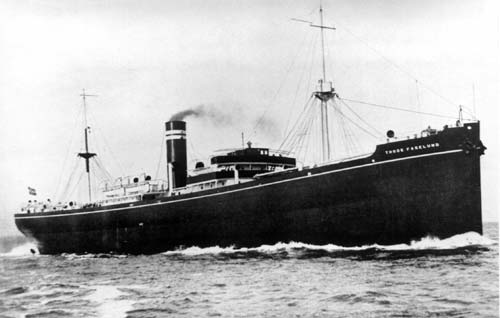
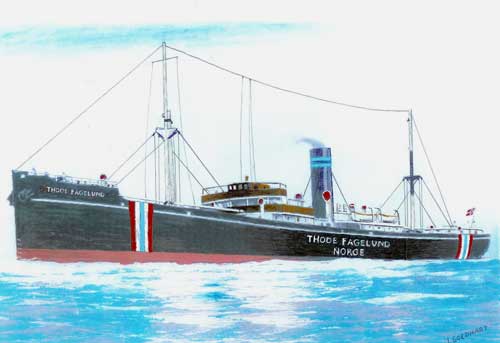
D/S Thode Fagelund To Thode Fagelund on the "Ships starting with T" page. Manager: Wilh. Wilhelmsen, Tønsberg Launched on Aug. 7-1920 by Sir James Laing & Sons Ltd., Sunderland (Yard No. 678), completed Oct. 29-1920. 395' x 53.3' x 32.7', 3-cyl. triple expansion steam engines of 2900 ihp by Palmers' Shipbuilding & Iron Co. Ltd., Jarrow. Subsequently fitted with a low pressure exhaust steam turbine. Service speed 12 knots, 8 passengers. Captain: This Jørgensen Related item on this website: Her voyages are listed on these original images from the Norwegian National Archives: Please compare the above voyages with Arnold Hague's Voyage Record below.
(Received from Don Kindell - His source: The late Arnold Hague's database). Follow the convoy links provided for more information on each. Errors may exist, and some voyages may be missing.
As will be seen when going to Page 1 of the archive documents, Thode Fagelund was in Rio de Janeiro when war broke out in Norway on Apr. 9-1940, having arrived there from New York the day before. In Sept.-1940 she's listed, along with Skaraas, in Convoy SL 47, which departed Freetown on Sept. 10 and arrived Liverpool on the 28th - link in the table above. Thode Fagelund was bound for Hull, station 12, arriving that destination on Oct. 3, remaining there for about a month. She later also spent several weeks in Glasgow (Page 1). We now find her in Convoy OB 267, departing Liverpool on Dec. 30, dispersed Jan. 2-1941 - again, see the link provided in the Voyage Record above. Cetus, Charles Racine (Commodore Vessel) and Danio are also named. Thode Fagelund's destination is not given, but from the archive document, we learn that she arrived Durban on Febr. 2. According to the Memorial for Seamen in Stavern, Norway (link below), she lost a crew member a month later; 3rd Mate Martin Stensland is listed as having died at sea on March 2-1941 due to illness. Going back to the archive document, we see that she was on her way from Beira to Sandheads (Calcutta) at the time. It'll also be noticed that she subsequently had a long stay at Sandheads, before proceeding to Madras. Skipping now to May 30-1941, when she can be found in Convoy SL 76 from Freetown (4 ships were sunk). Thode Fagelund, cargo of pig iron and groundnuts, stopped at Oban on June 21, continuing to Leith a couple of days later. The following month she's listed, together with Benwood, Gallia, Gard, Lise, Tore Jarl and Vav, in Convoy OB 349, departing Liverpool on July 21, dispersed Aug. 1, Thode Fagelund arriving Trinidad Aug. 10. Again, see the links in the table above for more information on these convoys - Thode Fagelund's voyages in this period are shown on Page 2. More info on the other Norwegian ships named here can be found via the alphabet index at the end of this page, or go to the Master Ship Index. Related external link:
Thode Fagelund was on a voyage from Chittagong and Madras to Table Bay and the U.K. with a cargo of scrap iron, jute and tea when she was torpedoed in the starboard side and sunk on Nov. 17-1941 by the Vichy French submarine Le Héros (Lemaire), 60 n. miles east (another source says 35 miles southeast) of East London (South Africa). According to Page 2, she had departed Chittagong for Madras on Oct. 24, then left Madras on Oct. 28. All 35 survived, 4 lifeboats were launched, and by the time they had left the ship the entire after part was under water. One of the boats with 8 men reached Kidds Beach near East London that same evening, while those in the 2nd mate's boat were found by a vessel that had been sent out from East London. The men in the other 2 boats were picked up by D/S Nahoon and subsequently landed in Port Elizabeth. There seems to have been a great mystery and some suspicion surrounding this event, in that the authorities wouldn't believe at first that there could have been any enemy boats in that area, nor were there any mine fields or enemy aircraft. Therefore, the explosion must have come from inside the ship, possibly as a result of sabotage - due to the British 2nd radio operator's statements, the 1st mate was initially suspected of this act. Thode Fagelund's officers were interrogated, the captain said a torpedo had hit in the stern of the ship, and after she had sunk, he had spotted (from the lifeboat) a conning tower and periscope about 500 meters to the port side of the ship's course. Others also claimed to have seen the sub. The hearings were held in Capetown on Dec. 5-1941 with the captain, the 1st mate (officer on watch), Radio Operator Brochmann Johannessen and Ordinary Seaman Fredriksen (lookout) appearing. Eventually, based on information at hand, the interrogation staff at Capetown reported to the Admiralty that Thode Fagelund had been torpedoed by a Vichy French submarine. This conclusion was drawn from several facts. A French convoy from Madagaskar with supplies for France had been intercepted by the British on Nov. 3, and the merchant ships and their cargoes seized. Radio communications between the French authorities and the escorting d'Iberville, which was allowed to return to Madagaskar, were intercepted. Earlier, on Oct. 28, the subs Le Glorieux and Le Héros had departed Dakar for Madagaskar with another convoy, but did not return when the convoy did on Nov. 10. Additionally, on Nov. 22, aircraft had observed what was believed to have been one or more subs off Durban Bluff, and dropped some bombs, then on Dec. 7 private telegrams to Le Héros in Diego Suarez were intercepted. It was believed that Thode Fagelund was torpedoed as a reprisal for the earlier British interception of the French convoy. Glorieux had also attacked an allied ship on Nov. 15, but the attack was unsuccessful. An article found in "Krigsseileren", Issue No. 4 for 1995, written by someone who was on board at the time, states that the 3000 tons iron had been taken on board in Calcutta (for ballast, since the 36 000 cases of tea they were to get in Chittagong didn't weigh much). He says she had previously been to New York (from Birkenhead) and had sailed alone to Capetown where she got some supplies before continuing east, also stopping by Dar es Salaam (according to the archive documents, she had not been in New York since June-1940, but did not arrive there from the U.K. - see Page 1, unless she had stopped by New York on her way to Trinidad in Aug.-1941? see Page 2, which also shows that she did proceed to Capetown from Trinidad). While in Calcutta there was a fire in the engine, caused by reckless smoking. Fire services were called and when extinguishing the fire the ship filled with water and sank in the harbour, causing a delay of 6 weeks before she could proceed to Chittagong to take on board the tea. This does not quite fit the facts; according to Page 2, she had arrived Sandheads (Calcutta) on Oct. 11, and left again for Chittagong on the 18th, which does not indicate a 6 weeks delay. However, it'll be noticed, when going back to Page 1, that Thode Fagelund had spent several weeks there earlier that year (from March 9 to Apr. 6), perhaps the author of the article just remembers the sequence of events wrong? He adds she was en route to Capetown for bunkers when the torpedo hit in No. 5 hatch very early in the morning. She immediately started to list and all lights went out before she sank straight down in a few minutes, with the suction causing a "great hole" in the sea, so the lifeboats had to row for life to get away from it. Crew List - No casualties:
* See this Guestbook message Back to Thode Fagelund on the "Ships starting with T" page. Wilh. Wilhelmsen had previously lost another steamship by this name, built 1904, 4352 gt - torpedoed and sunk off Ostend on March 12-1917 by the German UB 27, 51 40N 02 58E, on a voyage Shanghai-Rotterdam with a cargo of sesame seed. The text on this page was compiled with the help of: Wilh. Wilhelmsen fleet list, "Nortraships flåte", J. R. Hegland, "Krigsseileren", Issue No. 4 for 1995, "Sjøforklaringer fra 2. verdenskrig", Volume II (Norwegian Maritime Museum) - (ref. My sources).
|