Site Map | Search Warsailors.com | Merchant Fleet Main Page | Warsailors.com Home Merchant Fleet Main Page | Warsailors.com Home |
|
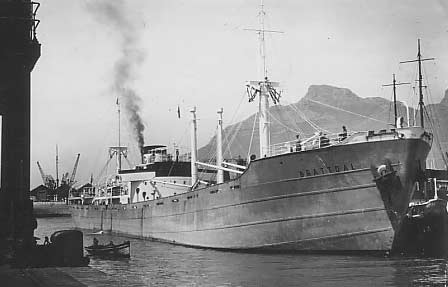
M/S Brattdal To Brattdal on the "Ships starting with B" page. Manager: Moltzau & Christensen, Oslo Delivered from Bremer Vulkan Schiffbau & Maschinenfabrik, Vegesack (713) as Brattdal to A/S Rendal (Moltzau & Christensen), Oslo in Aug.-1935. 414.3' x 55.7' x 25', 5 cyl. 2 TDV MAN DM (builders), 3400 bhp. Owned by A/S Moltzaus Tankrederi (Moltzau & Christensen), Oslo from 1938. Captain: Kristian Hartvik (later joined Fidelio - see also this external page). Her voyages are listed on this original document received from the National Archives of Norway. Please compare the above voyages with Arnold Hague's Voyage Record below.
(Received from Don Kindell - His source: The late Arnold Hague's database). Follow the convoy links provided for more information on each.
Accordingto the archive document, Brattdal was at Taku Bar when war broke out in Norway on Apr. 9-1940. From there, she proceeded to Vancouver a few days later. It'll also be noticed that she appears to have spent several weeks at Suez that fall. For info, the following Norwegian ships are also listed in the above mentioned convoys (some listings may be incomplete): All these ships are included on this website, see the Master Ship Index for information on them.
In Admiralty service. Brattdal had departed Alexandria on Apr. 7-1941 with armoured cars and 227 soldiers for Piræus (convoy info in the table above). On Apr. 9, she was ordered to Volo (Crete), where she arrived the next day and proceeded to unload. On Apr. 12, she was told to depart and meet an escort outside the torpedo net that evening, but no escort was to be seen though they searched for it all night, and since they had no destination to go to it was decided to return to Volo for orders, together with the British City of Karachi (it'll be noticed, when going back to A. Hague's Voyage Record above, that this ship had been in the same convoy as Brattdal upon departure Alexandria). They arrived Volo again in the morning of the 13th (see also the archive document). Shortly afterwards, several German aircraft attacked, and a bomb hit on her after deck between No. 4 and No. 5 holds, going through the shelter deck, the main deck and the "wall" between No. 4 and 5 holds, resulting in a hole of 3-5' in diameter, then exploded beneath No. 4 hold. She developed a heavy list to port, and the crew was ordered to launch and man the lifeboats and get ashore. Several attempts to get back on board were made that day, but this was impossible until that evening, due to continuous air attacks. At midnight, Brattdal was beached and the crew was about to spend the night on board, but new attacks occurred so they rowed ashore. On the 15th, they saw another bomb hit their ship, going horizontally down her funnel, but as she was still afloat they went back on board and managed to get her to Oreus Bay. Most of the crew then went ashore and when a new air attack started the next morning the remaining 7 also abandoned ship. On the 17th, attacks from another 3 aircraft finally sank her (in 14 fathoms). The crew used the lifeboats to row south to Calcis, where they on Apr. 19 boarded a train for Athens, with arrival the next day. By car, train and walking, they reached Aegeos on Apr. 24 and were placed on board the British cruiser Orion on the night of April 26. While being transported to the cruiser in motorboats, the galley boy died(? - see crew list below) when one of the boats turned over and almost everyone on board drowned. The rest of the men from Brattdal eventually reached Alexandria on May 4(?). See also M/T Nordanger.
In the book "Menn uten medaljer" Einar Nielsen's story is included. He had previously served on the torpedoed Orkanger, and I've included a summary of the first part of his story on my page about that ship. After a rather nerve racking time on board the British M/S Rodi he and his friends Helgesen and Brevik (also originally from Orkanger) decided they needed a "break from the war", so they left Rodi to join Brattdal. His story continues here. Summary of Einar Nielsen's story: Nielsen agrees they departed Volo on Apr. 12-1941, which was Easter, together with City of Karachi, but when they reached the determined meeting place for the convoy, there was no escort; it had been sunk and wiped out by the enemy, so they returned to Volo. No sooner had they arrived, than wave after wave of attacking German aircraft "with no respect for Easter peace" came over them. Some made an attempt at Brattdal's neighbour, the British Port Halifax, which was at the quay (this ship is also listed in several of the convoys mentioned above, including Convoy AG 11); "they managed to get the quay, but not the ship". City of Karachi, however, was hit (also in AG 11, as already noted further up on this page), and so was Brattdal. She received a bomb aft and immdiately started to sink, but Chief Engineer Arvid Isaksen saved her by closing the watertight bulkheads. Nevertheless, they all left in the lifeboats, but went back on board that evening after having acquired a tug with the intent of beaching her, but another wave of air attacks took place, resulting in the tug departing at full speed, leaving Brattdal floating helplessly on her own. But Isaksen again saved the day by managing to start the engines, whereupon they "limped down Pagasitikos" until they came to the Almira Bay. Taking their blankets and some food ashore with them they spent the night under some trees, but the next day a mine from an aircraft "landed down the funnel and destroyed all the exhaust pipes". An inspection showed that damages were quite severe but the chief engineer again declared he could get her going and on Tuesday, Apr. 15 they were up and running, reaching Gardiki Bay in the straits of Oreos that evening. Another night with their blankets under some trees, and another morning of waking up to the sound of aircraft, another attack, though no hits on that occasion. The Greek wanted them gone and so did the Admiralty, but she was in such a bad shape at this point that the chief engineer refused to start her up again. However, the following afternoon, Apr. 17, the Germans solved their problem when yet another air attack finally proved too much for Brattdal and she sank in 20 fathoms of water, with the Norwegian flag waving proudly till the end. They now took to the lifeboats and had a "wonderful trip in beautiful moonshine down through Evoikos, or the Talanta Straits which it's also called, to Calcis near Euripo". From Calcis, they caught the train to Athens which under normal circumstances would have taken 3 hours but took exactly 30 due to air attacks, during which the train stopped and all aboard had to disembark and take shelter the best they could. Once in Athens, they were placed in a camp, but continued on foot a few days later, around Eleusis Bay, below Mount Karata, past St. Dimitrios, St. Giorgios, Megara, Minoa, Kineta, Theodores, Susaki and Kolamaki, to the straits of Chorinth(?), the captain carrying his type writer the whole way (according to Nielsen). The last leg of the journey to Argos was by bus, with the usual "welcoming committee" of air attacks on arrival. They were told a ship was to come for them that evening, and in the afternoon they headed for the harbour of Nauplion. They were so delayed by the constant air attacks that by the time they reached their destination they found no ship so, tired, hungry, cold and miserable, they spent the night outside again, only to wake up to more "steel falling from the sky". Eventually, the next day they got the news that the British Navy would come to their aid, and they were sent out to the cruiser HMS Orion. (Einar Nielsen mentions nothing about the messboy drowning or a motorboat capsizing on the way out to Orion). They anchored at Suda Bay, but no date is mentioned. Einar Nilsen says "about 2500 years ago Greek culture was said to be resting on 375 Greek ships. What our culture rests on, I can't say, but it's tempting to think of the 1000 Norwegian ships". A couple of days later, they were placed on a British troop transport, which also carried German prisoners. In the afternoon of May 1, they arrived Alexandria (3 days earlier than stated further up on this page) and that evening, they ended up at a memorial service for themselves. When the "deceased" Nielsen and Helgesen walked in they caused quite a stir. A few days later, they had signed on another ship, the S/S Star of Egypt, eastward bound they were told, but didn't believe it. Helgesen was signed on as carpenter this time, Brevik as ordinary seaman and Nielsen had really advanced, he was the 3rd mate on this ship, which indeed headed east, to the peaceful Pacific, which by the time they got there was a "screaming inferno". (According to A. Hague, Star of Egypt left Alexandria for Port Said on May 10-1941 - later proceeded to Singapore, via Aden and Colombo). Nielsen ends his story by saying: The maritime hearings were held in Alexandria On May 16-1941 with the captain, the 2nd mate, the 1st engineer and Ordinary Seaman Ulvestad appearing.
Crew List:
"No cure no pay" contract to refloat vessel signed September-1950. Refloated Apr. 17-1952 and towed to Piræus. Rapairing May-1952, renamed Oreoi 1953 for Greek owners. Towed to Bremen that summer to be rebuilt. Entered service as North Duchess in the summer of 1954, Liberian flag, 4975 gt. Sold to Germany in 1956 and renamed Ebba Blumenfeldt (Hamburg owners). Renamed Reinhausen in 1959, having been sold to owners in Bremen. Sold to Beirut in Oct.-1960, renamed Elpidoforos. Broken up in China in 1971. This external page has some more detailed information. Back to Brattdal on the "Ships starting with B" page.
The text on this page was compiled with the help of: "Nortraships flåte", J. R. Hegland, "Menn uten medaljer" A. H. Rasmussen, "Sjøforklaringer fra 2. verdenskrig", Volume I (Norwegian Maritime Museum), "Lloyd's War Losses, Vol I - British, Allied and Neutral Merchant Vessels Sunk or Destroyed by War Causes", and misc. - ref. Sources / Books.
|
|||||||||||||||||||||||||||||||||||||||||||||||||||||||||||||||||||||||||||||||||||||||||||||||||||||||||||||||||||||||||||||||||||||||||||||||||||||||||||||||||||||||||||||||||||||||||||||||||||||||||||||||||||||||||||||||||||||||||||||||||||||||||||||||||||||||||||||||||||||||||||||||||||||||||||||||||||||||||||||||||||||||||||||||||||