Site Map | Search Warsailors.com | Merchant Fleet Main Page | Warsailors.com Home Merchant Fleet Main Page | Warsailors.com Home |
|
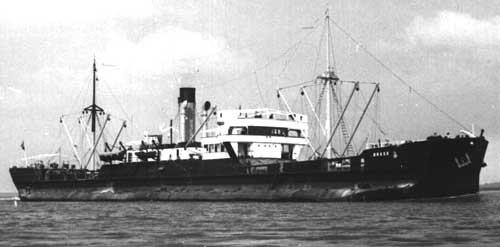
D/S Brask To Brask on the "Ships starting with B" page.
Owner: A/S Brask Built by William Doxford & Sons Ltd., Sunderland in 1911. Captain: Gustav Røkenes Related items on this website: Her voyages are listed on this original image received from the National Archives of Norway. Please compare the above voyages with Arnold Hague's Voyage Record below.
(Received from Don Kindell - His source: The late Arnold Hague's database). Follow the convoy links provided for more information on each.
With a cargo of ore for Workington, Brask is mentioned in the Advance Sailing Telegram for Convoy HN 22 from Norway to the U.K. on March 27-1940, however, it looks like this AST covers ships in Convoy HN 23A as well, and this is the convoy she actually sailed in (left Norway on March 30). According to Arnold Hague, she arrived her destination independently on Apr. 4, having detached from the convoy on Apr. 2. See also the archive document, which shows that this voyage had started out in Narvik, Norway (via Bergen), and as can be seen, she was still at Workington when war broke out in Norway on Apr. 9. In May that year, she's listed in Convoy OG 29. This convoy will be added to my Convoys section; in the meantime, the ships sailing in it are named on the page listing ships in all OG convoys. Brask had sailed from Milford Haven on May 11, joining Convoy OB 145 (link in Voyage Record), which joined up with Convoy OA 145 on May 12, the combined OG convoy arriving Gibraltar on May 18. Her destination is given as Alexandria, but there's no mention of her arriving there in the Voyage Record, nor on the archive document. From Gibraltar, she's said to have headed to Bizerta, subsequently on to France, then back to Gibraltar again in June (via Bougie). With a cargo of iron ore, she now returned to the U.K. in Convoy HG 35, sailing in station 62 of the convoy, which left Gibraltar on June 21. The original Advance Sailing Telegram gives her destination as Barrow, and she arrived there on July 2. The only other Norwegian ship was Atle Jarl. Brask subsequently proceeded to Cardiff, where she spent over a month. We now find her, together with Alaska, Bur, Einvik, Mosli and Veni, in Convoy OB 202, which originated in Liverpool on Aug. 22 and dispersed on the 26th, Brask arriving Wabana independently on Sept. 3 - 3 ships were torpedoed, see the external link provided further down on this page. With a cargo of iron ore for Cardiff, she headed back across the Atlantic a week later with the slow Convoy SC 4 from Sydney, C.B., and arrived her destination on Sept. 27. The Advance Sailing Telegram indicates she had been cancelled from the faster Convoy HX 72, in which Simla and several others were sunk (follow the links for details). Brask later returned to Wabana again, having joined Convoy OB 228, which originated in Liverpool on Oct. 13 and dispersed on the 17th, Brask arriving Wabana independently on Oct. 26. Other Norwegian ships in this convoy were Astra, Chr. Knudsen, Dokka (sunk, follow link for details - see also the link further down on this page), Gudrun, Noreg, Polyana and Topdalsfjord - ref. external links provided within the table above for more on the OB convoys mentioned here. Brask, again with a cargo of iron ore, subsequently returned to the U.K. in Convoy SC 11, in which Bruse and Salonica and several others were torpedoed - again, follow the links for more info. This convoy left Sydney, C.B. on Nov. 9-1940. Brask arrived Greenock on Nov. 25, proceeding to Ardrossan the next day, remaining there for almost a month - see the archive document. At the external website that I've linked to below she's listed as bound for St. John's, N.F. in ballast in Convoy OB 264, which left Liverpool on Christmas Eve and dispersed on the 29th. However, she must have cancelled, or returned to port, because when she was sunk shortly thereafter (see next paragraph), she had been part of Convoy OB 272, originating in Liverpool on Jan. 10-1941, dispersed on the 15th. More information on the other Norwegian ships named here can be found via the alphabet index at the end of this page, or go to the Master Ship Index. Related external links: OB (& OA) convoys - OB 264 is included.
Brask was on a voyage in ballast from Gourock to Durban in Convoy OB 272, having departed Oban on Jan. 10-1941 (archive document gives departure Clyde Jan. 11, destination looks like Table Bay). See link provided within the table above for more on this convoy; Don, Ferncastle, Gezina, Kongsgaard, Marita, Ravnefjell and Victo are also listed. The convoy was dispersed in the evening of Jan. 15, with the ships continuing in individual groups to their various destinations. Brask headed south together with the Greek Nemea, but both ships were torpedoed that same evening by the Italian submarine Luigi Torelli (Longobardo), Brask in position 52 45N 23 59W*. She was struck on the port side near No. 2 hatch, resulting in the entire forepart being torn up, and she sank in 3 minutes.
The lifeboats were freed but there was no time to put them on the water so everyone jumped overboard, then clung to misc. debris and one of the rafts that had floated free. 9 men had come across the capsized starboard boat and climbed up on its keel. It was later righted, and others were picked up from the water, until there were 20 men in all in the boat. After having gotten in the lifeboat Brask's survivors saw a spot against the horizon. They maneuvered towards it, thinking it might be one of the rafts with more survivors, but as they got closer it turned out to be the abandoned Nemea. They boarded her, but fearing that the ship might be attacked again they soon returned to the boat (this was about midnight on Jan. 15). At dawn on the 16th they again boarded the Greek ship where they found dry clothes and some food, while the radio operator was sent to the radio station and was able to get the radio in order. In the meantime, a lifeboat carrying about 18 Greek survivors also came alongside. Some of them came on board, among them the 1st mate and 2 radio operators who sent out an SOS which was received by Valentia Radio, so the men from Brask decided to remain on the Greek ship. They managed to get the engine going then hoisted both lifeboats aboard. The Greek seamen insisted on trying to reach the Azores, while the others wanted to head for Ireland, but they set course for the Azores for about an hour. However, due to the wind being against them it was agreed that afternoon to head towards Ireland. Fearing that the ship might be attacked in the course of the night, the engine was stopped that evening, and they went back to the lifeboats again; these were tied to the ship with a long line. Early the next morning, Jan. 17, they saw rockets in the horizon and responded with their own rockets and flares. Before dawn they reboarded the Greek ship, then sent up 2 large rockets, seen by 2 British destroyers which came to their aid. The shipwrecked men offered to remain on Nemea and take her to port, escorted by the destroyers, but due to lack of fuel this was not considered a good idea, so at 09:00 on Jan. 17 they were all transferred to HMS Highlander, which landed them in Londonderry in the morning of Jan. 20. The following morning, they continued to Glasgow, with arrival Jan. 22. The maritime enquiry was held there on Febr. 11-1941 with the 1st mate, the 2nd mate and Able Seaman K. Berge (helmsman) appearing.
*See this Guestbook message Related external links: Luigi Torelli - The attack on Brask is mentioned. Back to Brask on the "Ships starting with B" page. The text on this page was compiled with the help of: "Nortraships flåte", J. R. Hegland, "Sjøforklaringer fra 2. verdenskrig", Volume I (Norwegian Maritime Museum), and misc. others for cross checking info. - ref My sources.
|
||||||||||||||||||||||||||||||||||||||||||||||||||||||||||||||||||||||||||||||||||||||||||||||||||||||||||||||||||||||||||||||||||||||||||||||||||||||||||||||||||||||||||||||||||||||||||||||||||||||||||||||||||||||||||||||||||||||||||||||||||||||||||||||||||||