Site Map | Search Warsailors.com | Merchant Fleet Main Page | Warsailors.com Home Merchant Fleet Main Page | Warsailors.com Home |
|
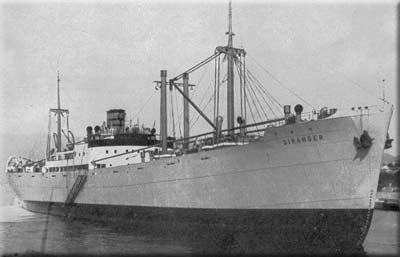
M/S Siranger To Siranger on the "Ships starting with S" page.
Another picture is available on this external page (click in it to enlarge). Captain: Amund Utne.
Her voyages are listed on these original images from the Norwegian National Archives: Please compare the above voyages with Arnold Hague's Voyage Record below.
(Received from Don Kindell - His source: The late Arnold Hague's database). Follow the convoy links provided for more information on each. Errors may exist, and several voyages are missing.
As can be seen when going to Page 1 of the archive documents, Siranger was in Buenos Aires when war broke out in Norway on Apr. 9-1940. She left that same day for Rosario. Her 1941 voyages start on Page 2 (it'll be noticed, that she appears to have spent quite a long time in San Francisco that spring/summer) and continue on Page 3, which also shows some 1942 voyages, while Page 4 lists the rest up until the time she was sunk. As can be seen, she sometimes had fairly long stays in port. Siranger is said to have rescued 16 men from a British ship in the Atlantic in 1943. According to Uboat.net (external link), she rescued survivors from the British Vimeira, but this took place in the fall of 1942. She's also said to have rescued a survivor from the British Sylvia de Larrinaga - ref. external link below for more info (Vimeira had been in the convoy in which the Norwegian Mirlo was sunk). Related external link:
Siranger, on charter to Barber Line, departed New York for West Africa on Sept. 22-1943* with 7300 tons general cargo as well as 5 R.R. tanks, trucks and road scrapers on her decks, and diplomatic mail for Amcon, Lagos, Nigeria. She called at Port of Spain on Oct. 10*, then departed in convoy for Takoradi on Oct. 13*, but left the convoy at 18:00 GCT on Oct. 22 in 00 13S, and was sailing alone, zig-zagging, when she was torpedoed by U-155 (Piening) in 39 27W** on Oct. 24. At the time of attack she was on a course 090°, sailing at a speed of 10.5 knots in clear weather with good visibility, wind east force 2-3, sea with swells, sun on horizon directly ahead, no other ships in sight. 2 lookouts were on the bridge, 1 on aft gun platform.
At 09:30 GCT a torpedo had been picked up by the ship's torpedo detector gear, approaching on the starboard side, and at the same time the wake of a torpedo was seen about 20 yards off, approaching at an angle of 95°. Orders for hard starboard wheel was immediately given, but within 5 seconds the torpedo struck in No. 1 hold, starboard side. A spray of water caused by the explosion went about 70' above the sea. Engines were stopped right away. The radio operator, who was in his cabin when the attack occurred, ran to the radio station intending to send an SOS but the equipment would not function. The explosion broke the glass in the portholes in the captain's cabin, which was located on the starboard side below the bridge, just forward of amidships, and pictures and furniture were strewn about. Windows and the teak planking on the bridge were torn off in places. However, apart from broken glass, no damage was visible above decks; all hatches on fore deck were secure and the deck cargo still lashed down. A fire erupted in a gas can stored in a raft in the foremost rigging. According to the 3rd mate, who was on the bridge with the 1st mate, the ship started to go in a wide circle towards starboard due to the large hole in her side, however, the official sinking report states that no damage to the hull was seen. She listed to starboard at first, but soon righted herself, and slowly sank by the bow in 20 minutes. About 10 minutes after the explosion, the captain had felt a shock, believed to be caused by the bulkheads between No. 1 and 2 holds bursting, and after that the bow went down more rapidly. The explosion was described as sharp and staccato, much like that of a depth charge, with a noticeable cordite-like odor; smoke was observed but it was more like a haze than heavy smoke. A certain amount of oil was seen on the water near the stern. Automatic emergency transmitter began to function immediately but ceased when current quickly failed. No counter offensive was possible - the confidential codes and the dimplomatic mail went down with the ship. Those on board had time to go in 4 lifeboats, and the ship was abandoned by 09:40 GCT. The captain remained on board thinking the ship might stay afloat, but lowered himself down by a rope astern 10 minutes later when it became apparent she would sink, and was picked up by one of the lifeboats. 1 of the boats was swamped by water and the crew members who were in it were transferred to 2 of the other boats, so 3 boats were used in all, 1 of which, the 3rd mate's boat, had to row back to pick up a passenger who had jumped overboard. When the U-boat appeared nearby soon afterwards to ask the usual questions about the ship, cargo, destination etc., 3rd Mate Otto Friis Hansen was asked to come aboard to get his injured hand and face seen to. Little did he know he was to stay on the U-boat until Jan. 1-1944, when they arrived Lorient, France. He was subsequently sent to the camp Marlag und Milag Nord in Germany. A report dated Nov. 29-1943 (summary of the survivors' statements - see my sources at the end of this page) says an engine room hand was also taken aboard the U-boat, but he was not questioned and was allowed back in the lifeboat, then the U-boat circled the survivors once, heading in a southwesterly direction and submerged at 10:30 GCT. This report says the chief "interrogator" was described as age 27, 5'10", 160 lbs, dark blonde hair, bearded, light complexion, but very tanned, wore shorts, underwear(!) and a lifebelt. A rating addressed him as "Herr Kapitan". His English was good, but a decided German accent was noticed, he seemed to be a fairly decent fellow. Everybody seen by the survivors had a remarkable tan. The survivors were somewhat surprised at the smallness of the U-boat, which was described as about 500 tons with a rounded bow extending about 5' out of the water. Stern aft of diesel exhaust was submerged, dark grey paint appeared old, barnacles were noted, jumping wire extended from center of conning tower to bow. 1 gun forward smaller than ?" (illegible) but larger than 3", possibly an 88 mm, 2 AA guns on rear of conning tower thought to be larger than 20mm, no flash guards on barrels. On the platform aft of the conning tower was an AA gun, consisting of 4 barrels, 2 above 2. Barrels were shorter but heavier than those on the conning tower and were equipped with flash guards. Some armour protection was seen. The survivors did not think battery was director controlled. A cross was painted on the front of the conning tower beneath the overhang, similar to cross on German war planes. It was black, edged in white, no other device was seen on it. A design on the starboard side of the conning tower was described as a coat of arms, consisting of about 6 painted squares, light blue or green with intermediary spaces described as "stripes" diagonally coloured red and white. The design may have had 2 bands extending from the upper corners to near the bottom of coat of arms outline, forming somehwat of an "X". Many survivors thought at first that the design was that of the Italian flag. The colours were quite faded, and no words or inscriptions were seen. The general description fit that of a 500 tons submarine. During the entire interrogation 3 crew men were on the aft platform constantly scanning the sky with binoculars. The report adds that the torpedo was possibly magnetic, no impact was felt, main force of explosion was outside of the ship, as evidenced by the damage. If the torpedo had penetrated the ship, deck damage would probably have been much greater. After the ship sank the 5 R.R. tank cars that had been carried on deck broke loose and came to the surface. The captain felt that they would have remained afloat and constituted a navigational hazard. He estimated that as of Nov. 3 they would have drifted north of the Equator and about 45°W. The lifeboats set sail at 11:15 GCT, but were seperated in the morning of Oct. 27. The captain's boat with 17 people, including the 4 passengers, sighted a lighthouse at 23:00 that same evening and the next morning they were met by a fishing vessel which directed them to Nazare, Brazil, a few miles north of Cururupu (01 40S 44 50W). By 18:00 GCT on Oct. 30 the survivors from all 3 boats* were assembled in Cururupu, the other 2 boats having been met on the way.
The inquiry was held in New York on Nov 29-1943 with the captain, the 1st mate, the radio operator and the 2nd engineer appearing. For info, U-155 had also been responsible for the attacks on Sama, Baghdad, Bill and Lysefjord. Follow the links for more details on these incidents.
Friis Hansen wrote a book about his stay on the U-boat after the war. An excerpt can be found in "Krigsseileren" No. 3 for 1997. He experienced a number of attacks on convoys, some of which were, naturally, quite frightening to him when the depth charges were sent into the deep after them. They always attacked during the night, but after a number of unsuccessful attacks, when they had to submerge before they even had a chance to send off the torpedoes, because of the firing from the escort vessels, Piening asked him if the Allies had invented some kind of an apparatus that could see in the dark. Not even the Norwegian knew at that time how far the development of the radar had come. One episode is described in detail. No date is given but he places the incident on a Sunday and estimates the location to be somewhere between Trinidad-Equator and it was extremely hot and difficult to breathe. The U-boat commander and the doctor came to his room and Piening (who was always in a good mood except when complaining to the cook about the food) told him they would soon go to the surface, because it was Sunday and he had heard the American pilots were useless on Sundays because of their partying the night before. They had been on the surface for about 15 minutes when the alarm suddenly sounded and within seconds the boat started to dive at a sharp angle causing everything in his room to fall over and break. A horrendous explosion followed and he was flung out of his bed to the floor. A few seconds later a 2nd explosion occurred, even more powerful than the 1st and he was convinced it was the the end of them all. He later found out that all the commotion had been caused by bombs which resulted in quite a lot of damage to the boat and he understood from the conversations he overheard that they had to go "home" for repairs. He gives an interesting account of life on board, what kind of food was served, the mood of the men etc. He says they were fond of "schepk" (type of bacon) which to his utter amazement was consumed with great gusto though he personally saw that it had worms in it. The French sugar they had on board tasted like oil (sabotage) and it got so bad that a song was written about the sugar and the cook, who got the blame for everything that had to do with the food. The verses of the song announced they now had to hurry home because they had run out of diesel oil, the cook having used it all to mix in the food. The Germans were interested in knowing what it was like in America, but when he told them a Liberty ship was built in 7 days they didn't believe him. He says he was well treated, but on arrival Lorient on Jan. 1-1944 he was sent to Germany immediately, and life in the camp was, of course, not as easy. He was freed on Apr. 28-1945 and still alive in 1997. In his book the 3rd mate also mentions meeting an English captain in the camp who had been a prisoner on the same U-boat. This man told him that the captain of D/S Bill had been on board at the same time and during a bombing attack gas had leaked into the U-boat. The English captain had been able to wet a handkerchief which he held over his mouth and nose, while the Norwegian captain did not have anything similar on hand and, therefore, later died from the effects of having inhaled the gas (Captain Evensen of D/S Bill was taken to a German hospital in Rennes where he died of heart trouble on Nov. 27-1942). I've since learned that the British captain was Frederick Tate who was prisoner on board U-155 after the sinking of his ship Empire Arnold - see my page M/S Breñas / Captain's Report, as well as the external link provided at the end of this page to Uboat.net's account on Empire Arnold's loss (in fact, this ship had also been in the convoy in which Vimeira, mentioned further up on this page, was sunk). See also Dalvangen. Crew/Passenger List - No casualties:
Related external links: U-155 | Adolf Cornelius Piening - Uboat.net also has info on the attack on Empire Arnold. Description of Marlag und Milag Nord - On the website "US Merchant Marines at War". Back to Siranger on the "Ships starting with S" page.
Other ships by this name: Westfal-Larsen later had another ship by the name Siranger, the former M/S Narvik (ex Cape River), built 1943 - follow the link for more info. This post war Siranger had a Canadian female radio operator (Olive Carroll) about whom a book has been written, called "Deep Sea Sparks", ISBN 1-895590-05-1 (Cordillera Publishing Co. Box 46, 8415 Granville St. Vancouver, BC, Canada, V6P 4Z9). In March-1960 another Siranger was delivered to the company from Bergens Mek. Verksteder, Bergen, 7127 gt. This ship was sold to Panama in Sept.-1977 and renamed Min Chiang. (Info from company fleet list).
The text on this page was compiled with the help of: "Nortraships flåte", J. R. Hegland, "Skip og menn", Birger Dannevig, official sinking report dated Nov. 29-1943, signed Lieutenant R. G. Fulton, USNR, received from Tony Cooper (this is a memorandum to the Navy Department, Office of the Chief of Naval Operations, Washington, based on Summary of Statements by Survivors), "Krigsseileren" No. 3 for 1997, "Sjøforklaringer fra 2. verdenskrig", Norwegian Maritime Museum, Volume II, and misc. other for cross checking facts - (ref. My sources).
|
|||||||||||||||||||||||||||||||||||||||||||||||||||||||||||||||||||||||||||||||||||||||||||||||||||||||||||||||||||||||||||||||||||||||||||||||||||||||||||||||||||||||||||||||||||||||||||||||||||||||||||||||||||||||||||||||||||||||||||||||||||||||||||||||||||||||||||||||||||||||||||||||||||||||||||||||||||||||||||||||||||||||||||||||||||||||||||||||||||||||||||||||||||||||||||||||||||||||||||||||||||||||||||||||||||||||||||||||||||||||||||||||||||||||||||