Site Map | Search Warsailors.com | Merchant Fleet Main Page | Warsailors.com Home Merchant Fleet Main Page | Warsailors.com Home |
|
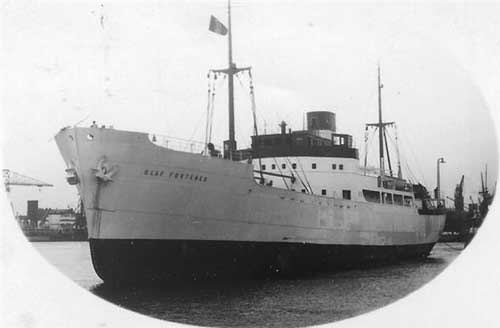
M/S Olaf Fostenes To Olaf Fostenes on the "Ships starting with O" page. Manager: Lars Fostenes & O. A. Knutsen, Haugesund Delivered in Nov.-1936 from Helsingør Jernskibs- og Maskinbyggeri, Helsingør (Elsinore), Denmark as Olaf Fostenes to Lars Fostenes Rederi A/S (Lars Fostenes & Ole Andreas Knutsen), Haugesund (sister ship of Vibran). Fruit carrier (bananas, Gabon/Kamerun). The 3 fruit carriers M/S Mosdale, M/S Mosfruit and Olaf Fostenes were well known for their fast voyages back and forth across the Atlantic during the war, usually sailing alone. In the course of 1941 they had transported 58 549 tons of cargo to the U.K., and had made 25 trips. Fruit cargoes were, of course, no longer a priority, so these ships were to a great extent used for the transportation of meat and general cargo. After the other two ships had been lost, Mosdale carried on, sometimes in convoy, but often alone (follow the link to my page about this ship). Captain: ? Valvatne, later Axel Meier Lidahl (previously of M/S Tosca). Related item on this website: Her voyages are listed on these original images from the Norwegian National Archives: Please compare the above voyages with Arnold Hague's Voyage Record below.
(Received from Don Kindell - His source: The late Arnold Hague's database). Follow the convoy links provided for more information on each.
Captain Valvatne. According to Page 1 of the archive documents, Olaf Fostenes arrived Dakar on Apr. 9-1940, the day of the German invasion of Norway. A French visitor to my website has told me that she sailed from Casablanca in Convoy 90 KF under French escort on Apr. 20, arrived Brest Apr. 24(? the archive document gives arrival Havre Apr. 25, Brest Apr. 30). Sailed from Brest on Apr. 30 in Convoy 41 BF under French escort. To Casablanca or Oran (? it looks like she was bound for Dakar on this occasion, arriving there on May 7, leaving for Duala that same day - again, see the archive document). Both these convoys are available via the external links provided in the Voyage Record above. In June, we find her, together with Sildra and Tana, in Convoy OB 163, which departed Liverpool on June 8 and joined up with Convoy OA 163 on the 9th, the combined convoy forming the Gibraltar bound Convoy OG 33F, which arrived there on the 14th (see my page naming ships in all OG convoys). Olaf Fostenes, however, was bound for Dakar again, where she arrived June 18, continuing to Duala 2 days later. According to the first external website that I've linked to below she was scheduled for Convoy SLF 38 from Freetown to the U.K. on July 4, but did not sail. From Page 1, we learn that she had arrived Freetown from Duala on July 5, left again on July 6, and arrived Liverpool July 17/18. Olaf Fostenes rescued 251 survivors from the torpedoed Dutch passenger steamer Volendam (15 000 gt, captain Wepster) on Aug. 30-1940, Convoy OB 205. This convoy had departed Liverpool on Aug. 29 and was dispersed on the 30th, and also had other Norwegian ships, in addition to Olaf Fostenes, namely Bestum, Evanger, Solhavn and Thorøy - ref. link in the table above (as will be seen, other ships were also sunk). Judging from the details found on the archive document, Olaf Fostenes was bound for Cameroons at the time. Volendam, the Commodore Vessel of the convoy, was on a voyage from Liverpool to Halifax with a complement of 273 and 606 British passengers, including well over 300 women and children, all being evacuated to Canada due to the war, but was torpedoed by U-60 (Schnee) on Aug. 30. The rescued passengers were landed at Greenock on Sept. 1. The British Bassethound and Valldemosa also took part in the rescue operations. Volendam did not sink, but was towed to Clyde and beached (an undetonated torpedo was found in her bow), later repaired and used as troop transport. My Guestbook has a message from one of the rescued passengers, saying: I was thrilled to find a picture of this ship, I was one of the 251 survivors of the Volendam torpedoed 30th August 1940 in the Atlantic. I was just 9 years old at the time, we boarded Olaf Fostenes in one of the baskets used to load bananas. I well remember how kind the crew were to us, and was sad to hear of the fate of this good ship, but very pleased that none of the crew were lost. Whenever I see the Norwegian flag I think of the Olaf Fostenes. Thanks for the picture I shall treasure it. The external link provided below has more on the attack on this ship. Together with the Norwegian Katy, Olaf Fostenes later joined Convoy OB 209, originating in Liverpool on Sept. 5-1940, dispersed Sept. 9, Olaf Fostenes arriving Freetown on Sept. 21 (she had joined from Clyde). Having made a voyage from Freetown to Victoria, Nigeria, she headed back to the U.K. on Oct. 2, and is subsequently listed, with Boreas, Ingerfire and Tore Jarl, in Convoy OB 236, which left Liverpool on Oct. 29 and dispersed Nov. 2. Olaf Fostenes served as Commodore Vessel for this convoy - her destination is not given, but going back to Page 1, we learn that she arrived Freetown on Nov. 14, proceeding to Victoria, Nigeria the following day. Again, see the external links in the table above for more info on these 2 convoys. Olaf Fostenes is also said to have rescued 37 survivors from a British ship in the Atlantic in 1941; name of the ship and exact date not known. In the Commodore's narrative for Convoy ON 36, there's mention of the British Ancylus colliding with Olaf Fostenes at 05:00 GMT on Nov. 25, but I believe this must have been a separate incident, as this ship is said to have continued to Halifax, and there's no mention of a rescue. Note that Olaf Fostenes was not part of this convoy herself, in fact, she was sailing in the other direction - according to Page 2, she was en route from Halifax to Liverpool on that date, but put in at St. John's, N.F. the next day, continuing her voyage to Liverpool from there on Dec. 16. Her 1942 voyages also start on this document (it'll be noticed that she appears to have spent a long time at Newport at the beginning of that year) and continue on Page 3. Related external links:
Captain Axel Lindahl (who had been on board for 18 months). Olaf Fostenes was on a voyage alone from Liverpool to Halifax in ballast, having departed Liverpool on Sept. 12-1942 (Page 3), when she was torpedoed, starboard side between holds No.'s 1 and 2 by U-380 (Röther) on Sept. 18, position 44 56N 41 05W. According to a summary of survivors' statements, found in a memorandum signed Lieutenant H. V. Stebbins, USNR, dated Nov. 4-1942, she was on course 285° true, sailing at a speed of 15 1/2 knots and was zig-zagging at the time. The weather was clear and very calm, visibility very dark, no other ships were in sight. The radio was silent, but had been in use about 56 hours prior to the attack. There were 4 lookouts; 2 on top of the chart house and 1 on each wing, but the U-boat and wake of torpedo had not been seen due to the darkness. Time of attack is given as 07:00 GCT in this report, which adds that the torpedo resulted in a large hole about 35' forward of the bridge between the 2 holds where she had been struck. The confidential papers and books, as well as 13 packages of diplomatic mail were thrown overboard (the secret W/T code was delivered to N.C.S.O. St. John's). The radio operator's attempt to send an SOS failed, but the emergency antenna was rigged up so that a message could be sent (the receiver was inoperable). The raft, which was located on No. 2 hatch was thrown across the bridge and down to the boat deck where it was smashed, and the starboard lifeboat was also blown away and partly destroyed. She listed heavily to port and, fearing the ship would capsize, the port boat and the port motorboat were launched. The 15 men in the motorboat and the 21 in the lifeboat rowed away, but as no U-boat could be seen the captain and the 1st engineer decided to return to the ship to see if anything could be done to save her. However, before they could do so, about 35 minutes after the ship had been abandoned, a U-boat was seen coming to the surface between the lifeboat and the ship, then submerged to periscope depth and fired a second torpedo which struck in the engine room port side, and she sank (time given as 08:30 GCT in survivors' statements). The U-boat then resurfaced and the lifeboat was ordered alongside for questioning regarding ship's name, destination etc. There were 3 officers and 5 or 6 crew in the tower and an officer and a rating came out of the tower through a door in the after part of the tower to the after deck. When the name of the ship was given, the officers on the U-boat exchanged smiles, leading the survivors to believe that the U-boat had been looking for Olaf Fostenes. Her captain was asked for but they were told he had gone down with the ship. (A Hanza Plast bandage was given to one of the crew members; the container was later left on board HMS Firedrake). While this interrogation was taking place, another U-boat was sighted some distance away signalling to the first one by flashing light, which was read by Olaf Fostenes' radio operator as beginning "AAA-K-UBZ", then continued by semaphore. This U-boat also came alongside and stood by. After the questioning had ended, the first U-boat examined the other lifeboat as well as a 3rd empty one, then semaphored the second U-boat before they both moved off on the surface in a northeasterly direction at 09:45 GCT. The 2 boats were described as exactly alike "about 150' long, 500 tons, were newly painted a very dark grey or black, no signs of chipping or rust, aerials bow to stern but no net cutters. Conning tower about 12' high, 6' to 8' long, squarish in shape, 3" gun on forward deck, Oerlikon was mounted on tower, and machine gun raised portion of after deck aft of tower". All of Olaf Fostenes' officers were convinced that the U-boat's officers were German and at least 3 of her crew Italian. The radio operator believed that there had been tampering with his radio switches prior to the attack, but was not absolutely certain. The captain was satisfied that no suspicion could be attached to his crew and that "switches" incident was attributable to the explosion. After having helped themselves to extra provisions and water from the ruined lifeboat and one of the rafts, the 2 lifeboats set sail for New Foundland (about 550 n. miles away). On Sept. 26, after having sailed about 450 m, they were spotted by an American aircraft (H-10) and shortly thereafter rescued by HMS Firedrake which landed them at St. John's the following morning. An inquiry into the sinking was held there on Sept. 29-1942 with the captain, the 1st mate and the 1st engineer appearing.
Crew List - No casualties:
Related external link: Back to Olaf Fostenes on the "Ships starting with O" page. The text on this page was compiled with the help of: " Våre motorskip", Leif M. Bjørkelund & E. H. Kongshavn, "Nortraships flåte", J. R. Hegland, "Skip og menn", Birger Dannevig, "Sjøforklaringer fra 2. verdenskrig", Norwegian Maritime Museum, summary of survivors' statements received from Tony Cooper, England, and misc. (ref. My sources).
|
|||||||||||||||||||||||||||||||||||||||||||||||||||||||||||||||||||||||||||||||||||||||||||||||||||||||||||||||||||||||||||||||||||||||||||||||||||||||||||||||||||||||||||||||||||||||||||||||||||||||||||||||||||||||||||||||||||||||||||||||||||||||||||||||||||||||||||||||||||||||||||||||||||||||||||||||||||||||||||||||||||||||||||||||||||||||||||||||||||||||||||||||||||||||||||||||||||||||||||||||||||||||||||||||||||||||||||||||||||||||||||||||||||||||||||||||||||||||||||||||||||||||||||||||||||||||||||