Site Map | Search Warsailors.com | Merchant Fleet Main Page | Warsailors.com Home Merchant Fleet Main Page | Warsailors.com Home |
|
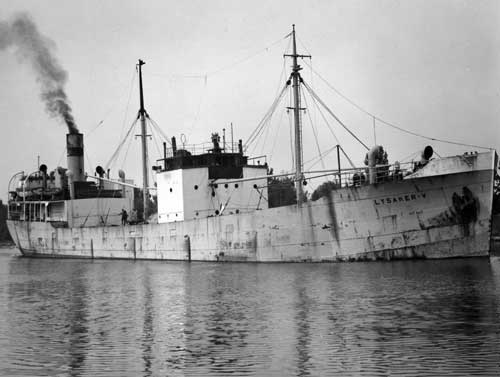
D/S Lysaker V To Lysaker V on the "Ships starting with L" page. Manager: Ludvig Lorentzen, Oslo Delivered in Nov.-1936 from Porsgrunds mek. Verksted, Porsgrunn (100) as Lysaker V to Ludvig Lorentzen, Oslo. (Tonnage given as 1599 gt in "Våre gamle skip" at time of delivery). 255' x 37.9' x 18.2', 2 cyl. Comp. (builders), 133 nhp. Captain: Lars Anker-Thøversen, later Einar Apeland. Her voyages are listed on these original images from the Norwegian National Archives: Please compare the above voyages with Arnold Hague's Voyage Record below.
(Received from Don Kindell - His source: The late Arnold Hague's database). Follow the convoy links provided for more information on each (please be aware that some of the listings are incomplete). Errors may exist; this could mean that she may not have sailed in all the convoys mentioned here. Also, several voyages are missing.
Lysaker V was at Calais in May of 1940 during the chaotic days of evacuations from France, having arrived from Tyne via Boulogne on the 16th with a cargo of coke (had departed Tyne on May 12). Captain at that time was Lars Anker-Thøversen. Under bombardment from German aircraft she had finished unloading her cargo on the 19th but was not permitted to leave. By the 21st the situation was almost unbearable, and due to the heavy bombing the crew had spent the night in shelters. The naval authorities told the captain to be ready for departure as soon as the town's authorities, some valuable papers, secret documents etc. had been brought on board. That afternoon the city was attacked several times with bombs hitting in and around the docks, sinking 2 tugs, and that night another attack occurred and a small cargo ship was sunk. The officers and crew again spent the night in air raid shelters, this time below the city's 2 forts at the inlet to the harbour. The captain and 1st Mate D. Jacobsen returned to the ship several times to see how she was faring. The forts were also attacked by 6 aircraft around 20:30 that night; there were about 2000 people in the shelters below but nobody was hurt. Early the next morning, as soon as they arrived back on board, yet another attack took place, but still no orders to sail. Dutch and Belgian refugees flocking into town announced that the Germans were at this time right outside the city. While the captain was running from office to office to try to figure out how to proceed, a bomb fell on a house nearby, followed by the sound of children crying. Captain Thøversen and some Dutch refugees managed to pull 8 children out of the ruins, from 8 months to 2-3 years old. No adults were found alive so they took all the children on board Lysaker V. The captain then went back to town to continue his efforts to get the situation clarified but was still told to wait. On his return to the ship he saw masses of people, busses and cars. The refugees were in absolute panic and started to jump on board; one woman threw her little child on board. Sirens were sounding all the while, and the next time the aircraft flew in they hit a British destroyer embarking English refugees nearby and quite a battle ensued before the destroyer headed out with its human load. On her deck Lysaker V had Belgian and French soldiers and their gear. All the others had been sent below deck, but the officers were now ordered to man the machine guns. Finally, at 24:30 they were out of the harbour heading south at full speed. The captain planned to land the refugees at Cherbourg but on arrival there in the morning (May 23) they were told to continue to Brest with them as the place was already full of refugees, and after having taken on board some fresh water and other supplies they continued at midnight. On May 25 at 10:45 Lysaker V had moored at Brest (Page 1 of the archive docs gives arrival Brest as May 24); the ship and almost 700 lives had been saved. Calais fell on May 26. That same day preparations for the evacuation of British troops from Dunkirk started. The following month she shows up in Convoy OA 168, which left Southend on June 15 and joined up with OB 168 from Liverpool 2 days later to form Convoy OG 34F*, arriving Gibraltar on June 24. Lysaker V, however, was only bound for France again, ref. external links at the end of this page. As will be seen, these convoys had many other Norwegian ships as well. Note that Arnold Hague has not included Lysaker V in this OA convoy - I've linked directly to his listing below. Page 1 states she was diverted, probably because of the German advance on France. The same document shows that she made a voyage from Milford Haven to Sydney, C.B. in July that year. I have no convoy information for this voyage; perhaps she had sailed independently(?). Having made voyages to Mal Bay, Cape l'Aigle and St. Anne des Montes, she headed back to the U.K. on Sept. 10 in the slow Convoy SC 4 from Sydney, C.B., which also had several other Norwegian ships. Lysaker V was bound for Hull with pit props on that occasion, arriving Hull, via Clyde and Methil Roads, on Oct. 14 - see Page 2. The following month she appears in Convoy OB 244, joining from Oban. She arrived Halifax on Dec. 7, the convoy having been dispersed on Nov. 22. She was scheduled to return with Convoy SC 17 from Halifax on Dec. 23 (pit props for Immingham), but instead joined the next convoy on Jan. 2-1941, SC 18. According to Arnold Hague, she also took part Convoy OB 296, originating in Liverpool on March 10-1941, dispersed on the 15th. Ingerfire and Novasli are also listed (link in Voyage Record). Her destination is given as Freetown, where she arrived on Apr. 4 (having joined from Loch Ewe), returning to the U.K. later that month with Convoy SL 73, which left Freetown on Apr. 27 and arrived Liverpool on May 25; Lysaker V, cargo of groundnuts, stopped at Milford Haven that day. Elg, Fana, Hardanger, Novasli and Tanafjord are also named in this convoy. She now appears in Convoy OG 65*, departing Liverpool on June 14, arriving Gibraltar on the 28th. Her destination is not given, but from Page 2, we learn that she arrived Lunenburg from Milford Haven on July 2, in other words, she did not follow the convoy to Gibraltar but parted company in order to proceed to this destination. A. Hague later has her returning to the U.K. in Convoy SC 39*, which left Sydney, C.B. on Aug. 1, and in the middle of the following month, she shows up, with destination Sydney, C.B., in station 75 of the westbound North Atlantic Convoy ON 16. She arrived on Oct. 4, having started out from Loch Ewe on Sept. 15 (the convoy had been dispersed on Sept. 27). According to A. Hague, she subsequently returned across the Atlantic with Convoy SC 50*, departing Sydney, C.B. on Oct. 17 - her voyages in this period are shown on Page 3. Towards the end of March-1942, I have Lysaker V in Convoy RU 16 from Reykjavik to the U.K., bound for Clyde. Her subsequent voyages are listed on Page 4, Page 5, Page 6, Page 7 and Page 8 (convoy information for some of these voyages can be found in the Voyage Record). In June-1943 she can be found among the ships in Convoy OS 50/KMS 17, voyaging from Oban to Algiers with general cargo (station 42). Again, see the external link in the Voyage Record, as well as my own page for the Gibraltar portion, KMS 17 (and Page 8 above). The Norwegian Norfalk, Evviva, Kristianiafjord, Vigsnes and Marga are also listed. Some of them, including Lysaker V, are also listed in the second table on my page about KMS 17, in other words, she continued from Gibraltar for her destination on June 30, arriving Algiers on July 3. She did not go back to the U.K. again for quite some time, as will be seen when going to Page 8 and Page 9 of the archive docs (some convoy information for this period is available in Hague's Voyage Record). Lysaker V took part in Operation Neptune the following year (the maritime side of the invasion of Normandie), arriving June 12-1944 and leaving on June 23, according to "Nortraships flåte". By that time Einar Apeland had taken over as captain. In the book "Sjøfolk i krig" by Leif M. Bjørkelund there are several stories told by Captain Apeland (part of his story can be found under D/S Kongshaug). This book is largely based on interviews with seamen 50 years after the war ended, and has some very interesting personal stories in it. With regard to Lysaker V and her part in the Normandie invasion Apeland says they took on a cargo of petrol in Tilbury before joining a convoy at Southend. Each ship in the convoy was given a code number to indicate when to arrive the coast of France. Commodore ship was the British steamer Fenja, while Lysaker V was Vice Commodore Ship. When passing Dover they were fired upon by the guns near Cap Griz Nez on the French coast, but that was nothing compared to the "mess of fire" they encountered on the Normandie coast; Apeland says it was awful to watch, adding that what he saw there was the strongest experience he had of the entire war. Lysaker V was to unload her cargo in the British sector, namely Sword Beach. Apeland says that just as they passed on the inside of the battleship Nelson on their approach to the beach, Nelson fired off some salvos that went right over the heads of the Norwegians; "the air pressure was enormous!". Once they had maneuvered onto the beach and anchored up, the area came under artillery fire from the Germans on the other side of the Caen channel. A smoke screen was laid over Sword, but nevertheless, early the next morning they were ordered to Juno Beach. However, the anchor had gotten stuck during the low tide, and they couldn't get loose until the water had risen again around noon that day. While unloading at Juno, a powerful storm occurred, but they managed to get all the petrol ashore and by June 23 they were ready for another round trip. On the next trip they unloaded in the American sector, Omaha Beach near Arromanches, having dropped anchor near the ships that had been sunk for use as breakwater (ref. Lynghaug). During the night Apeland heard a strange sound, as if something came flying through the air. He got up and went to the bridge to ask the mate on duty if he knew what it was. The mate replied he had observed a splash in the water nearby but wasn't sure what had caused it. The next morning a landing craft full of soldiers approached the beach and just as it was behind Lysaker V it blew up in a powerful explosion. What the captain had heard the previous night was a mine being dropped, and with Lysaker V swinging back and forth in the water, it would seem she had a narrow escape, as the mine was just a few meters away from the ship. Lysaker V went to Plymouth and then to Newport in order to repair a leak in one of the tanks. She then took on a cargo of petrol in Port Talbot (Page 9), again for the American sector Omaha, as well as Utah. See also Page 10, Page 11, Page 12, Page 13 and Page 14. In Oct.-1945, she could finally go home to Norway (according to Page 13).
Sold in Oct.-1952 to Skibs-A/S Bratsberg (Finn Røgenæs), Haugesund and renamed Kya. On a voyage Norway-Poland with herring on Jan. 13-1955 she sprang a leak and was beached near Skåne, later repaired at Karlskrona. Sold in Sept.-1956 to Backers Rederi A/S, Kristiansund N, sailed as Saltvik for A/S Sandvik (A. C. Olsen), Sandefjord from July-1958, as Ramsvik for p/r Jens Hetland, Egersund & Kaspar Nilsen, Sand (Jens Hetland Jr.), Egersund from May-1963. Used as barge Porfyr of Oslo from 1967 (Bjønndalens Bruk A/S, Egersund, managed by Normann Tandberg, Oslo). Drifted ashore near Torekov, Sweden on Nov. 1-1969, voyage Brevik-Karlshamn in ballast, in tow of Boss. Condemned and broken up on the spot. External links related to the text on this page: See also this chronological Omaha Beach - includes several Maps | Utah Beach | Sword Beach | Juno Beach Back to Lysaker V on the "Ships starting with L" page. The text on this page was compiled with the help of: "Nortraships flåte", J. R. Hegland, "Våre gamle skip", Leif M. Bjørkelund & E. H. Kongshavn, Captain Anker Thøversen's report, "Krigsseileren" No. 4, 1991 and No. 1, 1995, "Sjøfolk i krig", Leif M. Bjørkelund. (ref. My Sources).
|
||||||||||||||||||||||||||||||||||||||||||||||||||||||||||||||||||||||||||||||||||||||||||||||||||||||||||||||||||||||||||||||||||||||||||||||||||||||||||||||||||||||||||||||||||||||||||||||||||||||||||||||||||||||||||||||||||||||||||||||||||||||||||||||||||||||||||||||||||||||||||||||||||||||||||||||||||||||||||||||||||||||||||||||||||||||||||||||||||||||||||||||||||||||||||||||||||||||||||||||||||||||||||||||||||||||||||||||||||||||||||||||||||||||||||||||||||||||||||||||||||||||||||||||||||||||||||||||||||||||||||||||||||||||