Site Map | Search Warsailors.com | Merchant Fleet Main Page | Warsailors.com Home Merchant Fleet Main Page | Warsailors.com Home |
|
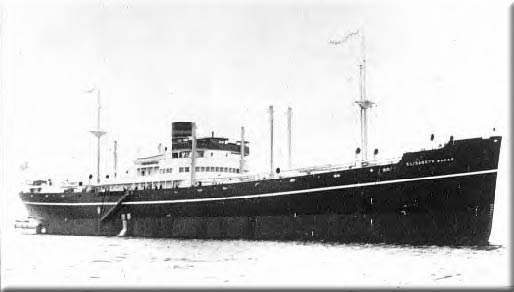
M/T Elisabeth Bakke To Elisabeth Bakke on the "Ships starting with E" page.
Manager: Knut Knutsen O. A. S., Haugesund Delivered in March-1937 from A/B Götaverken, Gothenburg as Elisabeth Bakke to D/S A/S Jeanette Skinner, Haugesund (Knut Knutsen O.A.S.). Captain: Captain Fjærtoft / Andrew Henry. Related items on this website: Her voyages are listed on these original images from the Norwegian National Archives: Please compare the above voyages with Arnold Hague's Voyage Record below.
(Received from Don Kindell - His source: The late Arnold Hague's database). Follow the convoy links provided for more information on each. Errors may exist, and some voyages are missing.
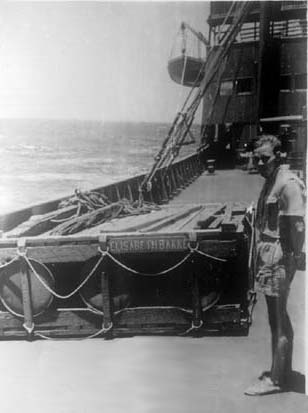
Elisabeth Bakke had left New York for Sweden on March 15-1940, and was still in Sweden when Norway was invaded on Apr. 9. She later managed to get to the U.K. along with 4 other Norwegian ships on Jan. 23-1941, and was in Nortraship's service until the end of the war. The others were M/S John Bakke by the same company, M/S Tai Shan, M/S Taurus and M/T Ranja - the text under each vessel has more information on the breakout of that particular ship. This operation, codenamed "Rubble", was lead by George Binney, who was also the leader of the disastrous "Operation Performance" in April of the following year (see Kvarstad Ships & Men). Operation Rubble could also have ended with less success than it actually did, as the battle cruisers Scharnhorst and Gneisenau (commanded by Admiral Lütjens) left Kiel on Jan. 23-1941 with orders to attack allied convoys between Halifax and the U.K., and passed very close by the Norwegian ships, without either of the parties knowing about the other. The Norwegian ships arrived safely in Kirkwall, though not entirely without incident; Ranja was attacked by aircraft the day after departure from Gothenburg, position 58 45N 04 10E, and her Swedish 1st mate was shot and later died. The captain on Elisabeth Bakke at the time of breakout was the British Andrew Henry, former 1st mate of D/S Romanby, which had been sunk in Narvik on Apr. 22/23-1940 (see also this Guestbook message and scroll down to Elisabeth Bakke). After the 2nd battle of Narvik, the crews of Romanby and 3 other steamers, D/S Blythmoor, sunk Narvik Apr. 10, D/S Mersington Court, sunk Narvik Apr. 15, and D/S Riverton, sunk Narvik Apr. 24, as well as survivors from the destroyers Hunter and Hardy had been taken through deep snow across to Sweden, where they were subsequently placed at the camp Hälsingmo north of Stockholm. George Binney used several of these men for Operation Rubble, because many of the Norwegians on board the chosen vessels were reluctant to take the risks involved, feeling the attempt was bound to fail. The chief engineer was the Swedish Birger Lundquist, and the rest of the engine room crew were also Swedish, while most of the others were British. (Note that quite a few of the crew from Romanby were also used for the Operation Performance ships - they are named on this page).
Naiad and Aurora under E. L. S. King departed Scapa Flow at 22:00 on Jan. 23 to meet the ships and provide escort, while the cruisers Edinburgh and Birmingham and destroyers Escapade, Echo and Electra under the command of L. E. Holland left 3 hours later. Aircraft escort was to be provided by 6 aircraft from each of 3 squadrons of the coastal command, operating from Scotland and the Shetlands, with Blenheims from the 254th Squadron to escort Admiral King's 2 cruisers, while Hudson aircraft from 269th Squadron, which departed Wick at 09:30 on Jan. 24 were to escort Admiral Holland's force, and Hudsons from the 224th Squadron were to patrol to Lista to cover the Norwegian ships when they were out of Skagerrak. The first ship to be spotted was Elisabeth Bakke, by Naiad at 09:50 on Jan. 24. She was allowed to continue to Kirkwall alone, because of her speed at the time (19 knots), and because of the fact that she had gotten that far. Taurus was spotted by Naiad at 11:45, then 25 minutes later Tai Shan observed Naiad, Aurora and Taurus, but at the same time a Blohm & Voss 138 seaplane was seen. At 13:45 it approached Tai Shan as if to attack and Naiad, which had left Taurus to the protection of Aurora, opened fire. The seaplane withdrew, but could still be seen, until the 2nd group of 2 Blenheims from 254th Squadron appeared at 14:15 and chased it away (the Blenheims had departed their base at 12:30). John Bakke and Ranja had still not been seen by the cruisers, but one of the Hudson aircraft under H. G. Holmes spotted them at 14:07, meaning they had sailed in full daylight and clear weather for almost 7 hours. Holmes flew back to Naiad to report it, but was not sure whether this had been understood, because at that time Naiad had spotted 2 Messerschmitt 110 bombers and a Heinkel III and was busy directing 2 Blenheims towards them. 1 of the British aircraft got a hit on 1 of the Messerschmitts, and the Blenheim was also damaged in the process, but not seriously and subsequently turned its attention to the Heinkel, but due to lack of fuel and ammunition both Blenheims eventually returned to base, while the German aircraft continued to circle above the ships. Holmes did not get his findings reported to Naiad until 14:41, and as the 5 other warships appeared just before 15:00 King asked Holland to take over the escorting of Taurus and Tai Shan, while Naiad and Aurora headed east in search of John Bakke and Ranja. Half an hour later Naiad asked one of the Hudson aircraft to give an exact position for the 2 Norwegian ships, but after having searched for them the aircraft could not find them. In the meantime, Holmes was about to run out of fuel, but before returning to base he attacked a seaplane, only to be hit himself in the port engine, resulting in him arriving Scotland with 1 engine. Naiad did not find John Bakke until around 16:00, then 15 minutes later Ranja was seen, both with German aircraft nearby, having been shadowed by them most of the afternoon, but they were not attacked, and strangely, it almost seemed as if they were being escorted by the German aircraft. Aurora was set to protect John Bakke, while Naiad headed towards Ranja at full speed. At this time, large forces of Blohm & Voss, Heinkels, Ju 88's and Dornier 17 aircraft arrived. Naiad, being still too far away from Ranja was unable to protect her, however, a series of bombs that were dropped did no serious damage. But when one of the seaplanes attacked with machine guns, the Swedish 1st mate Nils Rydberg, who was in the process of seeking shelter behind the concrete protection on the bridge, was hit by 5 bullets. He had been hit in the stomach, and though he was admitted to Balfour Hospital upon arrival Kirkwall he died 4 days later. He was post humously awarded "Order of the British Empire". Before the aircraft could prepare for another attack Naiad had reached Ranja. Aurora had also reached John Bakke. The ships were individually escorted to the Orkneys, arriving Kirkwall the following day. 147 men and 1 woman (wife of Chief Enginner Hans G. Hansen of John Bakke) had taken part in the breakout; 58 were British, 57 Norwegian, 31 Swedish and 1 Latvian. Again, follow the links to the other ships involved for more details on them (John Bakke, Tai Shan, Taurus and Ranja).
Her early 1941 voyages are shown on Page 1. Elisabeth Bakke is listed in station 53 of Convoy WS 9B in June/July-1941. According to A. Hague, she arrived Freetown on July 13, having left Liverpool on June 28. A few days later, she proceeded to Table Bay, and from there she made a voyage to Bombay, where she arrived Aug. 17, having sailed in Convoy WS 9BX - ref. links provided within the Voyage Record above. Together with the Norwegian Temeraire, she's listed among the ships in the Clyde-Halifax Convoy CT 6, which left Clyde on Nov. 15-1941 and arrived Halifax on the 24th (link above). According to Page 1, Elisabeth Bakke had started out from Avonmouth on Nov. 13 and arrived New York on the 25th, heading back to the U.K. from there on Dec. 6, with arrival Liverpool on Dec. 18, Manchester Dec. 21. Carrying troops, stores and 4 aircraft, she's later listed in Convoy WS 15, which left Liverpool Jan. 10-1942 and arrived Freetown Jan. 25. Elisabeth Bakke left Freetown again on Jan. 29 and arrived Cape Town on Febr. 10, according to A. Hague. She's also included in Convoy MW 11 in June that year. According to Arnold Hague, this convoy returned to Alexandria on June 16, having started out on the 11th - again, see external links in the table above. (Page 2 of the archive documents gives her arrival Alexandria as June 13). She was used as military transport in the Torch operations (the invasion of North Africa, which commenced on Nov. 8-1942 - Athos has a list of other Norwegian ships involved in these operations). A. Hague has included her in Convoy KMF 4. Her destination is given as Gibraltar, where she arrived on Dec. 5, according to the archive document referred to above (the convoy had left Clyde on Nov. 27 and arrived Bone on Dec. 7). She's also listed, with destination Oran, in Convoy KMF 5A, departing Gibraltar Dec. 20; A. Hague says she arrived Oran Dec. 21. Links to both these convoys have been provided in the table above. At the beginning of 1943 we find her, with no voyage information, in Convoy GUF 4, which left Oran on Jan. 31 and arrived Hampton Roads on Febr. 13, but there appears to be some uncertainty as to whether she sailed in this convoy or the earlier Convoy GUS 3 - again, see the external links within the above Voyage Record; Anna Knudsen and Athos are also included in the latter convoy, which departed Oran on Jan 18 and arrived Hampton Roads Febr. 7 (but the other 2 ships were not bound for the U.S.). Going back to Page 2 again, we learn that Elisabeth Bakke left Oran on Jan. 18, so it looks like she had sailed in GUS 3(?). On Febr. 8 that same year, she's listed as bound for Halifax in the New York-U.K. Convoy HX 226, but I'm not entirely sure she joined this convoy at all - again, see Page 2 above. She did, however, make a voyage from New York to Halifax with Convoy HX 228 later that month (in which Brant County was sunk). A cruising order is also available for this convoy, as well as misc. reports and an analysis of attacks. Elisabeth Bakke missed these attacks; she arrived Halifax on March 4, the convoy having left New York on Febr. 28. She's said to have made an independent voyage to Glasgow in Apr.-1943, but I believe the month is wrong here; this must have been the voyage she made in March that year, when she left Halifax on March 19 and arrived Glasgow on the 29th - again, see Page 2 of the archive docs, which adds that she headed back to New York on Apr. 12, with arrival Apr. 22. On May 7 she shows up, with a general cargo, explosives and passengers, in Convoy HX 238 from New York, again bound for Glasgow, where she arrived on May 22. She subsequently returned across the Atlantic with the westbound Convoy ON 187* (station 114), which originated in Liverpool on June 1 and arrived New York June 15 (Elisabeth Bakke joined from Clyde). The Norwegian Annik, Athos, Braga, Bralanta, Fagerfjell, Frontenac, Helgøy, Kronprinsen, Lista, Morgenen, Norbryn, Norefjord, O. B. Sørensen, President de Vogue, Toledo and Vanja are also listed, as is the Panamanian Norvinn, which had Norwegian managers and is included under the N's on this website. On June 30, Elisabeth Bakke joined Convoy HX 246 from New York, bound for Manchester with general cargo, station 41, arriving her destination on July 14 (she also had passengers on board). Acanthus, Potentilla and Rose are named among the escorts for this convoy. She now made an independent voyage back to the U.S., having left Liverpool on July 28, arriving New York Aug. 7, and on Aug. 20 she joined Convoy HX 253, general cargo for Glasgow, station 21, with arrival Glasgow on Sept. 3. Her voyages in this period are shown on Page 3 of the archive documents. On her next westbound voyage across the Atlantic later that month, Elisabeth Bakke witnessed the battle for Convoy ON 202 (ONS 18), in which Oregon Express and Skjelbred were sunk - please follow the links for further details; several reports are available. By this time the Germans had developed their so-called Zaunkönig torpedoes, or "Gnat" torpedoes. With the help of built in hydrophones these had the ability to find their targets by the propellers' movements, and were now put to use on these convoys. Further developments in the North Atlantic showed that the Zaunkönig techniques and the new offensive were unsuccessful. The subsequent convoys got across unharmed, with the U-boats carrying the losses. According to Arnold Hague, she returned to the U.K. in Convoy HX 261*, which departed New York on Oct. 11-1943 and arrived Liverpool on the 26th. The Norwegian Bajamar, Duala, Norsol, Pan Scandia, Tai Shan and Vav are also included, though the latter is said to have returned. Elisabeth Bakke proceeded to Manchester, where she arrived Oct. 26/27. Together with Bañaderos, Herbrand, Norholm, Trondheim, Vanja and Østhav, she later joined Convoy ON 211*, departing Liverpool on Nov. 13, arriving New York on the 29th; in fact, she served as Commodore Vessel on this occasion. The following month she acted as Commodore Vessel for Convoy HX 270*, leaving New York on Dec. 10, arriving Liverpool on the 26th. Again, several other Norwegian ships were in company, namely Heranger, Herbrand, Høyanger, Martin Bakke, Norholm and Washington Express. Elisabeth Bakke, serving as Commodore Vessel, headed in the other direction again at the beginning of the new year with Convoy ON 219*, together with Garonne, Heranger, Høyanger, Ivaran, Laurits Swenson and Norholm (departure Liverpool Jan. 8-1944, arrival New York Jan. 27). The following month we find her, with Washington Express, in the fast eastbound Convoy CU 14, leaving New York Febr. 12, arriving Liverpool Febr. 25, returning in Convoy ON 227*, which left Liverpool on March 8 and arrived New York on the 22nd, and in which the Norwegian Brimanger and Ivaran also took part. On Apr. 15 she's listed, with destination Manchester, in Convoy CU 21, arriving her destination on Apr. 29, returning with Convoy UC 23*, which left Liverpool on May 18 and arrived New York on the 28th, again with Washington Express in company. In June she again served as the Commodore's ship, this time for Convoy HX 295, bound for Manchester with general cargo, arriving there on June 27, and in July we find her in the westbound Convoy UC 30*, which left Liverpool on July 16 and arrived New York on the 27th - Hegra and Washington Express are also listed. See also Page 4. With a general cargo for Newport, she's now listed, along with California Express, in Convoy CU 35 from New Yok on Aug. 11. She arrived Newport on Aug. 22, and the following month she sailed to New York with Convoy UC 36* (originated in Liverpool Sept. 4, arrived New York Sept. 15). On Sept. 29, she joined Convoy CU 41 in order to head back to the U.K., this time with the Norwegian Karsten Wang. Elisabeth Bakke was again bound for Manchester, arriving there on Oct. 11, and on Oct. 25 she shows up in the westbound Convoy UC 42B*, which arrived New York Nov. 5. On Nov. 15 she joined Convoy CU 47, general cargo for Liverpool, with arrival Nov. 27. Her last Trans-Atlantic voyage that year was made in the westbound Convoy UC 48B* (Vice Commodore), departing Liverpool Dec. 12, arriving New York Dec. 24. She subsequently remained there for about a month before returning to the U.K. On Jan. 26-1945, we find her in Convoy CU 56, together with the Norwegian Nordahl Grieg. Elisabeth Bakke's destination is given as Manchester again, general cargo, and she arrived there on Febr. 6. Together with Karsten Wang, she returned across the Atlantic in Convoy UC 57A*, departing Liverpool on Febr. 20, arriving New York on March 5, Elisabeth Bakke serving as Vice Commodore Ship. Later that month she joined Convoy CU 63 to Liverpool, with Kirkenes and Washington Express, then headed in the other direction again in Convoy UC 64B*, which left Liverpool on Apr. 19 and arrived New York on the 30th. The last convoy she sailed in was CU 71, which left New York on May 20 and arrived Liverpool on May 30. Kaptein Worsøe, Mosdale and Trondanger are also named in this convoy. When she again sailed to New York in June-1945, no convoy was necessary. Page 4 and Page 5 of the archive documents show her subsequent voyages, up to and including Apr.-1946.
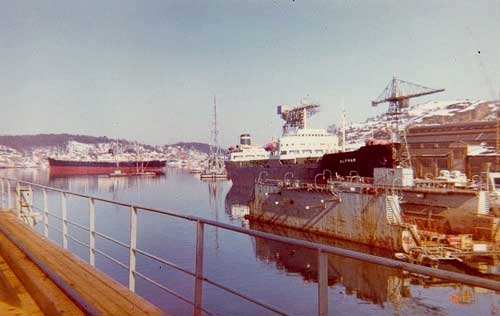
Sold in Aug.-1970 to Mesa Industri & Shipping A/S, Sandefjord and renamed Elisabeth. Laid up in Sandefjord June 30-1971. Went to Lorentzens Rederi Co., Oslo in 1971 then to A/S Bigra (Birger Gran), Oslo in Jan.-1973 as Bigra. Sold in 1974 without further trading to Spanish breakers. Left Sandefjord in tow on March 3 and arrived Bilbao March 11. Related external links: Convoy Vigorous - (MW 11) As will be seen, Elisabeth Bakke is included. (It's a section of the Encyclopedia of WW 2 Naval Battles). Roy Watvedt's story (relation to Elisabeth Bakke will be evident in the text - see also the text under Tirranna on my page Victims of Atlantis). Back to Elisabeth Bakke on the "Ships starting with E" page. The text on this page was compiled with the help of: "Nortraships flåte", J. R. Hegland and misc. others, incl. "Våre motorskip", Leif M. Bjørkelund & E. H. Kongshavn, "The Blockade Busters", Ralph Barker (1976). This book has detailed information on the breakout, as well as on Operation Performance. (It has also been translated to Norwegian under the title "Blokkadebryterne"). It should be possible to get it through one of the Internet bookstores. For instance, abebooks.com has several copies of it.
|
|||||||||||||||||||||||||||||||||||||||||||||||||||||||||||||||||||||||||||||||||||||||||||||||||||||||||||||||||||||||||||||||||||||||||||||||||||||||||||||||||||||||||||||||||||||||||||||||||||||||||||||||||||||||||||||||||||||||||||||||||||||||||||||||||||||||||||||||||||||||||||||||||||||||||||||||||||||||||||||||||||||||||||||||||||||||||||||||||||||||||||||||||||||||||||||||||||||||||||||||||||||||||||||||||||||||||||||||||||||||||||||||||||||||||||||||||||||||||||||||||||||||||||||||||||||||||||||||||||||||||||||||||||||||||||||||||||||||||||||||||||||||||||||||||||||||||||||||||||||||||||||||||||||||||||||||||||||||||||||||||||||||||||||||||||||||||||||||||||||||||||||||||||