Site Map | Search Warsailors.com | Merchant Fleet Main Page | Warsailors.com Home Merchant Fleet Main Page | Warsailors.com Home |
|
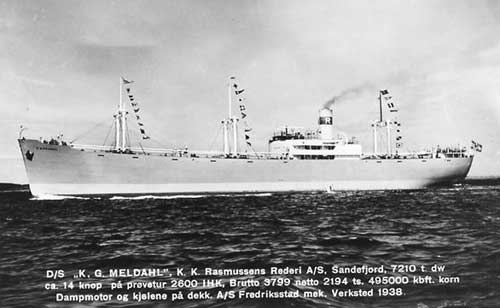
D/S K. G. Meldahl To K. G. Meldahl on the "Ships starting with K" page. Manager: K. K. Rasmussen, Sandefjord Built by Fredriksstad mek. Verksted A/S, Fredrikstad, Norway in 1938. Captain: Torjus Emil Johnsen Related item on this website: Her voyages are listed on these original images from the Norwegian National Archives: Please compare the above voyages with Arnold Hague's Voyage Record below.
(Received from Don Kindell - His source: The late Arnold Hague's database). Follow the convoy links provided for more information on each. Errors may exist, and several voyages are missing.
It looks like K. G. Meldahl was in Marseilles when war broke out in Norway on Apr. 9-1940; she had arrived there from Bombay on Apr. 1 - see Page 1. Engine Boy Vilfred Melsom is said to have died in a war related accident in Marseilles, date and year unknown, but this is the only time K. G. Meldahl was at that port. He's commemorated at the Stavern Memorial, ref. link at the end of this page. In June that year, she's listed in Convoy 7-P from Marseilles (ref. external link provided in the Voyage Record - Bosphorus, Fernhill and Tønsbergfjord are also listed), but left the convoy and went to Gibraltar instead of Oran (where the convoy arrived on June 22), thereby avoiding internment in North Africa - see also my text for Bosphorus. From Gibraltar, K. G. Meldahl continued to Takoradi on June 26, with arrival July 7. Her subsequent voyages are shown on the archive document mentioned above; her 1941 voyages also start on this document. She also made a voyage to Takoradi the following spring, arriving on Apr. 6 -1941, having taken on board 60 aircraft in New York the previous month, a very important "cargo" for the British in the Middle East at that time, and while at Takoradi she was ordered to take on as many additional aircraft as she could possibly hold, then continued to Suez, where she arrived safely, though without escort (it'll be noticed that Page 1 does not mention Suez in this period). On Oct. 22-1941, she was one of several Norwegian ships joining Convoy HX 156 from Halifax to the U.K. Montbretia and Eglantine are named among the escorts for this convoy. K. G. Meldahl's voyages in this period are shown on Page 2 (as can be seen, she had previously spent quite a long time at Hampton Roads, where she had arrived from Philadelphia on Aug. 31; departure is given as Oct. 15, when she proceeded to Halifax in order to join this convoy). She subsequently made a voyage to Freetown, having joined Convoy OS 13, which originated in Liverpool on Nov. 30-1941; K. G. Meldahl, carrying a general cargo and war stores, started out from Oban on Dec. 1 and arrived Freetown on the 21st. The Norwegian Finnanger, Siljestad and Velox are also listed (link in the table above). In Febr.-1942, she can be found going in the other direction, together with Siljestad, in Convoy SL 100, which left Freetown on Febr. 9 and arrived Liverpool on March 4; K. G. Meldahl stopped at Oban that day. Her cargo is given as W. A. produce, and she was also carrying mail and passengers. The following month, we find her in Convoy OS 24, voyaging from Oban to Freetown (station 43), arriving Freetown on Apr. 22. Acasta and Norma are also named in this convoy. Again, ref. external links in the Voyage Record for more details. Her subsequent voyages are shown on Page 2 and Page 3, while convoy info for some of them can be found in the Voyage Record. For more information on all the other Norwegian ships mentioned on this page, please see the alphabet index below, or go to the Master Ship Index.
K. G. Meldahl, on charter to British War Transport, departed New York on Sept. 20-1942 for Bombay, via Port of Spain and Capetown for bunkers. On deck she had several large crates containing aircraft and other materials, and in No. 5 hold she had 750 tons ammunition. She had a crew of 30 (31?) and 2 gunners. She left Capetown again on Nov. 7. On Nov. 10, she was torpedoed and sunk by U-181 (Lüth). Several hours earlier (at about 03:40) the 2nd mate, who was on bridge duty at the time, had clearly seen a U-boat* on the port side, 3 ships lengths off on a parallel course. The alarm was sounded and the ship positioned so that the aft gun faced the U-boat, at which time the latter quickly submerged, whereupon K. G. Meldahl proceeded at full speed in a zig zag course, after having radioed Simonstown Radio about the incident. However, the U-boat kept track of the Norwegian ship, and on her next try the torpedo hit in the engine room on the starboard side. Time given for this attack in a report presented at the maritime hearings is 09:22, position 35 33S 29 46E (Page 3 of the archive documents gives the time as about 09:08).
As she started to sink orders were given to abandon ship. The starboard lifeboat had been blown away so the majority of the crew took to the port boat and rowed away from the ship to avoid the suction. The 3rd mate got off on the aft raft. The captain had run to get the ship's papers and by the time he got back the boat had already been launched, and the aft raft with the 3rd mate in it had been cut loose, so he jumped overboard when the after part of the ship was under water and swam over to the lifeboat. She sank in about 6 minutes, duly photographed by the U-boat which had surfaced. Pictures were also taken of the lifeboats, before the U-boat came over to ask the usual questions about ship and cargo etc. Captain Johnsen describes the boat as about 300' long, sea green in colour with a double deck and 2 guns, a 4" on the foredeck, a smaller one on the after deck, 2 periscopes. Those who asked the questions claimed to be Italian. The commander, the only one in uniform "looked German", but did not say anything. They were also asked if an SOS had been sent out, but this had not been done as the radio station had been destroyed. After having inquired whether they needed anything, the boat circled around for a while, then submerged. The 30 survivors were subsequently distributed in 3 lifeboats and all supplies and equipment from 3 rafts were transferred to them. The port boat had a radio transmitter which was used every morning and night to signal the South African coastal stations. In the morning of Nov. 13 an aircraft came over and dropped water and provisions down to them, and that same afternoon, after having been in the boats for 79 hours, they were picked up by a South African mine sweeper and landed in Port Elisabeth the next day. 2 crew were lost. The maritime hearings were held in Capetown on Dec. 2-1942 with the captain, the 2nd and 3rd mates, Able Seaman Karlsen (at the wheel when the U-boat was spotted the first time), and Able Seaman Rong appearing. The latter had been at the wheel during the actual attack. In the Norwegian magazine "Krigsseileren", Issue No. 2 for 1975 there's an article written by someone who appears to have been one of the mates, who had joined the ship in Hull in 1942. At that time, she had a different captain and 1st mate, but they are not named. I get the impression that Captain Johnsen and 1st Mate Nilsen had joined the ship in New York, shortly before they were torpedoed. The author says they were travelling alone at the time, and that the 2 men who were lost were in the engine room. The survivors headed for South Africa in 2(?) lifeboats. He adds "via Cape Town and D/S Romulus to New York", but whether they all travelled that way or just he, is unclear. The article also mentions a few other voyages. (It'll be noticed, when going to my page about Romulus, that she did not go to New York until March-1943 - she had sailed from Capetown on Febr. 2). U-181 also sank the Norwegian Gunda 9 days later. Crew List:
Related external links: Back to K. G. Meldahl on the "Ships starting with K" page. This company had another K. G. Meldahl delivered in 1948, 2304 gt. Later sailed as Høegh Clair for Leif Høegh & Co., Oslo from 1949, and as Utsira for Vilhelm Torkildsens Rederi, Bergen from 1955, then as Cecilie Brøvig for Th. Brøvig, Farsund from 1960. Sold in 1968 to South Korea, renamed Atlas Pioneer, broken up in 1972. The text on this page was compiled with the help of: "Nortraships flåte", J. R. Hegland, "Krigsseileren", Issue No. 2 for 1975, "Sjøforklaringer fra 2. verdenskrig", Norwegian Maritime Museum, Volume I, and misc. (ref. My sources).
|
||||||||||||||||||||||||||||||||||||||||||||||||||||||||||||||||||||||||||||||||||||||||||||||||||||||||||||||||||||||||||||||||||||||||||||||||||||||||||||||||||||||||||||||||||||||||||||||||||||||||||||||||||||||||||||||||||||||||||||||||||||||||||||||||||||||||||||||||||||||||||||||||||||||||||||||||||||||||||||||||||||||||||||||||