D/S Freidig
Updated Aug. 20-2011
To Freidig on the "Ships starting with F" page.
Crew List
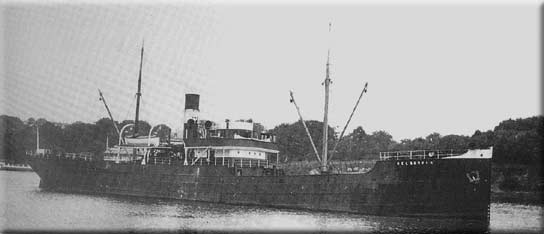
This picture shows the ship when named Melsomvik. Received from Leif M. Bjørkelund.
Managers: O. M. Olsen & A. Næss, Fredrikstad until Jan.-1940, Trygve Skogland, Haugesund from 1940, later Tollak Johan Skogland, Haugesund.
Tonnage: 1333 gt, 2050 tdwt.
Call Sign: LELP
Delivered in 1903 from Wood, Skinner & Co. Ltd, Newcastle, as Gerd for Johs. Bull, Tønsberg. 1203 gt., 750 nrt., 2050 tdw., 237.0 x 35.2 x 16,0 ft. Tr. exp. 149 nhp (N. East. Mar. Eng.). From 1909 she was managed by P. Johannessen, Tønsberg. Purchased by D/S A/S Haraldshaug & A/S Mercator, Haugesund in 1916 and registered as Haraldshaug. Sold in Dec.-1919 to Jens Salvesens Rederi A/S, Christiania and renamed Freidig in Jan.-1920, then Melsomvik, Einar Langes Rederi A/S, Oslo, Oct.-1929. Mesna, Rederi-A/S, Mesna (Einar Lange), Oslo, July-1933. Management transferrred in July-1935 to Knut Simonsen, Oslo. Sold in July-1937 to Skibs-A/S Freidig (O. M. Olsen & A. Næss), Fredrikstad, and renamed Freidig. Purchased in Jan.-1940 by A/S Rona (Trygve Skogland), Haugesund, no name change. (Management taken over by Tollak Johan Skogland, Haugesund in 1942).
Charles Hocking gives the tonnage as 1333 gt. Yet another number shows up in "Damp - Dampskipets æra i Vestfold", namely 1185 gt (when built). This book also lists D/S Gerd A/S (S. L. Christie), Bergen as owner in 1915, before she was purchased by D/S A/S Haraldshaug.
Captains: Adolf M. Ringen, later Albert Arntzen.
Her voyages are listed on these original images from the Norwegian National Archives:
Page 1 | Page 2 | Page 3 | Page 4 | Page 5 | Page 6 | Page 7 | Page 8 | Page 9 | Page 10
Please compare the above voyages with Arnold Hague's Voyage Record below.
Voyage Record
From March-1940 to Febr.-1944:
|
(Received from Don Kindell - His source: The late Arnold Hague's database).
Follow the convoy links provided for more information on each (it'll be noticed that some listings are incomplete). Where the "Convoy" column is left blank, it means that convoy is not known.
Errors do exixst. This, in turn, could mean that she may not have sailed in all the convoys noted, even though she's listed in them. Also, some voyages are missing.
| 1940 |
March 30 |
Norwegian Waters |
– |
– |
HN 23A |
Detached Apr. 1
Missing voyages, Page 1 |
| |
May 21 |
Downs |
Tyne |
May 24 |
FN 177 |
With bomb damage.
Convoy available at FN convoys
(external link) |
| |
June 7 |
Tyne |
Downs |
June 9 |
FS 190 |
Convoy available at FS convoys
(external link) |
| |
June 9 |
Downs |
Belfast |
– |
– |
Missing movements, Page 1 |
| |
Aug. 12 |
Clyde |
Methil |
Aug. 15 |
WN 7 |
Convoy available at WN convoys
(external link) |
| |
Aug. 17 |
Methil |
Blyth |
Aug. 17 |
MT 143 |
Convoy available at MT 143
(external link - incomplete listing) |
| |
Sept. 7 |
Blyth |
Tyne |
Sept. 7 |
– |
– |
| |
Sept. 12 |
Tyne |
Methil* |
Sept. 13 |
FN 278 |
Convoy available at FN convoys
(external link)
*Compare w/Page 1
(also, missing voyages) |
| |
Sept. 28 |
Tyne(?) |
Southend |
Sept. 30 |
FS 294 |
Convoy available at FS convoys
(external link) |
| |
Oct. 13 |
Southend |
Methil* |
Oct. 16 |
FN 307 |
Convoy available at FN convoys
(external link)
*Compare w/Page 1 |
| |
Nov. 1 |
Methil |
Southend |
Nov. 3 |
FS 325 |
Convoy available at FS convoys
(external link)
Again, see also Page 1 |
| |
Nov. 17 |
Southend |
Methil |
Nov. 19 |
FN 336 |
Convoy available at FN convoys
(external link) |
| |
Nov. 20 |
Methil Roads |
Dundee |
Nov. 21 |
– |
– |
| |
Nov. 28 |
Dundee |
Methil Roads |
Nov. 29 |
– |
– |
| |
Dec. 4 |
Methil |
Southend |
Dec. 8 |
FS 353 |
Convoy available at FS convoys
(external link)
See also Page 1 |
| |
Dec. 14 |
Southend |
Methil |
Dec. 16 |
FN 359 |
Convoy available at FN convoys
(external link) |
| |
Dec. 21 |
Methil |
Southend |
Dec. 24 |
FS 367 |
Convoy available at FS convoys
(external link)
See also Page 2 |
| 1941 |
Jan. 4 |
Southend |
Methil |
Jan. 7 |
FN 375 |
Convoy available at FN convoys
(external link) |
| |
Jan. 15 |
Methil |
Southend |
Jan. 17 |
FS 389 |
Convoy available at FS convoys
(external link) |
| |
Jan. 25 |
Southend |
Methil |
Jan. 27 |
FN 391 |
Convoy available at FN convoys
(external link) |
| |
Febr. 3 |
Methil |
Southend |
Febr. 5 |
FS 403 |
Convoy available at FS convoys
(external link)
See also Page 2 |
| |
Febr. 11 |
Southend |
Methil |
Febr. 13 |
FN 405 |
Convoy available at FN convoys
(external link) |
| |
Febr. 20 |
Methil |
Southend |
Febr. 22 |
FS 417A |
Convoy available at FS convoys
(external link) |
| |
Febr. 28 |
Southend |
Methil |
March 2 |
FN 419 |
Convoy available at FN convoys
(external link) |
| |
March 10 |
Methil |
Southend |
March 12 |
FS 433 |
Convoy available at FS convoys
(external link)
Again, see Page 2 |
| |
March 24 |
Southend |
Methil |
March 26 |
FN 441 |
Convoy available at FN convoys
(external link)
Missing voyages, Page 2 |
| |
Apr. 7 |
Methil |
Southend |
Apr. 9 |
FS 457 |
Convoy available at FS convoys
(external link) |
| |
Apr. 19 |
Southend |
Methil Roads |
Apr. 21 |
EC 9 |
Convoy available at EC convoys
(external link)
Compare w/Page 2.
See also Page 3 |
| |
May 10 |
Methil |
Blyth |
May 11 |
FS 486 |
Convoy available at FS convoys
(external link) |
| |
May 11 |
Blyth |
Oban |
May 14 |
EC 18 |
Convoy available at EC convoys
(external link) |
| |
May 15 |
Oban |
Belfast Lough |
May 15 |
Independent |
– |
| |
May 18 |
Belfast Lough |
Swansea |
May 19 |
BB 22 |
Convoy available at BB convoys
(external link) |
| |
May 23 |
Swansea |
Cardiff |
May 23 |
Independent |
– |
| |
May 26 |
Cardiff |
Milford Haven |
May 26 |
Independent |
– |
| |
May 27 |
Milford Haven |
Holyhead |
May 29 |
Independent |
Compare w/Page 3
(also, missing voyages) |
| |
May 29 |
Holyhead |
Liverpool |
May 29 |
Independent |
– |
| |
June 10 |
Liverpool |
Clyde |
June 11 |
Independent |
– |
| |
June 13 |
Clyde |
Methil |
June 17 |
WN 140 |
Convoy available at WN convoys
(external link) |
| |
June 19 |
Methil |
Southend |
June 21 |
FS 520 |
Convoy available at FS convoys
(external link)
Again, see also Page 3 |
| |
June 29 |
Southend |
Methil |
June 30 |
FN 486 |
Convoy available at FN convoys
(external link)
Compare w/Page 3
(also, missing movements) |
| |
Aug. 1 |
Methil |
Southend |
Aug. 3 |
FS 557 |
Convoy available at FS convoys
(external link) |
| |
Aug. 10 |
Southend |
Methil Roads |
Aug. 12 |
EC 58 |
Convoy available at EC convoys
(external link)
Compare w/Page 3 |
| |
Aug. 23 |
Methil Roads |
Belfast Lough |
Aug. 26 |
EC 63 |
Convoy available at link above |
| |
Aug. 29 |
Belfast |
Clyde |
Aug. 30 |
Independent |
– |
| |
Sept. 5 |
Clyde |
Oban |
Sept. 6 |
Independent |
– |
| |
Sept. 8 |
Oban |
Methil |
Sept. 11 |
WN 178 |
Convoy available at WN convoys
(external link) |
| |
Sept. 12 |
Methil |
Southend |
Sept. 14 |
FS 593 |
Convoy available at FS convoys
(external link)
See also Page 4 |
| |
Sept. 26 |
Southend |
Dundee |
Sept. 29 |
EC 78 |
Convoy available at EC convoys
(external link) |
| |
Oct. 3 |
Dundee |
Methil Roads |
Oct. 3 |
– |
– |
| |
Oct. 10 |
Methil Roads |
Belfast Lough |
Oct. 14 |
EC 83 |
Convoy available at link above |
| |
Oct. 19 |
Belfast Lough |
Clyde |
Oct. 20 |
Independent |
– |
| |
Oct. 27 |
Clyde |
Oban |
Oct. 28 |
Independent |
– |
| |
Nov. 2 |
Oban |
Methil |
Nov. 5 |
WN 200 |
Convoy available at WN convoys
(external link) |
| |
Nov. 7 |
Methil |
Southend |
Nov. 9 |
FS 641 |
Convoy available at FS convoys
(external link)
Again, see Page 4 |
| |
Nov. 21 |
Southend |
Methil |
Nov. 23 |
FN 558 |
Convoy available at FN convoys
(external link)
Compare w/Page 4
(also, missing movements) |
| |
Dec. 3 |
Methil |
Southend |
Dec. 5 |
FS 663 |
Convoy available at FS convoys
(external link)
See also Page 4 |
| |
Dec. 16 |
Southend |
Methil |
Dec. 18 |
FN 580 |
Convoy available at FN convoys
(external link)
Compare w/Page 4 |
| |
Dec. 26 |
Methil Roads |
Dundee |
Dec. 26 |
– |
– |
| |
Dec. 29 |
Dundee |
Methil Roads |
Dec. 30 |
– |
– |
| 1942 |
Jan. 1 |
Methil |
Southend |
Jan. 3 |
FS 688 |
Convoy available at FS convoys
(external link)
Also, Page 4 |
| |
Jan. 12 |
Southend |
Aberdeen |
Jan. 14 |
FN 603 |
Convoy available at FN convoys
(external link) |
| |
Jan. 27 |
Aberdeen |
Leith |
Jan. 28 |
– |
See also Page 5 |
| |
Febr. 2 |
Methil |
Southend |
Febr. 4 |
FS 716 |
Convoy available at FS convoys
(external link)
Also, Page 5 |
| |
Febr. 14 |
Southend |
Methil* |
Febr. 16 |
FN 631 |
Convoy available at FN convoys
(external link)
*Compare w/Page 5 |
| |
March 30 |
Methil |
Londonderry |
Apr. 3 |
EN 65 |
Convoy available at EN convoys
(external link) |
| |
Apr. 8 |
Londonderry |
Clyde |
Apr. 9 |
– |
– |
| * |
Apr. 14 |
Clyde |
Loch Ewe |
Apr. 17 |
Independent |
– |
|
*Voyage inserted from below and date corrected (see also Page 5). |
| |
Apr. 17 |
Loch Ewe |
Methil |
Apr. 19 |
WN 271 |
Convoy available at WN convoys
(external link) |
| |
Apr. 20 |
Methil |
Southend |
Apr. 22 |
FS 782 |
Convoy available at FS convoys
(external link)
See also Page 5 |
| |
Apr. 30 |
Southend |
Methil* |
May 2 |
FN 695 |
Convoy available at FN convoys
(external link)
*Compare w/Page 5 |
| |
May 9 |
Methil |
Belfast Lough |
May 12 |
EN 82 |
Convoy available at EN convoys
(external link) |
| * |
May 14 |
Clyde |
Loch Ewe |
Apr. 17 |
Independent |
– |
|
*Departure should be Apr. 14, and voyage belongs further up in the record (inserted there). |
| |
May 17 |
Belfast Lough |
Loch Ewe |
– |
Independent |
– |
| |
May 19 |
Loch Ewe |
Methil |
May 21 |
WN 285 |
Convoy available at WN convoys
(external link)
Missing movements, Page 5 |
| |
May 30 |
Methil |
Belfast Lough |
June 2* |
EN 91 |
Convoy available at EN convoys
(external link)
*June 5?
(Page 5) |
| |
June 5 |
Belfast Lough |
Liverpool |
June 6 |
Independent |
Missing voyages, Page 6 |
| |
June 14 |
Loch Ewe |
Methil |
June 16 |
WN 296 |
Convoy available at WN convoys
(external link) |
| |
June 17 |
Methil |
Ipswich |
June 19 |
FS 831 |
Convoy available at FS convoys
(external link) |
| |
June 23 |
Ipswich |
Southend |
June 24 |
FS 836 |
Convoy available at link above
(see also Page 6) |
| |
June 27 |
Southend |
Methil |
June 29 |
FN 745 |
Convoy available at FN convoys
(external link)
Compare w/Page 6 |
| |
July 10 |
Methil |
Loch Ewe(?) |
July 12 |
EN 109 |
Convoy available at EN convoys
(external link) |
| |
July 17 |
Belfast Lough |
Newport |
July 19 |
BB 199 |
Via Swansea
(Page 6).
Convoy available at BB convoys
(external link) |
| |
July 22 |
Newport |
Milford Haven |
July 24 |
Independent |
– |
| |
July 24 |
Milford Haven |
Liverpool |
July 25 |
Independent |
– |
| |
July 28 |
Liverpool |
Holyhead |
July 28 |
Independent |
– |
| |
July 30 |
Holyhead |
Mumbles |
July 31 |
BB 204 |
Convoy available at link above |
| |
July 31 |
Swansea Bay |
Milford Haven |
Aug. 1 |
Independent |
Compare w/Page 6 |
| |
Aug. 2 |
Milford Haven |
Clyde |
Aug. 4 |
Independent |
– |
| |
Aug. 13 |
Loch Ewe |
Methil |
Aug. 15 |
WN 322 |
Convoy available at WN convoys
(external link) |
| |
Aug. 16 |
Methil |
Southend |
Aug. 18 |
FS 883 |
Convoy available at FS convoys
(external link)
Also, Page 6 |
| |
Aug. 26 |
Southend |
Methil |
Aug. 28 |
FN 797 |
Convoy available at FN convoys
(external link)
Compare w/Page 6 |
| |
Oct. 3 |
Methil |
Belfast |
Oct. 7 |
EN 145 |
Convoy available at EN convoys
(external link) |
| |
Oct. 12 |
Belfast |
Liverpool |
Oct. 13 |
Independent |
– |
| |
Oct. 17 |
Liverpool |
Barry |
Oct. 19 |
Independent |
– |
| |
Oct. 22 |
Barry |
Liverpool |
Oct. 23 |
Independent |
– |
| |
Nov. 6 |
Liverpool |
Barry |
Nov. 8 |
Independent |
– |
| |
Nov. 10 |
Barry |
Liverpool |
Nov. 14 |
Independent |
– |
| |
Nov. 19 |
Liverpool |
Barry |
Nov. 20 |
Independent |
– |
| |
Nov. 22 |
Barry |
Preston |
Nov. 25 |
Independent |
– |
| |
Nov. 28 |
Preston |
Cardiff |
Nov. 30 |
Independent |
– |
| |
Dec. 3 |
Cardiff |
Liverpool |
Dec. 5 |
Independent |
– |
| |
Dec. 18 |
Liverpool |
Cardiff |
Dec. 20 |
Independent |
Compare w/Page 7 |
| |
Dec. 23 |
Cardiff |
Liverpool |
Dec. 25 |
Independent |
– |
| |
Dec. 30 |
Liverpool |
Cardiff |
Jan. 2-1943 |
Independent |
Compare w/Page 7 |
| 1943 |
Jan. 5 |
Cardiff |
Liverpool |
Jan. 7 |
Independent |
– |
| |
Jan. 13 |
Liverpool |
Barry |
Jan. 14 |
Independent |
Compare w/Page 7 |
| |
March 18 |
Barry |
Cardiff |
March 18 |
Independent |
– |
| |
March 19 |
Cardiff |
Solent |
March 21 |
WP 311 |
Convoy available at WP convoys
(external link) |
| |
March 25 |
St Helens Roads |
Southend |
March 26 |
CE 163 |
Convoy available at CE convoys
(external link)
See also Page 8 |
| |
Apr. 1 |
Southend |
Methil |
Apr. 3 |
FN 984 |
Convoy available at FN convoys
(external link) |
| |
Apr. 4 |
Methil Roads |
Clyde |
Apr. 10 |
– |
Missing movements, Page 8 |
| |
May 4 |
Liverpool |
Methil |
May 9 |
Independent |
– |
| |
May 10 |
Methil |
Middlesbrough |
May 11 |
FS 1112 |
Convoy available at FS convoys
(external link) |
| |
May 13 |
Middlesbrough |
Tyne |
May 13 |
– |
– |
| |
May 14 |
Tyne |
Southend |
May 16 |
FS 1115 |
Convoy available at link above.
Again, see also Page 8 |
| |
May 24 |
Southend |
Methil* |
May 26 |
FN 1029 |
Convoy available at FN convoys
(external link)
*Compare w/Page 8 |
| |
June 2 |
Methil Roads |
Belfast |
June 6 |
– |
– |
| |
June 10 |
Belfast Lough |
Cardiff |
June 11 |
Independent |
– |
| |
June 18 |
Cardiff |
Newport |
June 18 |
Independent |
– |
| |
June 23 |
Newport |
Preston |
June 25 |
Independent |
– |
| |
June 28 |
Preston |
Liverpool |
June 29 |
Independent |
– |
| |
July 3 |
Liverpool |
– |
– |
Independent |
Joined WN 450, July 5 |
| |
July 5 |
Loch Ewe(?) |
Dundee |
July 6 |
WN 450 |
Convoy available at WN convoys
(external link) |
| |
July 10 |
Methil(?) |
Tyne |
July 11 |
FS 1164 |
Compare w/Page 8
Convoy available at FS convoys
(external link) |
| |
July 14 |
Tyne |
Methil |
July 15 |
FN 1072 |
Convoy available at FN convoys
(external link) |
| |
July 15 |
Methil Roads |
Belfast |
July 19 |
– |
– |
| |
July 20 |
Belfast |
Clyde |
July 21 |
Independent |
– |
| |
July 28 |
Clyde |
Methil |
Aug. 1 |
– |
– |
| |
Aug. 2 |
Methil |
Southend |
Aug. 4 |
FS 1184 |
Convoy available at FS convoys
(external link)
See also Page 9 |
| |
Aug. 24 |
Southend |
Dundee |
Aug. 26 |
FN 1108 |
Convoy available at FN convoys
(external link) |
| |
Aug. 30 |
Dundee |
Southend |
Sept. 1 |
FS 1208 |
Convoy available at FS convoys
(external link)
See also Page 9 |
| |
Sept. 15 |
Southend |
Ipswich |
Sept. 16 |
FN 1127 |
Via Harwich
(Page 9).
Convoy available at FN convoys
(external link) |
| |
Sept. 18 |
Ipswich |
Southend |
Sept. 19 |
FS 1223 |
Convoy available at FS convoys
(external link) |
| |
Sept. 23 |
Southend |
Methil* |
Sept. 25 |
FN 1134 |
Convoy available at FN convoys
(external link)
Compare w/Page 9 |
| |
Oct. 2 |
Methil |
Tyne |
Oct. 3 |
FS 1236 |
Convoy available at FS convoys
(external link)
On to Blyth Oct. 9
(Page 9) |
| |
Oct. 13 |
Methil* |
Southend |
Oct. 15 |
FS 1245 |
Convoy available at link above.
*See Page 9 |
| |
Oct. 17 |
Southend |
St. Helens Roads |
Oct. 18 |
CW 217 |
Convoy available at CW convoys
(external link) |
| |
Oct. 22 |
Solent |
Plymouth |
Oct. 22 |
PW 419 |
Convoy available at PW 419
(external link - incomplete listing) |
| |
Oct. 28 |
Plymouth |
Falmouth |
Oct. 28 |
Independent |
– |
| |
Oct. 29 |
Falmouth |
Newport |
Oct. 30 |
PW 422 |
Convoy available at PW 422
(external link - incomplete) |
| |
Nov. 2 |
Newport |
Liverpool |
Nov. 4 |
Independent |
– |
| |
Nov. 16 |
Liverpool |
Methil Roads |
Nov. 20 |
– |
– |
| |
Nov. 23 |
Methil |
Southend |
Nov. 25 |
FS 1280 |
Convoy available at FS convoys
(external link) |
| |
Dec. 25 |
Southend |
Methil* |
Dec. 27 |
FN 1216 |
Convoy available at FN convoys
(external link)
*See also Page 10 |
| 1944 |
Jan. 8 |
Methil |
Southend |
Jan. 10 |
FS 1325 |
Convoy available at FS convoys
(external link)
Also, Page 10 |
| |
Jan. 21 |
Southend |
Harwich |
Jan. 21 |
FN 1243 |
Convoy available at FN convoys
(external link) |
| |
Jan. 22 |
Harwich |
Methil |
Jan. 24 |
FN 1244 |
Convoy available at link above.
Compare w/Page 10
(also, missing voyages) |
| |
Febr. 5 |
Methil(?) |
– |
– |
EN 342 |
Foundered off Strathie Pt.
See "Final Fate" below.
Convoy available at EN convoys
(external link) |
Captain Adolph M. Ringen (from 1940). Freidig sailed in Convoy HN 23A from Norway to the U.K. at the end of March-1940. She was bound for Rouen with pulp, thereby ending up in allied service. When the Germans invaded Norway on Apr. 9, she was on her way from Ardrossan to Rouen, where she arrived Apr. 10, according to Page 1 of the archive documents.
She was in the coal trade South Shields-Rouen and endured the heavy bombing of Rouen while discharging coal from the U.K. in the middle of May-1940. It was decided to try to take her out on the 19th and she was outward bound when she was attacked by German aircraft late in the evening of May 21, about 11 n. miles off Orfordness. No bombs hit, but she was damaged by the detonations in the sea close by, though the crew managed to take her to port. As can be seen in her Voyage Record above, A. Hague has her in Convoy FN 177 at this time (external link, incomplete listing). After Rouen had fallen in June (9th) Freidig entered the coal (and food) trade around the U.K.
The situation at that time:
The Germans soon won the entire continental coast from far up north to the Spanish border in the south, which enabled them to use Dutch, Belgian or French airfields as their points of origin, rather than having to use the ones in Germany. E-boats (torpedo boats) had a short distance to offensive operations against shipping on the British east coast, and the U-boats also had a shorter distance to travel to the British Atlantic inlets where ships assembled and offered good targets. From the beginning of July the German Air Force started hammering British coastal shipping and ports. When France had fallen the ports in the channel had been closed, and the transoceanic convoys were redirected north of Ireland. The ports on the west coast then became overloaded convoy terminals, while the ports on the east coast were practically empty. It was soon realized that this could not work in the long run. The overland transportation network could not handle the large amounts of supplies discharged by the convoys on the west coast, a considerable amount of which had to get to the densely populated areas in the east, like London, so ships had to be used to get the goods delivered in sufficient amounts. Therefore, traffic to the cities on the east coast was directed around Scotland, and in July it was again necessary to reestablish direct sailings between the Thames and the Bristol channel, past Dover. When the Germans intensified their air attacks on the British coastal traffic in July, Norwegian ships were in the most dangerous passage of all, the Dover passage, and several were sunk or damaged (Balder, Fjord, Kollskegg, Nina Borthen, Balzac, Stalheim, Audun to mention just a few). Improved measures for convoy defense were put to use, which reduced the losses for a while, but from Aug.-1940 German planes started swarming across the entire kingdom in their search for ships, and the number of losses again went up considerably.
Captain Albert Arntzen. 20 men died when Freidig sank on Febr. 7-1944 after her cargo had shifted in a storm with heavy seas while on a voyage from Aberdeen to Liverpool with a cargo of 1624 tons rye, having departed Aberdeen at 00:30 on Febr. 6 (her voyages in this period are shown on Page 10). According to Arnold Hague, she had been in Convoy EN 342 at the time (external link). She had already been listing slightly on departure, and that afternoon her boiler sprang a leak. By 08:00 on Febr. 7 she was listing about 10° to port because her cargo had shifted, as mentioned, and at 10:00 all men were called on deck after a heavy sea had taken the icebox and carried it towards the airpipe forward of the after hold with such force that the pipe broke off near the deck. They desperately tried to plug up the hole using mattrasses, but it was impossible due to the seas constantly washing over the after deck. Her list increased and she sank deeper and deeper by the stern, resulting in the after hatch being forced open so that the hold started to flood at 11:15. The captain ordered the lifeboats launched and the port boat with 7-8 men was successfully lowered and rowed away from the ship, but the starboard boat was taken by the seas and went away empty. 8 men were able to get on the raft on the boatdeck, while 6 got on the port raft on the after deck. SOS was sent out from 11:15 until 11:30, then the ship sank, the engine room having started to fill with water, about 15 n. miles north of Cape Wrath (in the vicinity of Strathie Point). Shortly after the men had gotten on the rafts the seas washed over the midships section so the men ended up in the water. 8 of them later managed to get onto the largest raft, 2 of whom subsequently went over to a smaller raft found drifting by. These were the only 2 who survived after having been drifting on the raft for 28 hours. They were observed by an aircraft, then picked up by a rescue vessel from Thurso. Another 2 survivors in a lifeboat were spotted near land, but the sea took them before they could be reached.
A visitor to my website has told me that "Shipwreck Index of the British Isles" says she foundered within sight of Cape Wrath. Thurso Lifeboat found 5 dead men on a raft and recovered them, 2 were rescued from a second raft, but there was no trace of any others. He has also told me that "The Story of the Thurso Lifeboats" by Jeff Morris describes how the 2 survivors were rescued and the 5 dead taken on board the Thurso lifeboat H.C.J. on Febr. 8. A report had been received that 2 objects were drifting at Melvich Bay, 2 miles off-shore, and in spite of the extremely rough seas, northerly gale and frequent snow the boat was launched at 3:00 that afternoon, with Coxswain John McLeod in command. At 4:30 p. m., 2 rafts were spotted, one of which was only 170 yards from the rocks. 2 exhausted men were found clinging to it. At great risk to themselves the men in the lifeboat were able to get close enough to the raft to take the survivors aboard, then headed for the second raft about a mile and a half away. Once there, lifeboat-man David Thomson and Assistant Motor Mechanic William Sinclair jumped aboard the raft, only to discover they were too late; all 5 men were already dead. The bodies had to be extricated from each other as their arms and legs were entwined, having huddled together for protection. After 10 minutes the 5 bodies had been taken on board the H. C. J. The 2 survivors were landed at 7:10 p. m. and taken to a hospital; both later recovered from their ordeal. Coxswain John McLeod was awarded the Bronze Medal by the RNLI for his seamanship and courage during this incident, and was also awarded the British Empire Medal. David Thomson and William Sinclair received the Institution's Thank's on Vellum for their part in the rescue.
The maritime hearings were held in London on Febr. 22-1944 with the 2 survivors appearing.
1 of the men who died, Kristen Møller Johansen, had previously been on board M/T Storstad which was captured by the German auxiliary cruiser Pinguin. He had eventually been sent home to Norway, but managed to escape to the U.K. to rejoin allied service in 1943.
Crew List:
|
Survivors:
|
|
2nd Mate
Anders Løvås
|
Stoker
Oddvar Clausen
|
|
|
|
|
|
Casualties:
|
|
†
Captain
Albert Arntzen
|
†
1st Mate
Peder Jansen
|
†
Able Seaman
Sverre Rasmussen
|
†
Able Seaman
Alexander Reielsen
|
†
Able Seaman
Sjur Ulvenes
|
†
Able Seaman
Kåre Thoresen
|
|
†
Able Seaman/Gunner
Jørgen Johansen
|
†
Able Seaman/Gunner
Kristen Johansen
|
†
Jr. Ordinary Seaman
Karl Lorentzen
|
†
1st Engineer
Petter Ellefsen
|
†
2nd Engineer
Håkon Storsten
|
†
Donkeyman
Reidar Ravnå
|
|
†
Stoker
Anton Dahl
|
†
Stoker
Ragnvald Andersen
|
†
Trimmer
Harald Søberg
|
†
Steward
Kristian Kristiansen
|
†
Cook
Oskar Ehnebom
|
†
Mess Boy
Patrick Nutt*
(British)
|
|
†
Gunner
Alfred White*
(British)
|
†
Gunner
Albert Smith*
(British)
|
|
|
|
|
* There's a Mess Room Boy Patrick Mervyn Nutt listed as having died on the date Freidig went down on this page on the Commonwealth War Graves Comm. website. No ship is mentioned, but Billy Mc.Gee, England has been able to confirm that this was Freidig's messboy. He was born on Aug. 7-1927, which made him 16 when lost, not 17 as stated. He may have been 1 of the bodies recovered by the Thurso lifeboat, because he's buried at Thurso Cemetery. I also found an Alfred Geoffrey White whom I believe to be Freidig's gunner (commemorated at Plymouth Naval Memorial). Albert Smith is listed with a ship, namely Freidig. He's commemorated at Chatham Naval Memorial.
Related external link:
Stavern Memorial commemorations - 17 Norwegians are commemorated at this memorial for seamen in Stavern, Norway.
Back to Freidig on the "Ships starting with F" page.
Norway also had a ship by this name during WW I - originally delivered in 1882 as Lahneck (Deutsche Dampfschiffahrts-Ges. Hansa, Bremen), 726 gt. Ran aground at Borkum Dec.-24-1894, refloated, condemned, repaired in Amsterdam, sailed as Dutch Ostria from 1896, then as Freidig from 1897, R. C. Apenes & H. Jacobsen, Fredrikstad. From June-1916 for J. Ringen A/S, Sept.-1916 Jens J. Salvesen, Christiania, July-1917 Gustav Pedersen & Søn, Lillesand. Sank on Oct. 24-1918 following a collision with S/S Ariadne Alexandra (of London) off the east coast of England on a voyage in convoy Middlesbrough-Rouen with raw iron. ("Våre gamle skip").
The text on this page was compiled with the help of: "Nortraships flåte", J. R. Hegland, "Våre gamle skip", Leif M. Bjørkelund & E. H. Kongshavn, "Sjøforklaringer fra 2. verdenskrig", Volume I (Norwegian Maritime Museum) and misc. others as named in above text. (ref. My Sources)
|
 Merchant Fleet Main Page | Warsailors.com Home