Site Map | Search Warsailors.com | Merchant Fleet Main Page | Warsailors.com Home Merchant Fleet Main Page | Warsailors.com Home |
|
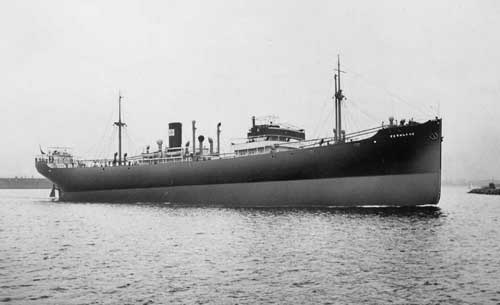
M/S Fernlane To Fernlane on the "Ships starting with F" page.
Lillesand Sjømannsforening's website (Lillesand Seamen's Association) also has pictures of Fernlane (external links - click in the pictures to make them larger). Manager: Fearnley & Eger, Oslo Built by Burmeister & Wains Maskin- og Skipsbyggeri, Copenhagen, Denmark 1927. Captain: Henrik A. Irgens Her voyages are listed on this original document received from the National Archives of Norway. Please compare the above voyages with Arnold Hague's Voyage Record below.
(Received from Don Kindell - His source: The late Arnold Hague's database). Follow the convoy links provided for more information on each.
As can be seen when going to the archive document, Fernlane was at Balik Papan when war broke out in Norway on Apr. 9-1940, having arrived there that same day from Wakamatsu. After the German invasion of Norway it was not uncommon for Norwegian ships in foreign trade to be treated with distrust and suspicion, resulting in quite a few of them being forced into British port by the authorities. This also happened to Fernlane on Apr. 12 when she was stopped north of Australia by an Australian war ship and sent to Singapore under armed guard. It looks like she subsequently remained there for a long time; arrival is given as Apr. 16, departure as May 21 when she proceeded to Table Bay. In Nov.-1940, she's listed in Convoy OB 251, which left Liverpool on Nov. 28 and dispersed on Dec. 1, Fernlane arriving Capetown on the 29th - see the link provided in the Voyage Record above. This was the convoy in which Samnanger had sailed before she met her final fate. In Febr.-1941, she can be found with a cargo of maize and magnesite in Convoy SL 65, which left Freetown on Febr. 10 and arrived Liverpool on March 8. Again, see the link above. The Norwegian Belita, Belinda, Bur, Morgenen, Polartank and Senta are also included. Fernlane later continued to Manchester, where she arrived March 10.
Fernlane departed Gourock on April 17 and joined a convoy in order to head to Freetown. She had a cargo of 1585 tons salt, 103 tons iron constructions, 8 gliders and 26 loaded trucks from Manchester (she had left Manchester on Apr. 4, according to the archive document). On Apr. 23, she left the convoy and continued south alone (this conflicts with A. Hague's detachment date of Apr. 26 - for info, Convoy OG 59, in which she's listed, was a Gibraltar bound convoy. It originated in Liverpool on Apr. 15-1941 and arrived Gibraltar on the 28. Will be added to in individual page in my Convoys section, in the meantime, see OG 59 on the page listing ships in all OG convoys. Bjørkhaug, Hjalmar Wessel, Ila, President de Vogue and Solsten are also listed). At about 08:25 GMT on May 7-1941, she was torpedoed by the Italian submarine Enrico Tazzoli (Cossato), position 10 02N 20 17W. The first torpedo hit in the afterpart of the ship, setting the engine room on fire, but those who were on duty there managed to get to the boat deck, and stopped the engine from there. The ship had just been making a hard to port 75° course alteration when the torpedo hit and continued to swing to port after the explosion; the wheel and therefore the steering had been affected by the explosion. All 4 lifeboats were launched, 3 of which were ordered to row away from the ship, while the radio aereal, which had fallen down was rigged up again by the carpenter and the 3rd mate whereupon the captain sent out a distress call* (the radio operator had already gone in one of the other boats). When a second torpedo was observed on the port side the remaining men, including the captain also took to the lifeboat, and just after this boat had set off (from starboard) the torpedo detonated in the engine room (at about 08:40), causing Fernlane to list heavily to port and start to sink. The sub now surfaced about 2 n. miles off to port, went around in front of the ship and sent off a third torpedo which hit amidships on the starboard side. She listed heavily to starboard, broke amidships and sank quickly by the bow. The sub went under and disappeared out of sight.
The entire crew of 32 and the 3 passengers (and a dog?) survived. After having transferred some food, water and equipment from a nearby raft the motor boat took the other 3 boats in tow at 11:00 and headed for Bissagos Islands. When the petrol was almost used up on May 10 they decided to save the rest until they were closer to land, so the boats set sail. Around 22:00 that night they saw land, but decided to wait until daylight before attempting to land. Early the next morning, May 11 they continued along the coast to look for signs of an inhabited spot and when they saw some houses on the beach at around 08:00 they went in. They had landed at Carabella Island, where they were fed and given lodgings, and after the motorboat had been overhauled and more petrol added they continued to Bissau on the 13th, with arrival that same evening. With the assistance of the British consul they were equipped with the necessary clothes etc. The 3 passengers were given passage to Freetown on a British cable ship on May 18 while the others had to wait until May 26 before they could find a ship that was willing to take all of them from Bissau, arriving Freetown that same afternoon, via Bathurst with the Portuguese M/S Africa Ocidental. The British radio operator had taken ill on the voyage from Bathurst and was transferred to the British hospital ship Oxfordshire. On June 6, 25 men including the captain departed Freetown for Takoradi with the British passenger vessel M/S Abosso. They were landed at Cape Coast Castle on June 16, continuing to Takoradi by bus, then left for New York with M/S Bajamar on June 20. The following 7 had remained in Freetown to await passage to the U.K.: Radio Operator A. Hastings, Boatswain A. Ellingsen, Able Seaman K. Bergland, Ordinary Seamen H. Rabba and K. Malmquist, as well as the 2 Chinese crew members who were to be sent to Singapore from the U.K. The maritime hearings were held in New York (date? Bajamar had arrived New York on July 9 - see her voyage record for this period) with the captain, the 1st mate, the 2nd engineer, Mechanic Olsen and Ordinary Seaman Raknes appearing. Enrico Tazzoli headed south after sinking Fernlane and sank M/T Alfred Olsen a few days later (on May 10). Crew & Passenger List - No casualties:
Back to Fernlane on the "Ships starting with F" page. The text on this page was compiled with the help of: "Nortraships flåte", J. R. Hegland, "Sjøforklaringer fra 2. verdenskrig", Volume I (Norwegian Maritime Museum) and misc. other for cross checking details - ref. My sources.
|
||||||||||||||||||||||||||||||||||||||||||||||||||||||||||||||||||||||||||||||||||||||||||||||||||||||||||||||||||||||||||||||||||||||||||||||||||||||||||||||||||||||||||||||||||||||||||||||||||||||||||||||||||||||||||||||||||||||||||||||||||||||||||